 Tempor
The 12-Week Clock: What Equal Treatment for Agency Workers Actually Takes
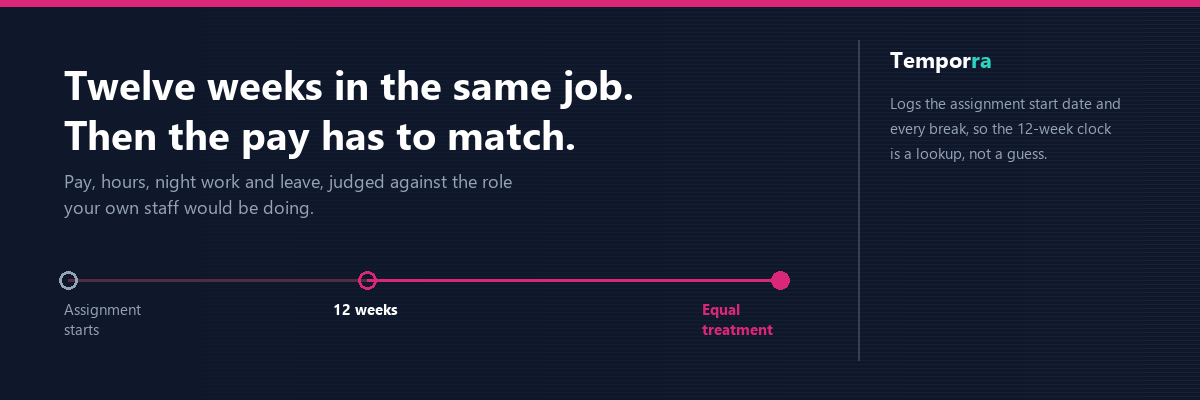
Most hirers assume that if the agency invoice gets paid on time, the compliance side of using agency staff is handled. It isn't. The Agency Workers Regulations 2010 have been law for fifteen years, and they still catch businesses out for one simple reason: nobody's tracking the date. After 12 calendar weeks in the same role with the same hirer, an agency worker is entitled to the same pay, hours, night work terms and annual leave as if they'd been recruited directly. Working out when that clock started, whether it paused, and whether it reset, is where most of the actual difficulty sits.
What the regulations actually require
The Agency Workers Regulations 2010 (SI 2010/93) came into force on 1 October 2011, transposing an EU directive that survived Brexit unchanged. Regulation 5 is the core of it: once an agency worker has completed a 12-week qualifying period in a particular role with a particular hirer, they're entitled to the same "basic working and employment conditions" as they would have got if the hirer had recruited them directly for that job. That covers pay, the duration of working time, night work, rest periods, rest breaks, and annual leave.
It's worth being precise about what this doesn't do. It doesn't make an agency worker an employee of the hirer. It doesn't transfer employment status, continuity of service for unfair dismissal purposes, or redundancy rights. It gives a narrower, specific right: equal terms on the things regulation 5 lists, judged against what a comparable worker doing the same job for that hirer would get, once the 12 weeks are up.
Day one rights and week-twelve rights are not the same thing
A lot of the confusion around this law comes from mixing up two different sets of rights that start at different times. From day one of any assignment, regulations 12 and 13 give an agency worker the right to equal access to the hirer's collective facilities, canteens, car parking, workplace crèches, transport services, and the right to be told about relevant vacancies with the hirer on the same basis as everyone else. Neither of those waits for 12 weeks.
Equal treatment on pay and hours under regulation 5 is different. That one only arrives once the 12-week qualifying period is complete. A hirer that gives an agency worker canteen access on their first morning has done the day-one part correctly. It says nothing about whether pay parity has kicked in three months later, and it's the second one that generates almost all the tribunal claims.
How the 12-week clock actually counts
The qualifying period runs in calendar weeks, not shifts or hours. A week in which an agency worker did a single Tuesday shift counts exactly the same as a week of five full days. That surprises a lot of hirers who assume it's tied to hours worked, and it means a worker on an irregular or part-time agency pattern can still reach 12 weeks faster than expected.
Breaks complicate it. A break of six calendar weeks or less, for any reason, pauses the clock rather than resetting it, and the weeks already worked carry forward once the assignment resumes. Certain longer breaks are also protected: sickness or injury, up to 28 weeks; pregnancy, childbirth or a protected maternity period; and jury service, up to 28 weeks. Those pause the clock too, they don't wipe it. Anything else that runs past six weeks, and isn't on that protected list, resets the count to zero.
| Type of break | Effect on the 12-week clock |
|---|---|
| 6 calendar weeks or less, any reason | Pauses. Weeks already worked carry forward |
| Sickness or injury (up to 28 weeks) | Pauses. Resumes where it left off on return |
| Pregnancy, childbirth, protected maternity period | Pauses. Doesn't reset |
| Jury service (up to 28 weeks) | Pauses. Resumes where it left off on return |
| Genuine change to a different role | Resets to zero for the new role |
| Any other break over 6 weeks | Resets to zero |
The role-change route gets tested the most, because it's the one an employer can influence. Moving someone to a genuinely different job, different duties, different skill set, different place in the hirer's structure, does restart the count. Giving the same person the same job with a new title on the assignment paperwork doesn't. Tribunals have been unimpressed by the second version when it's shown up as a pattern, and a hirer that reshuffles job titles every eleven weeks is building its own evidence trail against itself.
What "equal" actually covers, and what it doesn't
Regulation 6 defines pay for this purpose fairly narrowly. In scope: basic pay, night work pay, overtime as it's structured for the comparable role, and paid annual leave. Out of scope: occupational sick pay, pension contributions, redundancy pay, notice pay, maternity and paternity pay, and bonuses that aren't tied to the individual's own performance or output. A hirer running a generous occupational sick pay scheme for its own staff isn't obliged to extend it to agency workers under these regulations, even after the 12 weeks are up.
The comparator isn't a specific named colleague, it's whatever a hypothetical directly recruited employee doing that role, on that date, with the relevant skills and experience, would reasonably be paid. That's judged against the hirer's actual pay structures for the role, not against some external market rate.
How a dispute actually gets proved
Unlike some of the newer record-keeping duties landing under the Employment Rights Act 2025, the Agency Workers Regulations don't set out a specific "you must keep these records for this long" duty of their own. What they do instead is regulation 16: an agency worker who thinks they've been short-changed can send a written request to the agency asking exactly how their pay and conditions were worked out compared with the hirer's own staff. The agency then has 28 days to answer. If the worker still has nothing 30 days after asking, they can write to the hirer instead, and the hirer has 28 days to send the worker a statement of the relevant pay and conditions its own workers get.
Miss that window, or answer it vaguely, and an employment tribunal is entitled to draw its own adverse inference from the gap. In practice that means the 28-day request is the moment record-keeping actually gets tested, not some routine inspection. A hirer that can't say, on request, what a comparable directly recruited worker in that role was earning on a given date is not in a strong position, whatever its intentions were at the time.
What to actually start logging now
Five things make the difference between answering a regulation 16 request in an afternoon and reconstructing it from memory. The exact start date of each agency assignment, by role, not just "started working here". Every break in that assignment, with the date and the reason, since sickness, maternity and a six-week gap are treated completely differently from a longer voluntary absence. Whether the role itself changed at any point, and what actually changed about it. The hours and shifts the agency worker was rostered and actually worked, since duration of working time and night work are both part of regulation 5. And a record of what the comparable directly employed role was paid on the date the 12 weeks completed, because that figure is the one that gets asked for.
Temporra doesn't set pay rates or decide who counts as a comparator, that's a job for HR and payroll judgement. What it does hold is the assignment and shift history: when someone clocked in, what they were rostered against, and how long an assignment has actually run against the rota that was set for it. That's the half of a regulation 16 answer that's usually missing when a request lands.
Frequently asked questions
What are the Agency Workers Regulations 2010?
UK law, in force since 1 October 2011, that gives agency workers the right to the same basic working and employment conditions as a comparable directly recruited employee, once they've worked in the same role with the same hirer for 12 calendar weeks. It also gives day-one rights to shared facilities and vacancy information, which don't wait for the 12 weeks.
When exactly does equal treatment kick in?
After 12 calendar weeks in the same role with the same hirer. It's calendar weeks, not weeks worked, so a week where the agency worker did one shift still counts the same as a week of five. The clock starts on the first day of the assignment in that role.
Does a week count if the agency worker only worked one day?
Yes. The regulations count calendar weeks in which the worker was assigned to the hirer, not hours or days worked within them. A single Tuesday shift in a given week still uses up that week of the 12.
What happens if the assignment role changes partway through?
A genuinely different role can reset the clock to zero, because equal treatment is judged role by role, not worker by worker. The catch is that it has to be a real change, different duties, different skills, different place in the structure, not the same job with a different title. Tribunals have taken a dim view of relabelling used purely to dodge the 12 weeks.
Does equal treatment cover pension contributions and sick pay?
No. Regulation 6 sets out what "pay" means for this purpose, and it excludes occupational sick pay, pension contributions, redundancy pay, notice pay, maternity and paternity pay, and bonuses that aren't tied to the individual's own output. What's in scope is basic pay, night work pay, overtime as it's structured for the comparator role, and paid annual leave.
What is the 28-day written information request?
Under regulation 16, an agency worker who thinks they haven't been treated equally can write to the temporary work agency asking for the relevant facts: what the hirer's comparable staff get, and what the agency took into account when setting the worker's terms. The agency has 28 days to answer. If nothing arrives within 30 days, the worker can write to the hirer, which then has 28 days to send the worker a statement of its own workers' relevant pay and conditions. A missing or evasive answer lets an employment tribunal draw its own conclusions.
Do these rules apply to workers supplied through an umbrella company?
Broadly yes, where the umbrella company is acting as the temporary work agency supplying the worker to a hirer. The Employment Rights Act 2025 is also formally widening the definition of "agency" to bring umbrella companies within scope more explicitly, and a related government consultation on extending protections closed on 8 July 2026 with the response still awaited, so this is an area to watch rather than treat as settled.
Who is liable if equal treatment isn't given, the agency or the hirer?
It depends which duty was breached. The hirer is responsible for giving accurate information about its own workers' terms, and for day-one rights like facilities and vacancy access. The agency is responsible for actually setting the agency worker's pay and conditions once it has that information. In practice a tribunal claim can name either or both, depending on where the failure happened.
Related guides
- Zero-Hours Contracts: The Guaranteed-Hours Reform, and the Records It Will Take
- How to Calculate Holiday Entitlement for Hourly & Part-Time Workers (UK, 2026)
- National Minimum Wage: The Records HMRC Actually Checks
- Right to Work Checks: What You Must Keep, and For How Long
Start a free 14-day trial · Book a demo
No card required. Flat monthly pricing by team size, every feature on every tier — see pricing.