 Tempor
Zero-Hours Contracts: The Guaranteed-Hours Reform, and the Records It Will Take
A facilities firm running a pool of bank cleaners for sickness cover has never had to think hard about zero-hours contracts. Someone works, someone gets paid for what they did, nobody complains. That casual arrangement is getting three new legal strings attached, and unlike most employment law changes, the evidence for all three sits in your attendance data, not your contract templates.
What the Employment Rights Act actually adds
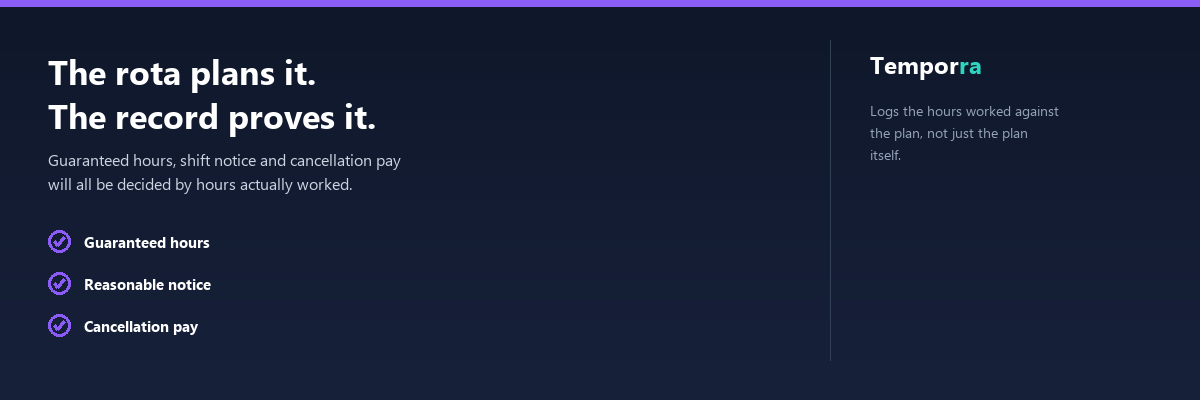
The government isn't banning zero-hours contracts. It says so directly, and it names who it wants to protect the flexibility for: students, people with caring responsibilities, anyone who genuinely prefers not to be tied to fixed hours. What the Employment Rights Act 2025 does instead is bolt three new rights onto the arrangement for workers who qualify. A right to guaranteed hours reflecting what they actually work. A right to reasonable notice of a shift, and of any change to one. A right to be paid if a shift gets cancelled, cut short, or moved at short notice. Unions and employers can agree different terms between themselves through a collective agreement, but for everyone else, this is the new floor.
The three rights, in plain terms
Guaranteed hours. If a worker qualifies, they'll be entitled to a contract that reflects the hours they've regularly worked over a reference period, instead of the zero or near-zero figure written on the original one. They can turn the offer down and stay as they are. If they qualify and get nothing at all, that's a tribunal claim.
Reasonable notice. Employers have to give reasonable notice of a shift, and reasonable notice of any change to one already confirmed. The Act doesn't fix a number of hours or days, that's being left to regulations, and the government has already said in its own guidance that even very short notice might count as reasonable in some sectors, depending on the work. What the right does draw a hard line around is who caused the change. Two workers swapping a shift between themselves at short notice isn't an employer breach. An employer moving someone's shift with no warning is.
Cancellation pay. Cancel, curtail or move a shift at short notice and, once the rules are finalised, you'll owe a payment. What counts as short notice and how much the payment is are both still to be set. The exemption runs the same way as reasonable notice: if the worker cancels or doesn't turn up, nothing is owed. If you do it, something is.
The numbers nobody's confirmed yet, and the one date that is
None of the specific thresholds are law. The government has consulted on where the low-hours cut-off sits, somewhere between 8 and 48 hours a week, with its own stated leaning toward the lower end of that range, 8 to 20 hours. Its preference for the reference period behind the guaranteed-hours calculation is 12 weeks, again subject to what the consultation returns. That consultation closed on 25 August 2026, and when this guide was last updated the government was still analysing the responses. The commonly repeated line that reasonable notice will land in October 2026 doesn't hold up against the government's own factsheet or the major employment law firms tracking the Act, which both point to 2027 for all three rights once secondary legislation is drafted and laid.
Why the 12-week window matters if your rota and your reality don't match
Here's the part that actually bites. If the guaranteed-hours offer is calculated off hours worked during a reference period, the number that decides it isn't the rota. It's what happened. A rota tells you who was supposed to be in. It doesn't tell you that someone covered an extra four hours when a colleague's van broke down, or left two hours early because a job wrapped up faster than planned, or picked up a Saturday nobody had planned for at all. Those gaps between planned and actual are exactly the hours a guaranteed-hours calculation is meant to capture, and exactly the hours that only exist properly if something logged the clock-in and clock-out, not the intention.
This is worth being blunt about: a business that only ever looks at its rota to answer "how much has this person worked" is going to get the guaranteed-hours number wrong, possibly in the worker's favour, possibly against them, and either way it's the kind of error a tribunal claim turns on.
| Right | Triggered by | What proves it |
|---|---|---|
| Guaranteed hours | Hours worked over the reference period | Actual clock-in/out records, not the rota |
| Reasonable notice | Employer-initiated shift or change | Timestamp of when notice was given vs shift start |
| Cancellation pay | Employer cancels, cuts short or moves a shift | Who initiated the change, and when |
What proving "reasonable" actually looks like
Reasonableness is deliberately fact-specific, the government's own factsheet says as much: what's reasonable in a hospital ward covering an unplanned absence is not what's reasonable in an office with three weeks' forward planning. That's not a loophole for employers, it's a genuine acknowledgement that a fixed number wouldn't fit every sector. What it means practically is that if a worker disputes the notice they were given, the case comes down to two timestamps: when the shift (or the change to it) was communicated, and when the shift actually started. "We definitely told her in good time" isn't evidence. A message log with a timestamp is.
Agency workers are in scope too
The Act extends all three rights to agency workers, which matters if a chunk of your casual cover comes through an agency rather than direct employment. The hirer, meaning the business the person is actually turning up to work for, is responsible by default for making the guaranteed-hours offer, based on hours worked under that hirer's direction and supervision. The agency itself is on the hook for short-notice cancellation payments, though it can recoup those from the hirer afterwards. Either way, if you're the one who cancelled the shift or benefited from the extra hours, the record of what actually happened needs to exist on your side, not just the agency's.
What this doesn't touch
Temporra doesn't build rotas and it won't decide who's working Tuesday. That's still a manager's call, made in whatever system or spreadsheet a business already uses for planning shifts. What it tracks is what actually happened against that plan: who clocked in, when, for how long, and whether that lines up with what was scheduled. For a reform where the legal entitlement is calculated off actual hours worked rather than a contract figure or a plan, that distinction between the rota and the record is the whole point.
What to start logging now, before the regulations land
Five things, and none of them need to wait for the final rules. The hours each zero-hours or low-hours worker actually clocks, separate from what the rota said. The date and time any shift was first confirmed to them. The date and time of any later change to a shift already confirmed. Whether a cancellation, curtailment or move was your decision or theirs, because only the employer-initiated ones create an entitlement. And a running total per worker over recent weeks, so that whatever reference period the regulations settle on, whether it's the government's preferred 12 weeks or something else, producing the figure is a lookup rather than a reconstruction from memory and old rotas.
Who this actually affects
Around 1.2 million people work on zero-hours contracts in the UK, about 3.6% of everyone in employment, concentrated in hospitality, transport, arts and other services, health and social care, and retail and wholesale. They're more likely to be young, female, or studying full-time. 26% of them say they'd like more hours than they're getting, against 8% of workers not on zero-hours contracts, which is the underemployment gap the whole reform is aimed at closing. On notice specifically, the Living Wage Foundation found 59% of variable-hours workers get less than a week's notice of a shift, and 13% get less than 24 hours. That's the practice this right is trying to change, and it's also roughly the scale of record-keeping a mid-sized employer with casual staff is about to be expected to produce evidence for.
Frequently asked questions
Are zero-hours contracts being banned?
No. The government has said explicitly it isn't taking the option away from workers who value it, students and people with caring responsibilities were named specifically. What's changing is that eligible workers get three new rights sitting on top of the contract: guaranteed hours, reasonable notice of shifts, and payment if a shift is cancelled or cut short at short notice.
When do the new rights actually start?
There's no live date yet. The government's own guidance points to 2027 for all three measures, with the detail set by secondary legislation that hasn't been written. A consultation on the thresholds and notice periods closed on 25 August 2026. The government is analysing the responses, and its timetable says the timings will be updated after the consultation.
Who counts as a zero-hours or low-hours worker for this?
Anyone on a genuine zero-hours contract, plus workers on a contract with guaranteed hours below an as-yet-undecided threshold. The government has consulted on where that threshold sits, somewhere between 8 and 48 hours a week, and has said its own preference leans toward the lower end, 8 to 20 hours.
How is the guaranteed-hours offer worked out?
Off the hours a worker actually did during a reference period, not what their contract says or what the rota planned. The government's stated preference is a 12-week reference period, though the final length depends on the outcome of the consultation that closed on 25 August 2026.
Does a worker have to accept a guaranteed-hours offer?
No. They can turn it down and stay on their existing zero-hours or low-hours arrangement. If they do qualify and never receive an offer at all, that's what gives them a claim to an employment tribunal.
Does this apply to agency staff we use for cover?
Yes. The hirer, meaning the business the agency worker is actually turning up to, is responsible by default for making the guaranteed-hours offer, based on hours worked under that hirer's direction. The agency handles the short-notice cancellation payments and can recoup them from the hirer afterwards.
What should we start recording now, before the regulations land?
Five things: the hours each casual or zero-hours worker actually clocks, not just what was rota'd; the date and time any shift was first confirmed; the date and time of any change to a shift already confirmed; whether a cancellation was your call or the worker's; and a running total per worker over recent weeks so a 12-week figure is a lookup, not a reconstruction job.
Related guides
- The 12-Week Clock: What Equal Treatment for Agency Workers Actually Takes
- On-call and standby hours: what counts, and what to record
- How to Calculate Holiday Entitlement for Hourly & Part-Time Workers (UK, 2026)
- How to Create a Staff Rota: A UK Small-Business Guide
Start a free 14-day trial · Book a demo
No card required. Flat monthly pricing by team size, every feature on every tier — see pricing.