 Tempor
National Minimum Wage: The Records HMRC Actually Checks
A cleaning contractor pays every worker £13 an hour, comfortably above the £12.71 National Living Wage rate for 2026. On paper, nobody is underpaid. Then HMRC asks for six weeks of clock data and finds the vans leave the depot at 7:50 but the payroll clock only starts at 8:00, and two of the crew are covering the cost of their own uniform out of that pay. Once the unpaid travel time and the uniform deduction are factored in, the effective rate drops under the legal minimum for those pay periods, and the wage itself was never the problem. The records were. This is what "sufficient records" for the National Minimum Wage actually means, how long you have to keep them, and what HMRC does once it finds a gap.
What "sufficient records" actually means
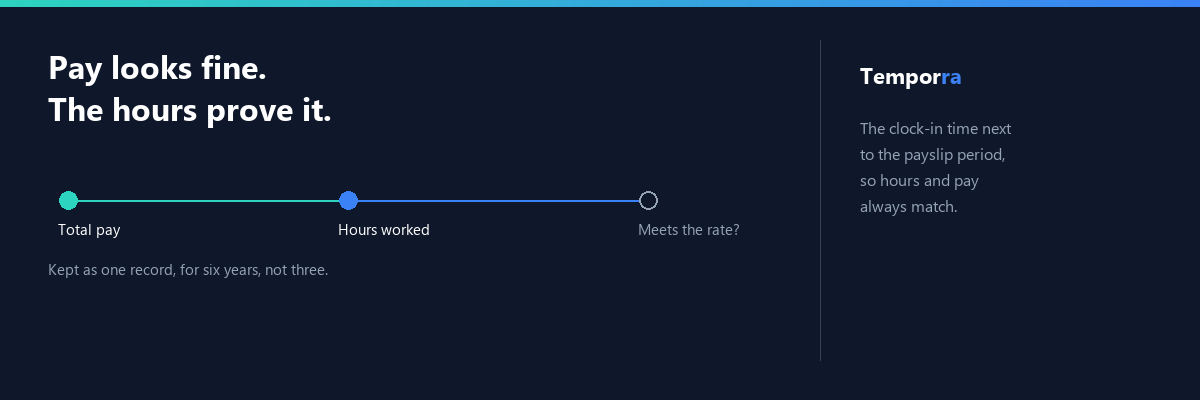
The law doesn't hand you a template. It says you must keep records good enough to establish that a worker was paid at least the minimum wage for each pay reference period, and be able to produce that as a single document if asked. In practice that means two things sitting next to each other: total pay for the period, and the hours actually worked, broken down by category of working time where it's relevant (standard hours, overtime, travel between sites, time on call).
Payroll records on their own aren't enough if the hours figure feeding into them is a guess. A rota tells you who was meant to be working. It doesn't tell HMRC who actually was, for how long, or whether the two matched. That's the gap that trips up otherwise well-run businesses: the pay side of the books is immaculate, and the hours side is a rounded estimate nobody has checked against reality in months.
Six years, not three
Since 1 April 2021, minimum wage records have to be kept for six years after the end of the pay reference period they cover, not three. That change is old enough now that most payroll software defaults to it correctly, but plenty of manual filing habits, particularly for smaller employers who moved to digital payroll gradually, still reflect the old three-year rule. If your archiving process was set up before 2021 and hasn't been revisited since, it's worth an actual check rather than an assumption.
Records don't have to be paper. A spreadsheet, a payroll export, or clock-in data from a time-tracking app all count, as long as they're retrievable and explain themselves without you having to reconstruct what happened from memory when HMRC asks.
How HMRC actually checks
Compliance officers can enter your premises at any reasonable time to interview staff or inspect records, and they can remove records to copy them off-site. A check might start from a worker's complaint, a referral, or HMRC's own risk-based targeting of sectors with a known history of underpayment, cleaning, hospitality, care, construction and hairdressing among them. There often isn't a polite warning first.
What an officer is actually testing is simple: does the pay divided by the hours actually worked clear the legal rate for that pay period, for every worker, every time. Not on average across the year. Per pay reference period. A month where someone worked unpaid overtime to hit a deadline can fail the test even if their annual salary looks generous.
Where employers go wrong without meaning to
Almost nobody sets out to pay under minimum wage. The businesses that get caught tend to have one of a handful of quiet habits that erode the hourly rate without anyone noticing at the time.
Rounding clock-in times down. If the system only starts counting from the shift's scheduled start, and workers are routinely on site or on the clock earlier than that, the unpaid minutes add up across a pay period and can drag the effective rate under the threshold.
Unpaid travel between sites. Travel from home to a single fixed workplace generally doesn't count as working time. Travel between sites during the working day usually does, and mobile trades are where this gets missed most often, because the time between the first and second job of the day looks like a gap rather than paid time.
Deductions that push pay below the line. Uniform costs, tools, or a training course the worker had to pay for themselves can all count against them for minimum wage purposes, even when the gross figure on the payslip looks perfectly fine. The deduction doesn't have to be unlawful in itself to cause a minimum wage problem; it just has to bring the effective hourly rate down.
Unpaid trial shifts. A genuine, brief work trial to assess suitability is one thing. A shift where someone does productive work for the business is another, and HMRC treats the second as working time that should be paid, trial or not.
None of these show up as a policy decision anyone made on purpose. They show up as a gap between the rota and what actually happened, which is exactly why the records, not the pay rate on the contract, are what gets checked first.
What it costs when HMRC finds a shortfall
Arrears are repaid at current minimum wage rates, not the lower rate that applied at the time of the underpayment, which can make an old shortfall more expensive to correct than it first appears. On top of that, the Fair Work Agency can issue a financial penalty of up to 200% of the arrears, capped at £20,000 per worker. Pay in full within 14 days of the notice and the penalty is halved. Those rules moved out of the National Minimum Wage Act and into sections 103 to 108 of the Employment Rights Act 2025 on 7 April 2026, with the same numbers.
Separately from the financial penalty, failing to keep minimum wage records at all, or knowingly putting false entries into them, is a criminal offence in its own right, not just a compliance failing. And there's the naming scheme: the government periodically publishes a list of non-compliant employers. The most recent round, announced on 3 September 2026 and the first since the Fair Work Agency took over, named nearly 660 employers, with about £4 million repaid to more than 27,000 workers and £7 million in penalties. Employers who come forward voluntarily before HMRC opens an investigation are generally excluded from naming, which is one of the few genuinely useful reasons to check your own records before someone else does.
From 7 April 2026, day-to-day enforcement responsibility formally sits with the new Fair Work Agency, though HMRC continues to deliver the actual minimum wage checks under a service agreement for the first year of the transition. The mechanics for employers, what gets checked and what the penalties are, haven't changed with the rebrand.
| Age band (from April 2026) | Hourly rate |
|---|---|
| 21 and over (National Living Wage) | £12.71 |
| 18 to 20 | £10.85 |
| Under 18 and apprentices | £8.00 |
Where accurate hours records actually come from
A rota is a plan. It says who's expected on site and when. It was never designed to be evidence of what actually happened, and treating it as one is how the gap between rostered hours and paid hours opens up in the first place. Temporra doesn't build or manage that rota, that decision stays with you, but it does the part that sits right next to it: capturing the actual clock-in and clock-out times against the plan, with GPS and photo verification so a start time is something that happened, not something typed in from memory at the end of the week. When travel between sites is logged as its own entry rather than folded silently into a gap between two shifts, it's far easier to see, and pay, correctly the first time. For the day-to-day mechanics of getting pay right each period, our guide on running payroll for a UK small business covers the process this sits inside. If your workforce includes subcontractors, the deduction rules work differently again, covered in our CIS payroll guide. And if you're still working from paper timesheets or a rounded estimate rather than logged clock times, our piece on how to track employee hours properly covers what changes once the record is a timestamp rather than a guess.
Frequently asked questions
How long do we actually have to keep minimum wage records?
Six years after the end of the pay reference period the records cover. That's been the rule since 1 April 2021, when it was extended from three years. If you're still working to the old three-year habit, anything older than that but within the six-year window needs to exist somewhere and be producible.
What actually counts as "sufficient" records?
Enough to show, for each pay reference period, the total pay a worker received and the hours they actually worked, not the hours they were rostered for. There's no fixed template. What matters is that you can produce it as a single document on request and explain it without falling back on memory.
Can HMRC just turn up without warning?
Compliance officers can enter your premises at any reasonable time to interview you or inspect records, and they can remove records to copy them elsewhere. Checks come from worker complaints, referrals, or HMRC's own risk-based targeting of sectors where underpayment is common, so there isn't always a warning beforehand.
Does rounding clock-in times down count as underpayment?
It can. If a worker clocks in at 07:52 and the payroll system only counts from 08:00, that's unpaid working time, and if it drags the average hourly rate under the legal minimum for that pay period, it's a minimum wage breach regardless of how small each individual rounding looks.
What about deductions for uniform, tools or training?
Any deduction or unreimbursed cost connected to the job, uniform, safety boots, tools, a training course, can reduce a worker's pay below minimum wage for calculation purposes even though their gross pay looks fine on paper. This is one of the most common ways employers end up underpaying without intending to.
What's the actual penalty if HMRC finds a shortfall?
Up to 200% of the arrears owed, capped at £20,000 per worker, on top of repaying the arrears themselves at current minimum wage rates. Pay in full within 14 days of the notice and the penalty is cut by half. Separately, failing to keep records at all, or falsifying them, is a criminal offence.
Will we be named publicly if we get it wrong?
Possibly, through the government's minimum wage naming scheme, which runs in rounds and has included large, well-known employers alongside small ones. The most recent round, announced on 3 September 2026, named nearly 660 employers, with about £4 million in arrears repaid to more than 27,000 workers. Employers who use the voluntary declaration route before HMRC investigates are generally excluded from naming.
Related guides
- Payslips and hours worked: what the law actually requires
- On-call and standby hours: what counts, and what to record
- Recording Apprenticeship Off-the-Job Training Hours Without Losing the Funding
- How to Run Payroll for a Small Business (UK): A Practical 2026 Guide
Start a free 14-day trial · Book a demo
No card required. Flat monthly pricing by team size, every feature on every tier — see pricing.