 Tempor
Annual Leave Carry-Over: When UK Employers Must Allow It
A member of staff has nine days of annual leave left on 20 December and no realistic way to take them before the leave year ends on 31 December. Maybe they were off sick for six weeks in October. Maybe they were on maternity leave for most of the year. Maybe nobody in the office ever actually told them the deadline was coming. What happens to those nine days depends entirely on which of those three situations applies, and getting it wrong is one of the easier ways for a small employer to end up with a genuine legal claim rather than just an awkward conversation.
Most employers assume unused leave simply disappears on 31 December, or whatever date their leave year ends on. Sometimes that's correct. Often it isn't, and the difference matters enough that it's worth knowing which rule applies before you tell someone their nine days are gone.
The default: use it or lose it, mostly
The Working Time Regulations 1998 give full-time workers a statutory minimum of 5.6 weeks' leave a year, capped at 28 days. That entitlement splits into two parts under the regulations: four weeks under regulation 13 (the "EU-derived" leave) and an extra 1.6 weeks under regulation 13A. Ordinarily, leave under both has to be taken in the year it's due. It doesn't automatically roll forward just because someone was busy, forgot, or the office never got round to booking cover.
An employer can agree to let staff carry leave over voluntarily, through a written agreement, a staff handbook clause, or an individual contract term. Plenty do, usually with a cap of five days and a use-by date early in the new year. That's a policy choice, not a legal requirement. The law only forces your hand in three specific situations, and each one works differently.
Sickness: the 18-month deadline
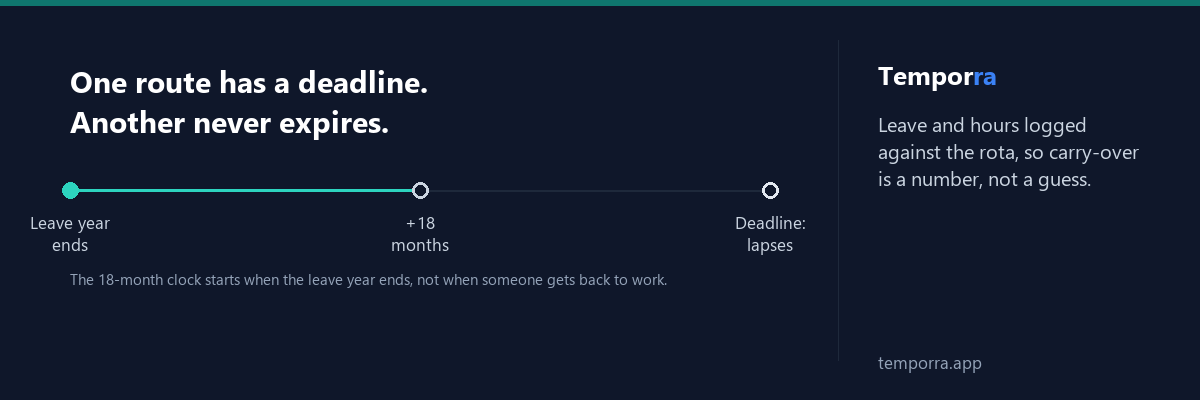
If someone is off sick for enough of the leave year that they genuinely can't take their leave, regulation 13(15) gives them the right to carry the untaken portion of their four-week entitlement into the following year. That right comes with a hard stop: it has to be used within 18 months of the end of the leave year in which it was accrued.
Work through the dates and it's less generous than it sounds. Say your leave year runs 1 January to 31 December, and an employee is off sick for most of 2025, leaving them with three unused days from that year. Those three days carry into 2026, and the 18-month clock runs from 31 December 2025. That puts the deadline to use them at 30 June 2027. After that, if the days still haven't been taken, the entitlement lapses. You don't have to pay it out, and you don't have to keep offering it indefinitely.
Two things trip employers up here. First, the 18-month carry-over only covers the four-week regulation 13 entitlement, not the full 5.6 weeks. The additional 1.6 weeks has its own, separate carry-over route (see below), and the two don't automatically combine into one longer runway. Second, this is a statutory floor, not a ceiling. Nothing stops you being more generous and letting the whole 5.6 weeks carry over with a longer window, if that's what your policy says.
Family leave: no fixed cut-off, and it's wider than it used to be
Maternity, paternity, adoption, shared parental and parental leave all count as "statutory leave" for this purpose. If someone can't take their annual leave because they were on one of those, regulation 13(14) entitles them to carry the untaken balance into the next leave year. Unlike the sickness rule, there's no 18-month backstop written into the regulation. The leave simply carries forward.
Until 1 January 2024, this right technically only applied to the four-week regulation 13 entitlement. The additional 1.6 weeks under regulation 13A carried over only if an employer's own agreement allowed it. The Employment Rights (Amendment, Revocation and Transitional Provision) Regulations 2023 closed that gap: a new regulation 13A(7A) now gives the same statutory carry-over right to the extra 1.6 weeks too, for leave years from 2024 onward. In practice this means someone coming back from a year of maternity leave, having accrued a full 28 days and taken none of it, is now entitled to carry the whole lot forward, not just four-fifths of it.
Irregular hours and part-year workers: the same three routes, recalculated
The 2024 changes also gave irregular-hours and part-year workers (think zero-hours staff, term-time-only roles, bank staff who might work three weeks one month and none the next) their own dedicated set of rules, in regulations 15B to 15E. Leave accrues at 12.07% of hours actually worked in each pay period, capped at 28 days a year, rather than being calculated as a fixed number of weeks up front.
Carry-over for these workers mirrors the regime above almost exactly. Regulation 15D allows carry-forward where statutory leave prevented someone taking it, with no fixed deadline, and carry-forward where sickness prevented it, with the same 18-month limit from the end of the accrual year. The mechanics are the same; only the underlying entitlement is calculated differently, because there's no fixed weekly figure to carry a fraction of.
If someone in this category leaves partway through the year with leave they've accrued but not taken, regulation 15E requires a payment in lieu, worked out either under a relevant agreement or as the equivalent of what they'd have been paid under regulation 16. For the calculation itself, our guide on calculating holiday entitlement for hourly and part-time workers covers the 12.07% method in full.
The route employers forget: your own failure to let people take leave
There's a fourth carry-over right, and it's the one that catches out well-meaning small employers rather than the ones deliberately cutting corners. Regulations 13(16)–(18), and the equivalent 15D(5)–(7) for irregular-hours workers, say that if an employer fails to give a worker a reasonable opportunity to take their leave, fails to encourage them to take it, or fails to warn them that unused leave will be lost at year-end, then that leave doesn't expire. It carries forward, and keeps carrying forward, until the first full leave year in which the employer actually gets it right.
That's a genuinely open-ended liability. A busy site or a small office where nobody chases people to book their remaining days, and nobody sends a "you have four days left, please book them" reminder, can end up owing several years of accumulated leave to someone who simply never got prompted. The fix is boring and cheap: tell people what they've got left, and say so in writing before the year ends. A single email in November naming the exact number of days does the job and creates the record that protects you if it's ever questioned.
The COVID-19 carry-over rule, mostly gone now
Back in March 2020, the government inserted a temporary carry-over right into regulation 13(9)(a): where coronavirus made it "not reasonably practicable" for someone to take their leave, up to four weeks could carry into the following two leave years, rather than just one. It was a genuine easement, built for staff who couldn't book time off during lockdowns or who were needed on the front line.
That specific wording was removed on 1 January 2024, replaced by the ordinary regulation 13(14)–(18) framework described above. If your business still has COVID-era leave sitting on the books from that period, it's worth checking exactly when it was accrued and under which version of the rules, because the coronavirus-specific route to a two-year window no longer applies to anything accruing now. Treat any leave carried forward today as governed by the sickness, family-leave or employer-failure routes, not the pandemic-era easement, because that easement effectively isn't there any more.
Keeping track of it without a spreadsheet nobody trusts
None of this is complicated in any single case. It gets hard when you're tracking fifteen people, several different leave years, some part-time, one on maternity leave, one who was off sick in March, and you're trying to work out by eye who's owed what and by when. Acas guidance already flags that from April 2026 employers need to be able to show records of holiday carried over, not just holiday taken, alongside the usual accrual and pay records, kept for at least six years.
A spreadsheet can do this. So can a name on a whiteboard, until someone leaves and takes the knowledge of what they were owed with them. What actually helps is having leave taken logged against the rota as it happens, rather than reconstructed from memory in December, so the carry-over conversation in January starts from a number everyone already agrees on. Temporra doesn't build the rota. That's still down to whoever's running the team. What it does is record actual hours and leave taken against it, which is the part that turns "I think I'm owed some days" into a figure you can both look at. Our guide to the 48-hour week and rest breaks covers the working-hours side of the same compliance picture, and running payroll for a UK small business covers what sits next to it on payday.
Frequently asked questions
Do employees automatically get to carry over unused annual leave?
No. The default under the Working Time Regulations is that leave has to be taken in the year it's due. Carry-over only becomes a legal right in specific situations: sickness, family-related statutory leave, irregular-hours accrual, or an employer's own failure to let someone take their leave. Outside of those, any carry-over is down to what your contract or policy allows.
How long does someone have to use leave carried over because of sickness?
Eighteen months from the end of the leave year in which it was accrued. If it isn't taken within that window, the entitlement lapses and you're not required to pay it out or extend the deadline further.
Does maternity leave carry over the same way as sickness?
Similar principle, different deadline. Leave untaken because of maternity, paternity, adoption, shared parental or parental leave carries into the next leave year under regulation 13(14), but there's no 18-month cut-off written into that provision the way there is for sickness. Since January 2024 this right covers the full 5.6 weeks, not just the four-week core entitlement.
What if we don't want to let anyone carry leave over at all?
You can require the statutory minimum to be used within the year, but only where none of the protected reasons apply: sickness, family leave, irregular-hours accrual, or your own failure to let someone take it. If one of those does apply, the carry-over right exists regardless of what your policy says.
What happens if we just never chased people to book their leave?
That's the route most small employers don't know about. If you failed to give someone a reasonable opportunity to take their leave, or never warned them it would be lost, the leave doesn't lapse at year-end. It carries forward indefinitely, until the first full year where you actually give them the chance and the warning.
Do irregular-hours and casual staff get the same carry-over rights as everyone else?
Broadly yes, under regulations 15B to 15E introduced for leave years from April 2024. The accrual method is different, 12.07% of hours worked per pay period rather than a fixed weekly figure, but the carry-over routes for sickness and statutory leave work the same way, including the 18-month sickness deadline.
Is the COVID-19 carry-over rule still available?
No, not in its original form. The temporary two-year carry-over window for coronavirus-related disruption was removed from the regulations on 1 January 2024. Any leave carrying forward now falls under the ordinary sickness, family-leave or employer-failure routes instead.
Can we let staff carry over more leave than the law requires?
Yes. Everything above is a statutory floor. You're free to offer a more generous carry-over policy, a longer window, a higher day cap, or carry-over for reasons the regulations don't cover, as long as you're clear about it in writing so staff know exactly what applies.
Related guides
- How to Calculate Holiday Entitlement for Hourly & Part-Time Workers (UK, 2026)
- Annual Leave Records: The New Duty Nobody's Fully Explained Yet
- Statutory Sick Pay in 2026: What You Actually Have to Record
- Maternity pay records: what you must keep, and for how long
Start a free 14-day trial · Book a demo
No card required. Flat monthly pricing by team size, every feature on every tier — see pricing.