 Tempor
Working Time Regulations: The 48-Hour Week, Opt-Outs and Rest Breaks
Ask five small-business owners what the 48-hour week actually means and you'll get five different answers. Most think it's a hard weekly ceiling — go over 48 hours in any single week and you're automatically breaking the law. That isn't how it works. The limit is an average, measured across months, and that's exactly why it catches people who were sure they were inside it. This guide covers what the Working Time Regulations 1998 actually require: the 48-hour average and its 17-week reference period, the individual opt-out and how a worker gets out of it again, the rest breaks most rotas quietly ignore, and why the plan on the wall proves none of this — only the clock does.
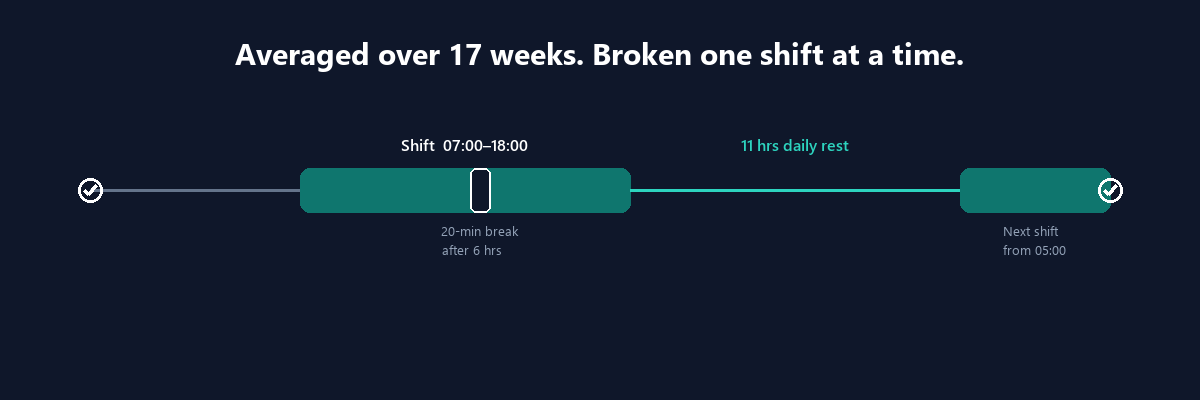
The 48-hour week is an average, not a weekly cap
Under the Working Time Regulations 1998, most adult workers can't be required to work more than an average of 48 hours a week. That average is normally calculated over a 17-week reference period, not the calendar week. A single 54-hour week, on its own, tells you almost nothing. What matters is what the sixteen weeks either side of it looked like too.
Say someone does 44 hours most weeks, covers a colleague's leave for a fortnight at 58 hours, then drops back to 44. Averaged over 17 weeks, that's still comfortably under the limit. Now put the same 58-hour fortnight into a run where every other week was already 47 or 48 hours. The average tips past 48 and nobody noticed, because no single week looked unusual. That's the trap. A weekly total that looks fine in isolation can still sit inside a breach, and a weekly total that looks alarming can sit inside a period that's perfectly compliant. You can't judge compliance one week at a time. You have to look at the run.
The individual opt-out
Workers can agree to work more than 48 hours a week on average, but only through an opt-out, and the rules around it are stricter than most employers assume. It has to be voluntary and in writing. An employer can ask a worker to opt out, but nobody can be sacked, disciplined or treated unfairly for refusing — and a blanket line buried in the staff handbook doesn't count as a valid opt-out on its own.
Here's the part employers forget: a worker can cancel their opt-out whenever they want, even if it's written into their contract. Minimum notice is seven days, though the agreement can set something longer, up to three months. An employer can't block the cancellation and can't force someone to sign a new one to replace it. If your only record of who's opted out is a folder nobody has opened since onboarding, it's worth checking who's actually still covered. People move teams, roles change, and an opt-out signed for one job doesn't automatically follow someone into a different one with different hours.
Rest breaks the law actually sets out
The regulations also cover rest, and this is the part that gets missed on busy rotas far more often than the 48-hour limit itself:
- A rest break of at least 20 minutes, uninterrupted, if a shift runs longer than six hours.
- 11 hours of rest between the end of one shift and the start of the next.
- Either 24 hours of continuous rest each week, or 48 hours every fortnight.
None of these are things a worker has to ask for. They're the floor, and a rota that fills every gap without checking against them has already broken the rules — even if every individual shift, taken on its own, looks reasonable. A 10pm finish followed by a 7am start the next day is only nine hours' rest, two short of the minimum, and it's the kind of clash that's invisible on a weekly grid but obvious the moment you check start and finish times against each other.
Night workers get a separate, stricter limit: an average of 8 hours in any 24-hour period, usually also averaged over 17 weeks. Anyone doing work involving specific hazards, or heavy physical or mental strain, gets an even harder rule — a flat 8-hour cap in any 24 hours, no averaging allowed at all. Workers can't opt out of that one under any circumstances.
Where the rota tells you nothing
A rota is a plan. It says who's supposed to be where, and for how long. It says nothing about who actually turned up at 6:45 instead of 7, who stayed on to finish a job and left three hours late, or who covered someone else's late shift on top of their own early one the next morning. Those are the moments that push a fortnight over the 48-hour average, or eat into the 11 hours of rest between shifts — and none of them show up if the only record you keep is the plan.
We've made this point about rotas before, and it applies just as directly here: the rota is your intention, not your compliance record. What actually happened — the real clock-in, the real clock-out, the break that was or wasn't taken — is the only thing that answers the question an inspector or a tribunal would actually ask, which is what hours were worked, not what hours were planned.
Building a record that would hold up
If someone asked you tomorrow to show that a specific worker's hours were compliant over the last four months, could you? For most small businesses running on a rota and a memory, the honest answer is no — not quickly, and not with confidence. A few habits close that gap:
- Record actual start and finish times, not a rounded daily total. "8 hours" hides exactly the kind of late finish that erodes rest.
- Log breaks as they're taken, not assumed. An unpaid break nobody actually took is still owed, and it's still missing from the compliance picture.
- Keep opt-out forms somewhere findable, tied to the person rather than the role, and note the date — a cancelled opt-out needs its own record too.
- Check the running average periodically instead of waiting for a complaint. A quick look every few weeks catches a drifting pattern before it becomes 17 weeks of evidence against you.
This is where Temporra earns its place, and it's worth being precise about what it does and doesn't do. Temporra doesn't build your rota and it doesn't decide shift patterns for you — that's still your call, made around the work in front of you. What it does is track the hours your team actually clock, break by break, shift by shift, across sites, and keep that record clean enough to check against the 48-hour average or the rest-break rules whenever you need to. Timesheets export straight to payroll, so the record that proves compliance is the same one that pays people, not a separate spreadsheet nobody trusts. See the guide to tracking employee hours for the wider picture on capturing that data cleanly in the first place.
Frequently asked questions
Does the 48-hour limit apply to every single week?
No. It's an average, normally calculated over a 17-week reference period, so one long week doesn't automatically breach it and one quiet week doesn't automatically cancel out a run of long ones either. What matters is the average across the period, not any single week in isolation.
How do I actually work out the 17-week average?
Add up the hours worked across the 17 weeks, which is a rolling period rather than a fixed calendar block, and divide by 17. Some absences, such as most sick leave and holiday, are excluded from the calculation under the regulations — a detail worth checking properly rather than guessing at.
Can I make staff sign the opt-out as a condition of the job?
No. It has to be voluntary, and nobody can be sacked, disciplined or treated unfairly for refusing to sign one. A clause buried in a standard contract that everyone is expected to sign isn't a valid opt-out on its own; it needs to be a genuine, separate, written agreement.
How much notice does a worker need to cancel their opt-out?
At least seven days, unless the opt-out agreement itself specifies a longer notice period, which can be up to three months. The employer can't block the cancellation and can't force the worker to sign a replacement.
What breaks are staff legally entitled to during a shift?
An uninterrupted rest break of at least 20 minutes if the shift is longer than six hours. It doesn't have to be paid unless the contract says otherwise, but it does have to actually happen, not just be offered on a shift too busy to take it.
Does a rota that avoids back-to-back long shifts count as compliance?
It helps, but it isn't proof. A rota shows what was planned. Compliance depends on what actually happened — the real clock-in and clock-out times, which can differ from the plan whenever someone starts early, finishes late, or covers an extra shift.
Are night workers covered by the same 48-hour rule?
They have their own limit on top of it: an average of 8 hours in any 24-hour period, usually averaged over the same 17 weeks. Workers doing hazardous or especially demanding work get a stricter version with no averaging at all — a flat 8-hour cap — and that one can't be opted out of.
What happens if a worker's average creeps over 48 hours?
Technically it's a breach of the regulations, and enforcement generally sits with the Health and Safety Executive or local authorities depending on the sector. In practice the more common real-world risk is a grievance or tribunal claim built on hours records you can't produce.
Related guides
- Night workers: the eight-hour limit nobody can opt out of, and what to record
- Young workers: the hours limits, and what you have to record
- On-call and standby hours: what counts, and what to record
- Recording Breaks Correctly: Why an Unpaid Break Nobody Took Still Costs You
Start a free 14-day trial · Book a demo
No card required. Flat monthly pricing by team size, every feature on every tier — see pricing.