 Tempor
Annual Leave Records: The New Duty Nobody's Fully Explained Yet
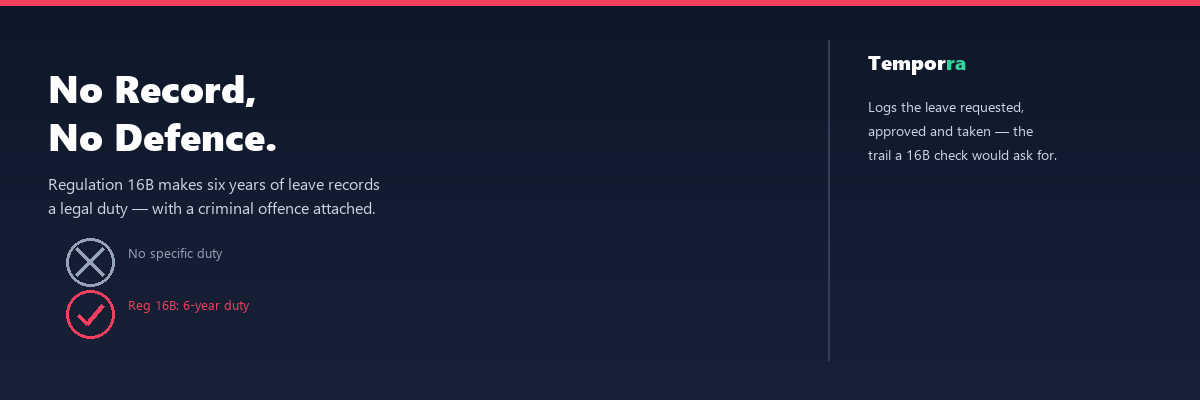
Ask most small business owners whether they keep proper holiday records and they'll say yes, more or less, it's on the payslip somewhere. Since 6 April 2026 that answer isn't good enough. A new regulation makes record-keeping for annual leave a standalone legal duty in its own right, with its own criminal offence for getting it wrong, and almost nobody outside HR and legal circles has noticed it exists.
What actually changed on 6 April 2026
Section 35 of the Employment Rights Act 2025 inserted a brand new regulation, 16B, into the Working Time Regulations 1998. It's titled, plainly enough, "Records relating to annual leave entitlement", and it does exactly what it says: it requires an employer to keep records adequate to show whether it has complied with its obligations on annual leave. Not hours worked, not the 48-hour week, not rest breaks. Specifically annual leave, entitlement, pay, and what happens to it when someone leaves.
This is genuinely new. Before 6 April 2026, holiday record-keeping was something most employers did because payroll needed it, not because a standalone law told them to. Regulation 9 of the same regulations already requires records of working hours and opt-out agreements, and that duty is old and well understood. Regulation 16B is different: it's the first time UK law has put a dedicated, named record-keeping duty specifically around holiday entitlement and holiday pay.
What the records have to cover
The regulation lists exactly which obligations the records need to demonstrate compliance with. Four of them are entitlement: the basic four weeks under regulation 13(1), the additional 1.6 weeks under regulation 13A(1), the special provisions for irregular-hours and part-year workers under regulation 15B(2), and the right to be paid a week's pay for each week of leave under regulation 16(1). The other three are about leaving: payment in lieu of untaken leave under regulation 14(2), the same for leave carried forward from earlier years under 14(6), and payment in lieu for irregular-hours and part-year workers under 15E(2). Between them, that's leave accrued, leave taken, leave carried over, the rate it was paid at, and what happened to any unused leave when someone's employment ended.
In plain terms, if a former employee (or, more likely now, the Fair Work Agency) asked you to prove a specific person got their full four weeks last year, got paid correctly for it, and was paid out fairly for whatever was left when they left, could you? Regulation 16B is the law that says you now have to be able to, in writing, for six years.
Six years, no prescribed format
The retention period is six years from the date each record was made. There's no prescribed format. The regulation itself says records can be "created, maintained and kept in such manner and format as the employer reasonably thinks fit", so the format is up to you. What goes in them is less open. Acas's holiday guidance, last updated on 3 June 2026, says employers must record holiday taken, holiday carried over from previous years, holiday pay and any payments in lieu of holiday. For holiday pay it wants the detail of what was included, bonuses or commission for example, and it says to keep the records for at least six years. That's guidance rather than a definition written into the regulation, but it's the closest thing to a checklist employers have, and a criminal offence still sits on the other side of getting it wrong.
For what it's worth, most payroll or time-tracking systems already hold a good chunk of this data. What they don't always hold cleanly is the trail around it: when leave was requested, when it was approved, what pay elements went into the rate used, and whether all of that survives past the point someone leaves the business. A number on a payslip proves pay happened. It doesn't, on its own, prove the leave was calculated correctly or that the request-and-approval process was followed.
The criminal offence, and how seriously to take it
Failing to keep adequate records is now a criminal offence under the amended regulation 29 of the Working Time Regulations, punishable by an unlimited fine in a magistrates' or crown court. That's a step up from the old civil-only exposure most employers were used to around holiday pay disputes. Enforcement is meant to sit with the new Fair Work Agency, which launched on 7 April 2026, the day after the record-keeping duty itself began.
Two honest caveats worth having, rather than either panicking or ignoring this. First, the enforcement regulations specifically transferring these powers to the Fair Work Agency hadn't been published as this was written, so exactly how actively this gets policed in its first year is genuinely unclear. Second, the Fair Work Agency is due to get powers to chase unpaid holiday pay, and when they arrive they can't reach any sum that fell due before 18 December 2025, when the Act received Royal Assent. Those powers are already live for minimum wage cases. For holiday and sick pay, the government said on 3 September 2026 that they were still to come. It's a different thing from the forward-only record-keeping duty. Old records still matter. They're just answering a different question.
| What it covers | WTR regulation | What "adequate" probably means in practice |
|---|---|---|
| Basic 4-week entitlement | 13(1) | Days accrued and taken, per leave year |
| Additional 1.6-week entitlement | 13A(1) | Same, tracked separately from the basic 4 weeks |
| Irregular-hours / part-year workers | 15B(2) | The hours-worked figure the accrual was based on |
| Holiday pay (a week's pay per week of leave) | 16(1) | The rate used, and what pay elements it included |
| Pay in lieu of untaken leave on leaving | 14(2), 14(6), 15E(2) | What was paid out, including any carried-over leave, and how it was worked out |
Where this sits next to the record-keeping you already do
It's worth being clear this doesn't replace anything, it adds to it. The 48-hour week rules under the older regulation 9 already require records of hours worked and opt-out agreements, and NMW record-keeping under HMRC's own rules already requires pay records for six years. Regulation 16B is a third, separate duty layered on top, aimed specifically at holiday. A business that's solid on hours and pay-rate records could still fail this one, because leave requested, leave approved and leave carried over aren't the same data as clock-in times or an hourly rate.
This is also where irregular-hours and part-year workers get harder, not easier. Their entitlement accrues at 12.07% of hours actually worked rather than a flat weekly figure, which means the record has to show the hours worked figure the accrual was based on, not just the days taken. A business running mostly casual or seasonal staff has more of this trail to keep clean than one running fixed nine-to-five contracts.
What to actually start keeping
Five things, none of which need waiting for official guidance to start. The dates leave was requested and approved, not just taken. The pay rate used for each period of leave, and what it was built from, base pay, regular overtime, or anything else that counts as normal remuneration. A running carry-over figure per worker, so the balance is a lookup rather than a reconstruction. For irregular-hours workers, the hours-worked figure behind each accrual calculation. And, for anyone who leaves, a clear record of what was paid out for unused leave and how that figure was reached.
Temporra doesn't run payroll and it won't calculate what a specific holiday hour is worth, that's still a job for whatever payroll system a business already uses. What it does hold is the leave request and approval trail, with a timestamp on both, and the hours worked that feed an irregular-hours accrual calculation. This is a duty about being able to produce a paper trail on demand. Having that half of the record already timestamped and searchable is most of the work.
Frequently asked questions
What is regulation 16B?
A new rule inserted into the Working Time Regulations 1998 by section 35 of the Employment Rights Act 2025. It requires employers to keep records adequate to show they've complied with the statutory annual leave rules, covering basic leave, additional leave, irregular-hours and part-year worker entitlement, holiday pay, and payments in lieu of untaken leave when someone leaves. It took effect on 6 April 2026.
When did this actually start?
6 April 2026. There were no transitional provisions and no phase-in period, so the duty applied in full from day one, whether or not a business had heard about it.
Do we need to go back and recreate records for leave taken before 6 April 2026?
No. The record-keeping duty itself isn't retrospective, it applies to leave and pay from 6 April 2026 onward. Worth knowing the separate point though: the Fair Work Agency is due to get powers to chase holiday pay underpayments, and they can't reach anything that fell due before 18 December 2025, when the Act received Royal Assent. As of September 2026 those powers weren't yet in force for holiday pay. Old payroll records still matter for that, just not for this specific duty.
What exactly counts as an adequate record?
The regulation doesn't define it. It lets employers keep records "in such manner and format as the employer reasonably thinks fit", and Acas's guidance, updated on 3 June 2026, lists what to record: holiday taken, holiday carried over, holiday pay with details of what it included, and any payments in lieu, kept for at least six years. In practice that means dates of leave requested and taken, the pay rate used and what it included, carry-over calculations, and any payment in lieu on termination, held somewhere you could actually produce it.
What happens if we don't keep adequate records?
Failing to keep them is now a criminal offence under the amended regulation 29 of the Working Time Regulations, carrying an unlimited fine in a magistrates' or crown court. Enforcement is due to sit with the Fair Work Agency, though the specific enforcement regulations covering this duty hadn't been published as this was written, so how actively it gets policed in year one is still an open question.
Does this replace the working-time records we already have to keep?
No, it sits alongside it. The 48-hour week rules already require records of hours worked and any opt-out agreements. Regulation 16B is a separate, newer duty specifically about annual leave entitlement, leave taken and holiday pay, not about weekly hours.
Does this apply to casual, part-time and irregular-hours workers too?
Yes, explicitly. The regulation names irregular-hours and part-year worker entitlement (regulation 15B(2)) as one of the things the records have to cover, alongside the standard 4-week and 1.6-week entitlements. That group is usually the hardest to keep clean records for, because their hours and their leave both vary week to week.
Does our payroll software already handle this?
Possibly some of it. Most payroll systems log that leave was paid. Fewer log when it was requested, when it was approved, what pay elements were included in the rate, or hold a clean six-year trail for someone who left the business two years ago. Check what your system actually keeps, and for how long, rather than assuming.
Related guides
- How to Calculate Holiday Entitlement for Hourly & Part-Time Workers (UK, 2026)
- Annual Leave Carry-Over: When UK Employers Must Allow It
- Neonatal care leave: counting the weeks, and the three-year pay record
- Carer's leave: one week in any 12 months, and the record you'll need to prove it
Start a free 14-day trial · Book a demo
No card required. Flat monthly pricing by team size, every feature on every tier — see pricing.