 Tempor
Payslips and hours worked: what the law actually requires
If someone's pay moves with the hours they work, their payslip has to show those hours. That has been the law since April 2019. Payroll software mostly handles it, and payroll practice mostly doesn't, because the number that lands on the payslip is only ever as good as the timesheet behind it.
The rule in one sentence
Section 8 of the Employment Rights Act 1996 sets out what has to be on an itemised pay statement. Since 6 April 2019 that list includes the number of hours paid, but only where the wages vary according to time worked. The change came in through the Employment Rights Act 1996 (Itemised Pay Statement) (Amendment) Order 2018, SI 2018/147.
A second order took effect the same day and matters just as much. SI 2018/529 extended the right to a payslip from employees to workers. Zero-hours staff, casual staff, agency staff on the agency's books: all of them get an itemised payslip, and all of them get the hours line if their pay moves with their hours.
Who this catches
Anyone paid by the hour, obviously. Beyond that it catches more people than most employers expect.
A salaried supervisor who picks up paid overtime is in scope, because part of the pay varies with time worked. Term-time staff paid on actual hours are in scope. Someone on a fixed salary with a shift allowance that changes depending on how many nights they covered is in scope for the part that moves.
Piece work is the interesting exception. If the pay is driven by output rather than by time, the hours line isn't triggered, because the wages don't vary as a consequence of time worked. Get a mixed arrangement, though, where someone is on a piece rate with a top-up to reach the minimum wage, and you're back in scope for the time-based element. Minimum wage compliance will require you to have those hours anyway.
When the hours don't have to appear
Fixed salary, fixed hours, nothing variable: no hours line needed. That's most office payrolls.
Acas is helpful on the halfway house. Where somebody is salaried but also works variable additional hours, you show the hours for the variable part. The fixed salary can stay as a single figure. You don't have to reconstruct a notional 37.5 a week for the contracted portion and print it.
One figure or a breakdown
The statute allows either. Section 8 says the total number of hours worked in respect of the variable amount can be given as an aggregate figure, or as separate figures for different types of work or different rates of pay.
Split it. Legally you can put 47 on the payslip and stop there, but if those 47 hours were 39 at standard rate, 6 at time and a half and 2 at a call-out rate, one number is an invitation to a query you'll spend twenty minutes answering. The breakdown costs nothing once the time data carries the rate with it.
Where it goes wrong
Rarely in the software. Almost always in what gets typed into it.
The most common failure is the contract number. Payroll enters 40 because the contract says 40, week after week, while the actual timesheet says 43.5 twice a month. The payslip is then wrong in a way that is invisible until somebody adds up their year.
The second is rounding drift. Your clock-in system records to the minute, your payroll rounds to the nearest quarter hour, and nobody has written down which one wins. The two figures disagree by twenty minutes and the worker who noticed is now standing in the office doorway holding a phone.
Third, timing. Overtime paid a month in arrears often gets shown against the period in which it was paid rather than the period in which it was worked. That is defensible if the payslip makes it clear, and it usually doesn't.
Fourth, and this one still turns up in 2026: no hours line at all, because the payslip template was configured years ago and nobody revisited it when the law changed.
What a worker can do about it
Start with the employer. Most of these are transcription errors and get fixed in a day.
If that fails, section 11 lets either side ask an employment tribunal to determine what should have been on the statement. Once employment has ended there's a time limit, extendable only where it wasn't reasonably practicable to apply in time. As of 25 September 2026 it's three months from the date employment ended. From 1 October 2026 the Employment Rights Act 2025 makes it six months, but only where the employment ends on or after that date, under the transitional rule in SI 2026/954. Check GOV.UK's Employment Rights Act timeline or legislation.gov.uk for the current position.
There's a limit worth knowing. Section 11(3)(b) says this route doesn't cover a question solely as to the accuracy of an amount stated. Arguing that the hours figure should have been 47 rather than 44 is really a claim about being underpaid, which is an unlawful deduction claim under a different part of the Act.
Now the part employers underrate. Under section 12(4), if the tribunal finds that deductions were made without ever appearing on a payslip, it can order the employer to pay the worker a sum up to the total of those unnotified deductions from the thirteen weeks before the application. It doesn't matter whether the deduction itself was perfectly lawful and contractual. Fail to itemise it, and you can be ordered to hand it back.
What this means for your time records
The hours line on a payslip is a payroll output, but it is a time-and-attendance problem. Payroll can only print what it is given.
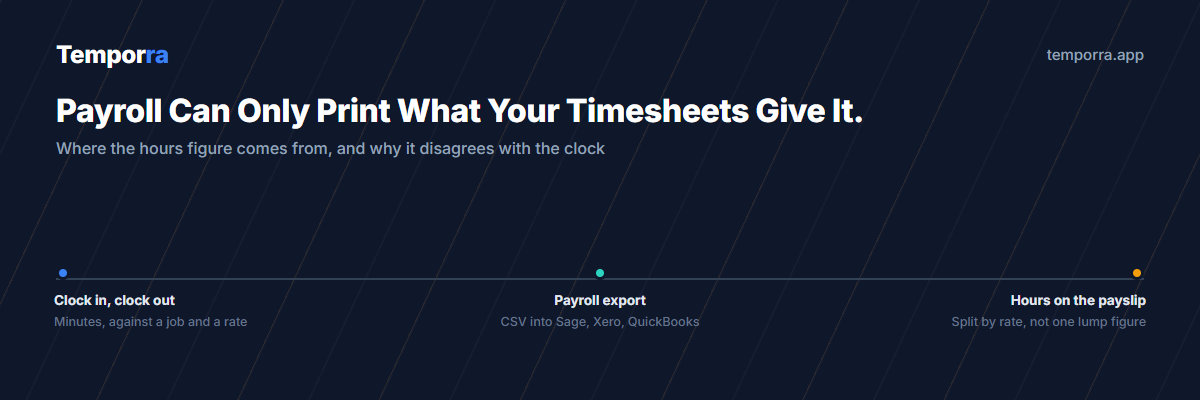
If your hours reach payroll as a paper sheet transcribed on a Friday afternoon, the payslip inherits every mistake on that sheet, and you will have nothing to show a tribunal beyond the sheet itself. If they arrive as clock-in and clock-out records with the rate attached, the payslip breakdown falls out of the data and the evidence trail already exists.
That's what Temporra is for: staff clock in and out, hours land against the right job and rate, and the payroll export produces a CSV that Sage, Xero, QuickBooks and BrightPay all read. Temporra doesn't issue payslips, and no time system does. It produces the numbers your payroll then has to print.
Common questions
Does a payslip legally have to show hours worked?
Only where the pay varies according to time worked. If someone is on a fixed salary for fixed hours, there's no hours line required. If any part of the pay moves with hours, that part's hours must be shown.
When did this become law?
6 April 2019, through SI 2018/147 amending section 8 of the Employment Rights Act 1996. A companion order, SI 2018/529, extended the right to a payslip itself from employees to all workers on the same date.
Do zero-hours and agency workers get payslips?
Yes. Since April 2019 the right covers workers, not just employees, so zero-hours and casual staff are included, as are agency workers on the agency's payroll. Genuinely self-employed contractors are not.
Can I show one total hours figure instead of a breakdown?
Legally yes. Section 8 permits an aggregate figure or separate figures by type of work or rate of pay. In practice a breakdown by rate causes far fewer queries and is easier to defend if the hours are ever challenged.
What about a salaried employee who does paid overtime?
The overtime hours must be shown, because that part of the pay varies with time worked. The fixed salary can remain as a single figure without an hours breakdown.
What happens if an employer doesn't provide payslips at all?
The worker can raise a grievance and then apply to an employment tribunal, which will make a declaration. If unnotified deductions were made, section 12(4) lets the tribunal order the employer to repay up to the total of those deductions from the thirteen weeks before the application, regardless of whether the deductions were otherwise lawful.
How long do I have to bring a claim?
While still employed you can apply at any time the question is live. After the employment ends the application must be made within three months, unless the tribunal accepts it wasn't reasonably practicable to do so in time. That's the limit as of 25 September 2026: it becomes six months from 1 October 2026, for employment that ends on or after that date. GOV.UK's Employment Rights Act timeline has the current position.
Does this apply to directors paid a small salary?
A director paid a fixed monthly amount with no variation by time worked doesn't need an hours line. If the company also pays them for variable hours, that element does.
Get the hours right before payroll does
- Check your payslip template actually carries an hours field, and that it's populated rather than sitting at zero.
- Write down your rounding rule, once, and make the time system and payroll follow the same one.
- Show hours split by rate where more than one rate applies.
- Keep the underlying time records. The payslip is the statement; the timesheet is the evidence.
Related guides
- How to Run Payroll for a Small Business (UK): A Practical 2026 Guide
- National Minimum Wage: The Records HMRC Actually Checks
- Statutory Sick Pay in 2026: What You Actually Have to Record
- On-call and standby hours: what counts, and what to record
No card needed for the trial. One flat monthly price by team size, from £39 for up to five workers, VAT included. See pricing.