 Tempor
On-call and standby hours: what counts, and what to record
The phone goes at ten past eleven. Somebody drives out, spends forty minutes on a fault, drives home, and is back in bed by one. At the end of the month there is an argument about what that night was worth, and both sides are quoting something real at each other, because there are two different tests and they do not give the same answer.
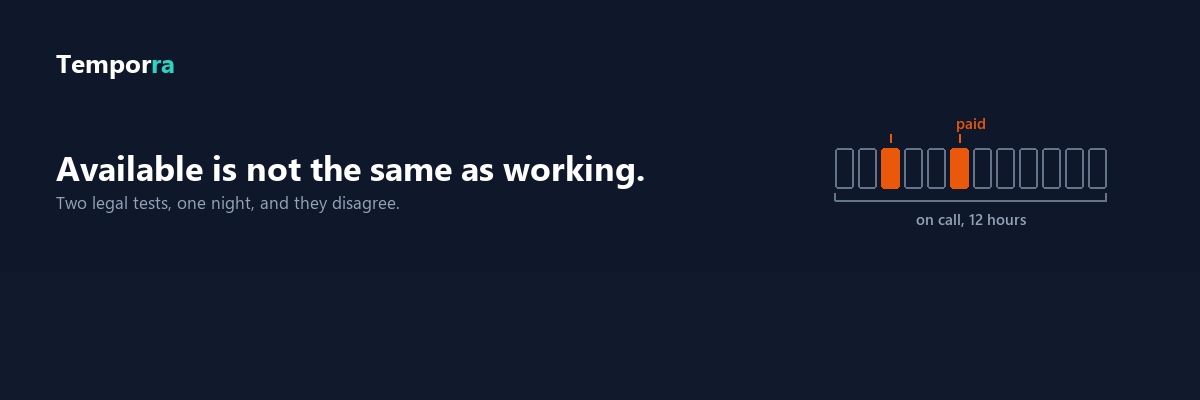
Neither test is complicated on its own. The confusion comes from running them together.
Two questions that sound like one
Ask whether on-call time counts and you will get a confident answer from almost anybody. The trouble is that there are two questions hiding inside it, and they come from different statutes with different purposes.
The first is whether the time is working time. That matters for the 48-hour average, for night work limits and for rest breaks, and it comes from the Working Time Regulations 1998. Regulation 2(1) defines working time in three limbs, and the one that does the work is the first: any period during which the worker is working, at the employer's disposal and carrying out their activity or duties.
The second is whether the time is paid hours for minimum wage purposes. That comes from the National Minimum Wage Regulations 2015 and it is a different test with different wording.
A single night can come out yes on one and no on the other. That is not a loophole or an oversight. The two regimes were built to do different jobs, and the record you keep has to be good enough to answer both.
On call at or near the workplace
Regulation 32(1) of the 2015 Regulations is the one to read. Time work includes hours when a worker is available, and required to be available, at or near a place of work for the purposes of working, unless the worker is at home.
GOV.UK's own guidance puts it the same way: time required to be available for work either on standby or on-call at or near their workplace counts, unless the worker is at home, with an exception where they are permitted to sleep and suitable sleeping facilities are provided.
So an electrician waiting in the yard because the call might come is on paid hours whether or not the call comes. GOV.UK says elsewhere in the same guidance that time spent at the workplace and required to be available for work counts, and that it makes no difference whether or not you actually provide work for that time. Sitting there doing nothing is the job.
The phrase that gets argued over is at or near. A portakabin on site is obviously near. A bed above the pub, when the pub is the workplace, has been litigated. If your arrangement sits anywhere close to that line, write down what you decided and why, because the alternative is deciding it retrospectively in front of someone from HMRC.
On call at home
Being at home is carved out. A worker who is at their own house, phone on, free to watch television and go to bed, is generally not on paid hours for minimum wage purposes just because they might be called.
That changes once they arrive and start work, not when the phone rings. GOV.UK says a worker at home waiting to be called in is only entitled to the minimum wage "after they have arrived at work and are working or available for work". The drive out is the part that gets argued about, and for minimum wage purposes it usually doesn't count. Regulation 34(1) of the National Minimum Wage Regulations 2015 treats travel as working time unless it is between the worker's home and a place of work or a place where an assignment is carried out, and GOV.UK says travelling from home to a task or assignment will generally not count. What does count is travel between assignments. If one call-out leads to a second fault across town, the drive from the first job to the second is paid time under regulation 34(2)(a), the same as GOV.UK's example of a care worker driving from one client to another.
Log the drive out anyway. The contract may pay it, and for working time the answer can be different: GOV.UK notes that the Court of Justice of the European Union has treated journeys between home and the first and last customer of the day as working time under the Working Time Directive for workers with no fixed place of work, while saying pay is a separate issue. So the midnight drive can matter for the 48-hour average and for rest even where it isn't minimum wage time.
We went through the wider version of this in the piece on what records HMRC actually checks. Unpaid travel between jobs is one of the most reliable ways for an apparently fine hourly rate to come out under the legal minimum once the real hours are added up.
Sleeping at work, and the condition nobody quotes
This is the part that changed, and it changed at the top.
The Supreme Court decided Royal Mencap Society v Tomlinson-Blake on 19 March 2021, heard together with Shannon v Rampersad. The outcome, unanimous, is that a worker on a sleep-in shift is only working, and only eligible for the minimum wage, for the hours they are awake for the purposes of working. Regulation 32(2) says it in statute: hours when the worker is awake for the purposes of working count, even if the worker by arrangement sleeps at or near a place of work and the employer provides suitable facilities for sleeping.
Most people stop reading there, and they stop one clause too early.
The exception only applies where suitable sleeping facilities are actually provided. GOV.UK spells out what happens when they are not: the minimum wage must be paid for the entire shift. So the question is not only whether somebody was asleep, it is whether you gave them somewhere to sleep, by arrangement, and whether it was suitable. That is a factual question about a room, and it is much easier to answer honestly in advance than a year later.
The practical consequence for the record is blunt. If you run sleep-ins, you need the periods awake for the purposes of working written down as they happen, with start and stop times, because those are the paid hours and nothing else in the night is. An entry saying "sleep-in, Tuesday" tells you nothing about the two call-outs at half past three.
The same night, two answers
Take an engineer who sleeps at a depot from ten at night until six, with a bed and a shower provided, and who is woken twice for a total of ninety minutes of work.
For minimum wage purposes, ninety minutes is the paid time, subject to whatever the contract pays on top. For working time purposes, Acas give being on call at the place of work as an example of working time, so the whole period is in play for the 48-hour average and for rest. Eight hours counted one way, an hour and a half the other, and both are defensible readings of different law.
This is why the record has to carry categories rather than a single total. If all you have is "hours worked", you have answered one question and lost the other. The 48-hour side of it, including the opt-out and what has to be kept, is covered in the working time piece.
What the record has to show
Five things, and they are not interchangeable.
Rostered hours, which you already have. Standby hours at or near the workplace, with start and stop times, because those are paid. Callout hours, separately, because those are what a home-based worker is actually owed. Travel between assignments, separately again, because it counts and because folding it into a gap between two jobs is how it disappears. And for a sleep-in, the periods awake for the purposes of working, logged at the time.
The retention question has a boring answer with a long number attached. Minimum wage records have to be kept for six years, which we covered in the HMRC records article, and since April 2026 there is a standalone holiday record-keeping duty running to six years as well. Six years is long enough that nobody involved will remember the night in question, which is rather the point of writing it down.
Where this actually falls over
Almost never at the level of the law. It falls over at the level of what somebody typed on a Friday afternoon.
The common pattern is a weekly sheet filled in from memory, where the callout on Tuesday gets rounded to an hour because that sounds about right, and the drive from the first fault to the second is not mentioned at all because it did not feel like work. Multiply by four people and fifty-two weeks and you have a number nobody can stand behind.
The second pattern is the flat allowance. Thirty pounds for a week on the rota, paid regardless. There is nothing wrong with an allowance, and it does count towards the minimum wage arithmetic. But it is a payment, not a record, and if the hours underneath it are unknown then so is whether the arithmetic works. Somebody called out six times in a week on a thirty-pound allowance is a problem waiting for an inspection.
The third is the one that looks tidiest. A rota showing who was on call, with no record of what happened. A rota is a plan. It tells you who was supposed to be available. It says nothing about who was woken at three and drove to Barking.
Common questions
Do I have to pay someone for being on call?
It depends where they are. Under regulation 32 of the National Minimum Wage Regulations 2015, hours when a worker is available, and required to be available, at or near a place of work for the purposes of working do count, unless the worker is at home. So a fitter sitting in the depot waiting for a call is on paid hours. The same fitter sitting in his own front room, phone on, generally is not, until he arrives at the job and starts work.
What happens the moment they are called out?
The time counts from when they arrive and start work. Under regulation 34(1) of the National Minimum Wage Regulations 2015, travel between home and a place of work or an assignment is not minimum wage time, and GOV.UK says travelling from home to a task or assignment will generally not count. Travel from one assignment to another does count. Record the drive out anyway: the contract may pay it, and it can still count as working time for the 48-hour average and rest.
Is a sleep-in shift paid for the whole night?
Not since 2021. The Supreme Court decided Royal Mencap Society v Tomlinson-Blake on 19 March 2021, and the position is that a worker permitted to sleep is only working, and only eligible for the minimum wage, for the hours they are awake for the purposes of working. Regulation 32(2) says the same thing. There is a condition attached, though, and it is the part people forget.
What is the condition on the sleep-in rule?
Suitable facilities for sleeping have to be provided, and the sleeping has to be by arrangement. GOV.UK puts the consequence plainly: where suitable sleeping facilities are not provided, the minimum wage must be paid for the entire shift. A camp bed in a store cupboard is the sort of thing that gets argued about afterwards, which is a reason to decide it in advance rather than during a compliance check.
Can a night count as working time but not as paid hours?
Yes, and it catches people out because the two questions come from different laws. The Working Time Regulations 1998 define working time at regulation 2(1) as any period during which the worker is working, at the employer's disposal and carrying out their activity or duties. Acas give being on call at the place of work as an example of working time. That is about the 48-hour average and rest breaks. Minimum wage law asks a separate question about which hours get paid, and regulation 32(2) can answer it differently for the same night.
Does a flat call-out allowance cover it?
An allowance is a payment, and payments count towards the minimum wage arithmetic, so it is not useless. What it does not do is remove the need to know how many hours it is paying for. If someone is called out three times in a month and the allowance works out at a rate below the minimum for the hours actually worked, the allowance does not save you. The hours are the thing that has to be right first.
What should the record actually show?
Start and stop times, split by category. Rostered hours, hours on standby at or near the workplace, hours actually worked during a callout, travel between assignments, and for a sleep-in the periods awake for the purposes of working. One line reading "on call, Saturday" is not a record of anything. HMRC can go back six years, and reconstructing a night from memory eighteen months later never ends in your favour.
Does Temporra decide any of this for me?
No. It is not payroll software, it does not build your rota, and it does not rule on whether a particular night is working time. What it does is hold the times themselves, captured when they happened rather than written up on Friday: who clocked in, when, against which job and which site.
Where hours fit in
Temporra records the hours people actually worked: clock-in and clock-out, against a job and a site, with a face check at the point of clocking in so a colleague cannot do it for somebody who is not there. That check is a descriptor match against a stored photo rather than a liveness test, so treat it as one control against buddy punching and not as proof of identity.
It does not run payroll, it does not decide whether a given night is working time, and it does not build your rota. What it does is put a timestamp on the moment somebody started and the moment they stopped, so a callout at ten past eleven exists as a fact rather than as a recollection. Every argument described above is easier when the times are not in dispute.
Related guides
- Working Time Regulations: The 48-Hour Week, Opt-Outs and Rest Breaks
- National Minimum Wage: The Records HMRC Actually Checks
- TOIL vs Overtime: How to Record Time Off in Lieu Without the Argument Later
- Zero-Hours Contracts: The Guaranteed-Hours Reform, and the Records It Will Take
No card needed for the trial. One flat monthly price by team size, from £39 for up to five workers, VAT included. See pricing.