 Tempor
Winning main-contractor daywork and variation disputes: how verified site timestamps save your margin
When you put two commercial sparks on a client variation for two days at £300 a day and the quantity surveyor knocks half of it off your payment certificate because your only record is a Friday WhatsApp message, that £600 comes straight out of your net profit. Here is how verified clock-ins and itemised hours stop the haircut before it starts.
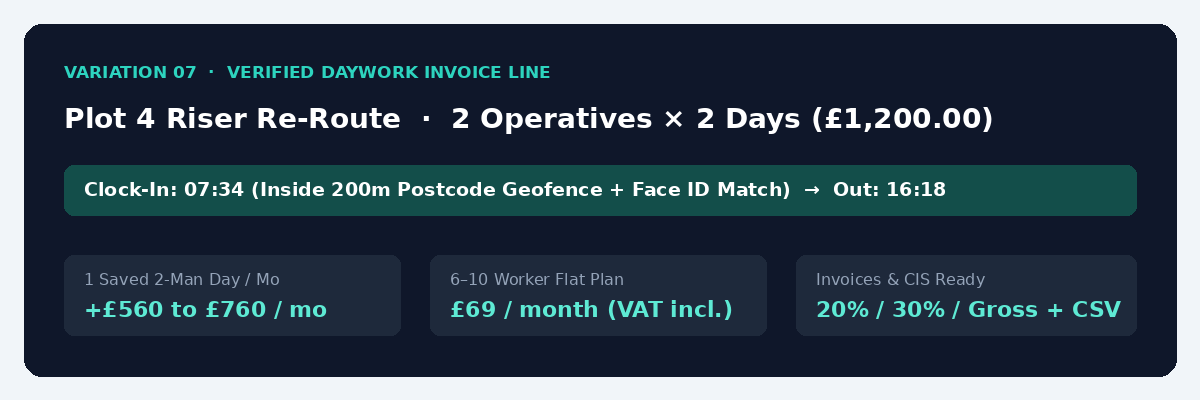
Every electrical, M&E, and groundwork subcontractor in the UK knows the feeling at the end of the month when the main contractor’s quantity surveyor sends back the payment certificate with red lines through your variation claims. Your site supervisor was asked on a Wednesday morning to strip out and re-run three distribution circuits because another trade boxed in the riser. You put two commercial sparks on it for two days at £300 a day each. Three weeks later, the QS crosses out half the £1,200 claim because your only proof of the hours is a line in an email that says “2 men, 2 days” backed by a Friday afternoon WhatsApp message.
The cruel part of construction cash flow is that you still have to pay those two subcontractors on Friday, and you still have to hand over their 20 per cent CIS deduction to HMRC by the 19th of the month, whether the main contractor pays your variation or not. We built Temporra with STF Electrics so that when you bill a day-rate job or a site variation, your invoice is backed by an exact GPS postcode and face-verified timestamp for every worker on the line.
Why quantity surveyors knock back paper and WhatsApp daywork
A quantity surveyor’s job is to protect the main contractor’s margin. When you submit a variation or a daywork claim at the end of the month, the easiest target on the desk is unverified labour.
If your invoice says two electricians worked eight hours each on Thursday 5 November, and the backing sheet is a crumpled piece of paper filled in from memory in the van on Friday afternoon showing 08:00 to 16:30 every single day of the week, the QS knows those times were guessed. They compare your rounded sheet against the main gate turnstile log (or point out that nobody signed your paper daywork sheet on the day) and offer you fifty pence on the pound to settle the account.
In 2026, with commercial electrical and M&E day rates running between £250 and £350 across the UK and £280 to £380 in London and the South East, losing just one two-man daywork day a month to a QS dispute costs your company between £500 and £760 of pure margin every single month.
Guessed Friday sheets versus verified clock-in records in Temporra
When you replace Friday messages with a geofenced and face-verified clock-in, the conversation with a client or a main contractor changes completely:
| What the client or QS asks for | Paper daywork sheets & WhatsApp | Temporra verified hours & invoice |
|---|---|---|
| Proof the operative was on site | A rounded “8 till 4:30” text sent on Friday afternoon | GPS postcode check (refuses clock-in outside the 200m site boundary) |
| Proof of who actually worked the shift | A scribbled name (easy for one mate to write down three others) | Face ID template match on the phone or 4-digit PIN on the site Kiosk tablet |
| Splitting standard contract vs variation work | All hours lumped together into one 40-hour weekly total | Workers clock out of the main contract job and into the variation job code on site |
| What lands on the client’s desk | A flat total typed into Word three weeks later | Itemised invoice generated straight from clocked hours with worker, date, and exact times |
| Cost of losing one 2-man day/month vs Temporra | £560 to £760 / month lost in knocked-back variations | £69 / month flat for 6–10 workers (VAT included) |
How to separate contract work from daywork on site in ten seconds
When a site manager asks your crew to do extra work outside your fixed-price scope, the biggest mistake is letting those hours disappear into the main job’s timesheet. Once forty hours of contract work and twelve hours of variation work are mixed together on a Friday text message, you can never untangle them cleanly.
In Temporra, setting up a separate bucket for extra work takes thirty seconds from your phone or office computer. You create a job card for the variation at the same site postcode, give it a clear name (for example, “Plot 4 Riser Re-route – Variation 07”), and set the hourly or day rate.
When your lads switch from the main contract onto the variation at 11:15 in the morning, they tap Clock Out on the main job and tap Clock In on the variation job right there inside the site geofence. You can also attach your toolbox talk or RAMS sign-off and any required digital site permits (hot work, working at height, or confined space) against the record at the same time.
From verified site hours to client invoice and CIS statement in one click
At the end of the week, you do not sit at the kitchen table copying numbers out of WhatsApp into three different spreadsheets.
First, Temporra generates the client invoice directly from the approved hours logged against that variation or day-rate job, with the job and the worker on each line. When a QS sees an invoice backed by a 07:34 arrival inside the postcode boundary and a 16:18 departure, verified by the worker’s face check at the gate, they pay that invoice and go looking for an easier subcontractor to argue with.
Second, those exact same approved hours feed your Friday payroll run. Temporra exports a clean CSV of regular hours, daily overtime, and gross pay that drops straight into Sage, Xero, QuickBooks, or BrightPay, and generates the monthly CIS payment and deduction statements (at 20%, 30%, or 0% gross status with each subcontractor’s UTR stored on file) ready before the 19th.
One flat monthly price by team band, VAT included
If Temporra saves you a single disputed day-rate shift all year, it has already paid for its annual subscription twice over. We price the whole system by team band with VAT and every feature included: £39 a month for up to 5 active workers, £69 a month for 6 to 10 workers, £129 a month for 11 to 20 workers, and £239 a month for 21 to 50 workers.
Your own admin account is free on top of your band, and marking a subcontractor inactive when a project wraps up frees their slot immediately. You can compare the bands and see a worked example on the pricing page.
Common questions
Can Temporra generate invoices for day-rate workers as well as hourly workers?
Yes. When you generate an invoice from clocked hours in Temporra, it supports both hourly billing and day-rate work, listing the job and the worker clearly on each line so your client or main contractor can see exactly what they are paying for.
What if a subcontractor works in a basement or plant room with no mobile signal?
Put a shared tablet in the site cabin or near the entrance running Temporra’s Kiosk Mode on site Wi-Fi or a data SIM. The whole crew can clock in and out on that tablet using their own four-digit PIN and optional camera check.
What languages does the worker app support on site?
Every worker can run Temporra in English, Romanian, Polish, Bulgarian, Russian, or Italian on their phone or on the web, while your office dashboard and invoices stay in English.
Can we try it on a live job without putting a card down?
Yes. You get a full 14-day free trial with every feature switched on and no payment card required. Put your crew on it for two weeks and see the difference on your next Friday invoice run.
Related guides
- Live Job Costing for UK Trade & Construction Teams
- STF Electrics Case Study: How a UK Electrical Contractor Uses Temporra
- The Real Cost of Paper Timesheets for UK Construction Firms
- CIS Payroll for Construction: A Subcontractor Deductions Guide
We post each new guide on the Temporra Facebook page. Follow it there if you’d like the next one, and a like helps other UK employers find it.
Start a 14-day free trial →No card needed for the trial. One flat monthly price by team size, from £39 for up to five workers, VAT included. See pricing.