 Tempor
TOIL vs Overtime: How to Record Time Off in Lieu Without the Argument Later
Someone works a Saturday callout to get a job finished, and the boss says "take the Monday off instead." Nobody writes it down, nobody agrees a rate, and three months later the worker thinks they're owed a day and a half and the employer thinks it's already been used up in early finishes over the summer. That gap is where most TOIL disputes actually start. TOIL and overtime pay solve the same problem, extra hours worked beyond the contract, in two different ways, and mixing them up, or running either one off memory instead of a record, is what turns a simple arrangement into an argument. This is a UK small-business guide to telling the two apart, recording TOIL properly, and the mistakes that cost real money when they go wrong.
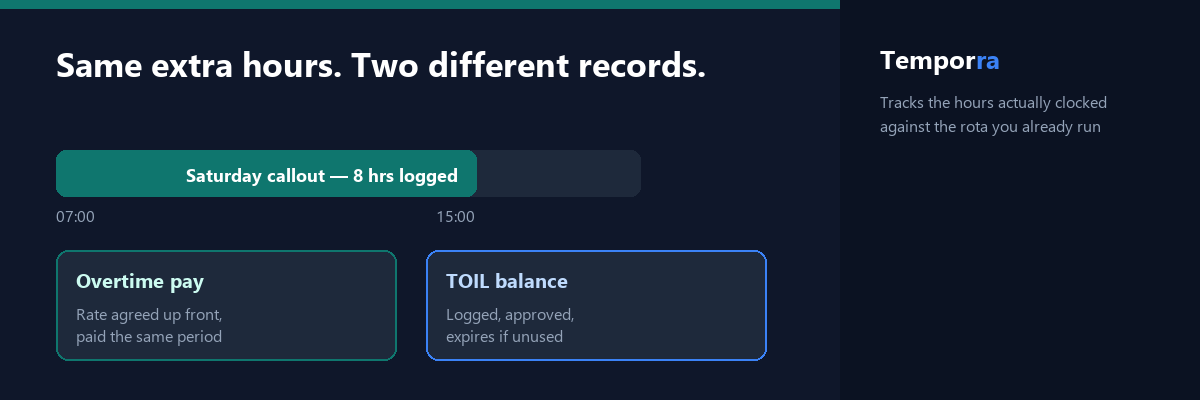
What's actually different between the two
Overtime pay is money: extra hours worked, extra pay on top, at whatever rate the contract sets. Time and a half is common but it isn't the law, it's custom. TOIL, time off in lieu, is the same extra hours banked instead and paid back later as time off rather than cash.
Here's the bit that catches people out: neither one is a legal entitlement by default. The Working Time Regulations set maximum hours and minimum rest, not a right to overtime pay or a right to TOIL. Gov.uk is direct about this: whether overtime is paid, and at what rate, depends entirely on what's in the contract. The same applies to TOIL. If it isn't written down somewhere, it's a favour, not a policy, and favours are exactly what people disagree about later.
When each one actually makes sense
Overtime pay suits hourly and waged staff, particularly where the extra cash matters more to them than an extra day off, which is often the case for younger workers or anyone with a mortgage due. TOIL suits salaried staff better, and it suits any business with a predictable quiet patch coming where the debt can be worked off without extra payroll cost sitting on top.
We see a mixed pattern most often in construction and field-service teams: overtime pay for the trades doing the extra hours physically on site, TOIL for the site manager or supervisor who's salaried and worked the same Saturday for different reasons. Both are legitimate. What matters is that everyone involved agreed which one applies before the hours were worked, not after.
How to record TOIL properly
This is where most of the argument potential lives, and it comes down to four things.
Get the exact hours, not an estimate
"About a day" isn't a number. A Saturday callout from 07:00 to 15:00 is eight hours, and it needs to be logged as eight hours against a start and end time, the same way you'd log a normal shift. Round it and you've already created a dispute waiting to happen.
Agree the conversion rate up front
Hour for hour is the most common approach and the easiest to defend if anyone ever asks how a balance was worked out. Some employers pay time off at 1.5x to match what overtime pay would have been, which is generous but fine as long as it's consistent and written down somewhere the worker can see it.
Get sign-off before the hours are worked, not after
A manager agreeing "yes, this Saturday counts as TOIL" before the shift happens is worth more than a conversation six weeks later about whether it was ever authorised at all.
Keep a running balance the worker can actually see
If TOIL only exists in a manager's head, or scattered across text messages, it doesn't exist in any way that survives a disagreement. It needs to sit in the same record as clock-in and clock-out for the shift that earned it, not a separate notebook nobody else can check.
Keep TOIL separate from annual leave
This is the mistake we see most. A worker books "two days off" and nobody records whether that's statutory annual leave, which they're entitled to regardless, or TOIL they earned by working extra hours. Mix the two together in the same column and by the time someone leaves the company, nobody can say with any confidence what they're actually owed. Annual leave and TOIL need to be two separate balances, tracked separately, even if they end up looking the same on a shift rota. See our guide on calculating holiday entitlement for how the statutory side works on its own.
There's no statutory right to be paid out unused TOIL when someone leaves, unlike accrued annual leave, which does have to be paid. Whether unused TOIL gets paid, carried over, or simply lost depends entirely on what the contract or company policy says. Check it before assuming either way, and put the answer in writing so it isn't a live question every time someone hands in their notice.
The mistakes that cause the real problems
Verbal-only agreements are the biggest one. "Just take it back whenever" sounds flexible right up until two people want the same Friday off and there's no record of who's actually owed what.
Letting a balance run without an expiry causes the second most damage. TOIL that can be banked indefinitely turns into a liability nobody budgeted for, and it gets worse the longer nobody deals with it. A written expiry window, use it within a set period or agree an extension, keeps the balance from becoming unmanageable.
Treating a rota as proof of hours worked is the third. A rota shows what was planned. It doesn't show what actually happened, whether the shift ran over, started early, or didn't happen at all. Temporra doesn't build that rota or decide who's working when, that's still down to you, same as it's always been. What it does is track the shift that actually happened against it: clock-in, clock-out, and the extra hours either side that turn into overtime pay or a TOIL balance, logged as they occur rather than reconstructed from memory at month end. See our guide on tracking employee hours for how that record works day to day, and our guide on running payroll for how it feeds into pay at the end of the month.
Frequently asked questions
Is TOIL a legal right in the UK?
No. There's no statutory right to time off in lieu. It exists only where it's written into a contract or established as a genuine, consistent company practice. If neither applies, an employer isn't obliged to offer it and a worker isn't automatically entitled to it.
Do I have to pay overtime by law?
Not automatically. The Working Time Regulations don't require overtime pay or set a rate for it. What the law does require is that average pay across the hours actually worked doesn't fall below the National Minimum Wage, which can catch employers out if unpaid overtime is common.
Hour for hour or 1.5x, what's the normal TOIL rate?
Hour for hour is the most common and the simplest to defend. A 1.5x rate is generous and some employers use it to match overtime pay, but there's no legal requirement either way. Whatever you choose, write it down and apply it consistently.
What happens to unused TOIL when someone leaves?
It depends entirely on the contract. Unlike statutory annual leave, there's no automatic right to be paid for unused TOIL on leaving. Some employers pay it out, some let it lapse, some require it to be taken during the notice period. Decide the policy before it comes up, not during an exit conversation.
Can an employer force someone to take TOIL instead of overtime pay?
Only if the contract or a genuinely agreed arrangement allows it. Changing someone's pay arrangement without agreement risks a breach of contract claim, so get sign-off on the approach before the extra hours are worked, not after.
Does TOIL count towards the 48-hour week average?
The hours actually worked to earn the TOIL count towards the 48-hour average, yes, because that average is based on hours worked, not hours paid or banked. The time taken back later doesn't add to it. We cover the 48-hour rule itself in our separate guide.
How long should a TOIL balance be allowed to run before it expires?
There's no set legal answer, so this is a policy decision. Many small businesses use a three-month window, use it or agree an extension, specifically to stop balances drifting into a liability nobody's tracking properly.
Do casual and zero-hours workers get TOIL?
Only if it's offered to them under the same terms as anyone else, since there's no statutory entitlement for any worker type. In practice it's less common for casual staff, who are more often paid overtime directly because the arrangement is simpler for both sides.
Related guides
- Working Time Regulations: The 48-Hour Week, Opt-Outs and Rest Breaks
- On-call and standby hours: what counts, and what to record
- How to Calculate Holiday Entitlement for Hourly & Part-Time Workers (UK, 2026)
- How to Run Payroll for a Small Business (UK): A Practical 2026 Guide
Start a free 14-day trial · Book a demo
No card required. Flat monthly pricing by team size, every feature on every tier — see pricing.