 Tempor
Neonatal care leave: counting the weeks, and the three-year pay record
A plasterer who joined you three weeks ago rings his supervisor at 6.40 on a Wednesday morning. His daughter was born the night before at 33 weeks and is in the neonatal unit. He won't be in. He wants to know what he's entitled to, and the honest answer in most small firms is that nobody has read the rules that started on 6 April 2025.
He is entitled to neonatal care leave, even at three weeks' service. He probably isn't entitled to the pay. The two have different qualifying rules, different notice rules and different records, and most of the mistakes come from treating them as one thing.
Where the law sits
The Neonatal Care (Leave and Pay) Act 2023 created both rights. The leave went into the Employment Rights Act 1996 as a new chapter built on section 80EF. The pay went into the Social Security Contributions and Benefits Act 1992 as Part 12ZE, starting at section 171ZZ16. Both apply to babies born on or after 6 April 2025, in England, Scotland and Wales.
The detail is in three statutory instruments, and it helps to know which one you are reading:
- the Neonatal Care Leave and Miscellaneous Amendments Regulations 2025 (SI 2025/375), for who qualifies, how the weeks build up and the notice for leave;
- the Statutory Neonatal Care Pay (General) Regulations 2025 (SI 2025/376), for entitlement to pay, the notice and evidence for pay, and the rate;
- the Statutory Neonatal Care Pay (Administration) Regulations 2025 (SI 2025/206), for the record you keep, HMRC's right to inspect it, and recovering what you pay.
GOV.UK's employer guide and the Acas neonatal care leave and pay page summarise all three. Where a summary and a regulation disagree below, I've followed the regulation.
What counts as neonatal care
Section 80EF(6) defines neonatal care as care of a kind the regulations specify that starts before the end of 28 days beginning with the day after the birth. Regulation 4 of the leave regulations then lists the kinds: medical care in a hospital, palliative or end of life care, and medical care somewhere else once the baby has left hospital, provided it is under a consultant's direction and includes monitoring and visits arranged by that hospital. A transfer between two hospitals doesn't break the run.
So the baby does not need to be on a neonatal unit. Acas says so plainly. A week on a general paediatric ward counts, and so can a fortnight at home under a consultant-led team from the hospital that discharged the baby.
There is a floor. Under section 80EF(5), the care has to continue without interruption for at least seven days, counted from the day after it starts. Six nights in hospital gives no entitlement at all.
How days in care turn into weeks of leave
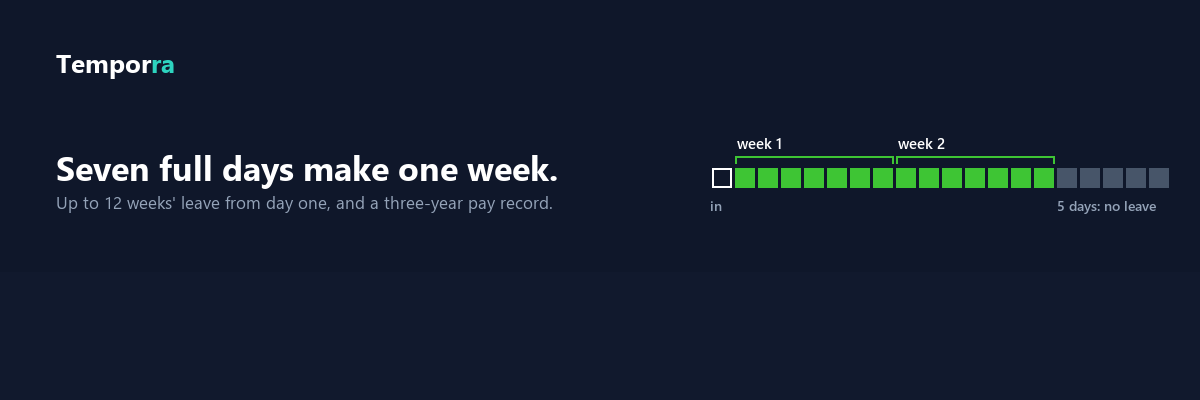
Regulation 5(1) gives one week of leave for each qualifying period. Regulation 3 defines that as a week of uninterrupted care, the first starting on the day after care begins and each later one starting the day after the last one ended. Nothing is prorated. Regulation 7 caps the total at 12 weeks and says it must all be taken within 68 weeks beginning with the date of birth.
Take the plasterer's daughter. She was born and admitted on Tuesday 3 March 2026 and went home on Sunday 22 March.
| Date | What it means |
|---|---|
| Tue 3 March | Care starts. The day of admission is not part of any qualifying period. |
| Wed 4 to Tue 10 March | First qualifying period: one week of leave earned. |
| Wed 11 March | The earliest day neonatal care leave can start (regulation 8(1)(a)). |
| Wed 11 to Tue 17 March | Second qualifying period: a second week earned. |
| Wed 18 to Sun 22 March | Five days of care. Not a full week, so no leave for them. |
| Sun 29 March | Last day of tier 1: the seventh day after care stopped. |
| Mon 21 June 2027 | Last day of the 68-week window. |
Nineteen days after admission, two weeks of leave. Most people round that up to three in their heads, and it's wrong.
The other thing the table shows is that the first week off can never be neonatal care leave. He was absent from 4 March and the leave cannot begin before 11 March. That first week has to be something else: paternity leave, holiday, or time off for dependants, which is what Acas suggests. Whatever it is, write down which one, because it changes what he has left.
Twins don't double it. Where two babies from the same pregnancy are in care at the same time, regulation 9 lets the parent accrue for only one of them over that stretch, and the 12-week ceiling stays where it is.
Tier 1 and tier 2: the notice rules change on a date
Tier 1 runs from the day care starts to the seventh day after it stops. In tier 1 the employee can take the weeks separately, with gaps between them, and gives notice one week at a time: under regulation 10(4) it is due before they are expected to start work on the first day of absence that week, or as soon as reasonably practicable. GOV.UK tells parents a phone call, voicemail or text is enough. A tier 1 week cannot be cancelled once notice is given.
Tier 2 is everything after that. Any weeks still untaken must be used in one continuous block, and regulation 10(5) requires written notice at least 15 days ahead for a single week, or 28 days ahead for two or more. Withdrawing that notice follows the same 15 and 28 days. You and the employee can agree to waive notice altogether under regulation 10(7), which is sensible when a baby is still in hospital and nobody knows the discharge date.
The notice itself has content. Regulation 10(1) lists the employee's name, the baby's date of birth, the date care started and the date it ended if it has, the date the absence is to start, how many weeks, a statement that the leave is to care for the baby and, the first time only, confirmation that they meet the relationship conditions. They must also tell you the date care ended, as soon as reasonably practicable after it happens. That date is what starts the tier 1 clock running down.
Here's where firms actually get caught. The tier 1 notice arrives as a text on a supervisor's phone before 7am. Nobody copies it anywhere. Six months later there is no record that notice was ever given, and that notice is what makes the absence leave rather than an unexplained week off.
Two interactions matter. If the baby goes into care while the mother is on maternity leave, the neonatal weeks are added to the end of the maternity leave; GOV.UK's example is a baby in care for 56 days whose mother gets eight weeks added after her 39. And under regulation 12, if tier 1 leave is interrupted by another statutory leave that was already booked, such as paternity leave, the neonatal leave stops and the rest is taken straight after.
Leave from day one, pay after 26 weeks
The leave needs employee status and the relationship conditions, and no length of service at all. The pay has its own tests, in section 171ZZ16(2):
- 26 weeks' continuous employment with you, ending with the relevant week;
- still entitled to be employed by you at the end of that week;
- normal weekly earnings, averaged over the 8 weeks ending with the relevant week, at or above the lower earnings limit in force at the end of it.
The relevant week moves depending on what else the parent gets. If they get Statutory Maternity Pay for the same child, it is the maternity relevant week, the week before the 14th week before the expected week of birth. If they get paternity or adoption pay, it is that relevant week. Otherwise it is the week immediately before the one in which care starts. For a father with no paternity pay, that is the week before his baby was admitted.
From 6 April 2026 the rate is £194.32 a week or 90% of average weekly earnings, whichever is lower, according to GOV.UK's rates and thresholds for 2026 to 2027. Two older numbers are still in circulation. The pay regulations as made say £187.18, which was the 2025 to 2026 rate, and GOV.UK's parent guide still prints it. The eligibility pages also say £125 a week, the 2025 to 2026 lower earnings limit; the limit for 2026 to 2027 is £129. Because the test uses the limit in force at the end of the relevant week, £125 can still be right for a baby admitted before April. For anything since, use £129.
Recovery works as it does for maternity pay: 92% back, or 109% if your Class 1 National Insurance for the previous tax year was £45,000 or less. The eight-week earnings calculation is the same arithmetic too, and it's worked through in our guide to maternity pay records, so I won't repeat it.
Our plasterer has three weeks' service. He gets the leave and no pay. You still have a job to do: regulation 11 of the administration regulations says that once an employee has given you evidence of entitlement and you decide you have no liability, you must tell them within 28 days, give the reason, and hand the evidence back. GOV.UK points to HMRC's form NEO1 for this, or a letter of your own.
The notice for pay is separate
Regulation 11 of the pay regulations sets its own deadlines. For a pay week that starts in tier 1, notice is due before the end of 28 days beginning with the first day of that week, which is generous. In tier 2 it is 15 days before a single week and 28 days before two or more, the same as the leave. Either way it comes in writing with evidence: the claimant's name, the baby's date of birth, the dates care started and ended, a declaration that they cared or will care for the baby in those weeks, and the first time, a declaration that they meet the relationship conditions. GOV.UK offers form NEO3 for parents, though an email with the same content does the job.
One rule catches payroll out. Regulation 12(1)(a) says no neonatal care pay is due for any week during any part of which the employee is entitled to Statutory Sick Pay. Since April 2026 SSP is payable from the first day of sickness (our SSP guide has the detail), so one sick day inside a neonatal pay week turns the whole week into an SSP week. That's easy to miss when the employee is off anyway.
What regulation 9 makes you keep
The written record duty sits in regulation 9 of the administration regulations. You must keep:
- for each period of payment, the date it began;
- the evidence of entitlement the employee gave you under regulation 11(5) of the pay regulations;
- any week inside the period for which you paid nothing, and the reason;
- the weeks in which you did pay, and the amount paid each week.
The retention has two clocks, and this is the part that differs from maternity pay. The first three items are kept for three years after the end of the tax year in which the period of payment began. The payments are kept for three years after the end of the tax year in which you made them.
They split whenever a claim straddles 5 April. Say an employee who does qualify has pay weeks starting 11 and 18 March 2026. The period began in 2025 to 2026, so the start date, the evidence and any unpaid weeks go to 5 April 2029. If your monthly payroll paid the first week on 31 March and the second on 30 April, the first payment is kept to 5 April 2029 and the second to 5 April 2030. Keeping the whole file to 2030 is the sane answer.
GOV.UK's summary says three years "from the end of the tax year they relate to" and offers HMRC's form NEO2, or your own format. It also lists the baby's name among the records. Neither regulation 9 nor the evidence list in the pay regulations asks for it, so I'd leave it out: it is personal data the law doesn't make you hold.
Regulation 10 lets an HMRC officer ask to see those records together with your wage sheets and any other documents about calculating or paying the money, at a place you agree or where they are normally kept. If the records are on a computer, you must give the officer whatever access they need to get the information out. Under regulation 14, when an officer asks for information or documents to decide whether the pay was due, you have 30 days to provide them.
The record nobody makes you keep, and why you'd want it
No regulation prescribes a record of neonatal care leave. The duty in regulation 9 is about money. But almost every dispute about the leave turns on dates, and without them you can't defend anything.
Regulation 13 says the employee keeps the benefit of all their terms and conditions while on leave except wages or salary, and GOV.UK confirms holiday carries on accruing. Holiday has its own record duty now, under regulation 16B of the Working Time Regulations; our guide to annual leave records covers that one. Regulations 17 and 18 protect against detriment and dismissal for taking the leave. Regulation 15 decides whether they come back to the same job, and it depends on how much statutory leave has been taken for that child in total, with 26 weeks as the line.
Then there is redundancy. Under regulation 14 of the leave regulations, once an employee has taken six consecutive weeks of neonatal care leave, an additional protected period starts and runs until 18 months after the birth. During it, if their job goes in a redundancy and a suitable alternative vacancy exists, they are entitled to be offered it before their employment ends. You cannot know whether that applies unless you know whether six of the weeks were consecutive.
So keep, for each parent: the date care started and ended as they told you, each notice and when it arrived, which weeks were neonatal care leave and which tier they fell in, and what the absence in the week before counted as. It's a short list. It is also the list a tribunal would ask for.
Where it goes wrong
Refusing the leave because the person doesn't qualify for the pay. That's the new-starter mistake, and it's the expensive one, because refusing a statutory right invites the detriment claim regulation 17 protects against.
Booking the first week as neonatal care leave. It can't be. Rounding a part week up. Also wrong.
Letting tier 2 leave go in separate weeks. After the seventh day following discharge, what's left is a single block. Agreeing something more flexible is fine if both sides want it, but then it is a contractual arrangement on top of the statutory leave, and you should say so in writing.
Paying neonatal care pay for a week in which SSP was due. And, on the other side of the ledger, not recording why that week wasn't paid, which regulation 9(1)(a)(iii) requires.
Forgetting the 68 weeks. A parent who hasn't used their weeks by then has lost them, and it is worth telling them that in writing well before the date arrives.
Common questions
Does an employee need a minimum length of service for neonatal care leave?
No. The leave is a day-one right for employees, so someone who started last week can take it. Statutory Neonatal Care Pay is different: section 171ZZ16 of the Social Security Contributions and Benefits Act 1992 requires 26 weeks' continuous employment ending with the relevant week, and normal weekly earnings at or above the lower earnings limit. A new starter can be entitled to the leave and not the pay.
How many weeks of neonatal care leave does an employee get?
One week for each full week the baby spends in neonatal care without interruption, up to a maximum of 12 weeks. The weeks are counted from the day after care starts, and part weeks are ignored. A baby in care for 19 days after the day of admission gives two weeks of leave, not three.
Can neonatal care leave start on the day the baby is admitted?
No. Regulation 8(1)(a) of the Neonatal Care Leave and Miscellaneous Amendments Regulations 2025 says leave taken while the baby is in care may not start before the day after the first qualifying period. For a baby admitted on 3 March, the first qualifying period runs from 4 to 10 March, so neonatal care leave can start on 11 March at the earliest. The first week off has to be covered some other way, such as paternity leave, holiday or time off for dependants.
How much notice does an employee have to give?
It depends on the tier. While the baby is in care and for seven days after, notice is given week by week, before the employee is due to start work on the first day of absence, or as soon as reasonably practicable, and it can be by phone or text. After that, the remaining leave has to be one continuous block, with written notice at least 15 days before a single week or 28 days before two or more weeks.
What is the rate of Statutory Neonatal Care Pay for 2026 to 2027?
£194.32 a week or 90% of the employee's average weekly earnings, whichever is lower, from 6 April 2026. The regulations as first made said £187.18, which was the 2025 to 2026 rate, and GOV.UK's guide for parents still shows that older figure.
What records does an employer have to keep for Statutory Neonatal Care Pay?
Regulation 9 of the Statutory Neonatal Care Pay (Administration) Regulations 2025 requires the date each period of payment began, the evidence of entitlement the employee gave you, any week inside the period that was not paid and why, and the weeks that were paid with the amount each week. The first group is kept for three years after the end of the tax year in which the period of payment began. The payments are kept for three years after the end of the tax year in which you made them.
Can an employee get Statutory Neonatal Care Pay and Statutory Sick Pay in the same week?
No. Regulation 12(1)(a) of the Statutory Neonatal Care Pay (General) Regulations 2025 says there is no liability to pay neonatal care pay for any week during any part of which the employee is entitled to Statutory Sick Pay. That unpaid week then has to appear in your regulation 9 record with the reason.
Does the baby have to be in a neonatal unit?
No. The regulations cover medical care in a hospital, consultant-led medical care after the baby has left hospital with ongoing monitoring and visits arranged by that hospital, and palliative or end of life care. Acas notes that the care does not need to take place in a neonatal unit. It must start within the 28 days beginning with the day after the birth and last at least seven days without interruption.
Where hours fit in
Temporra records the hours people actually work: clock-in and clock-out against a job and a site, on a phone or a shared site tablet. There is a face check at clock-in so a colleague cannot clock in for someone who isn't there. That check is a descriptor match against a stored photo rather than a liveness test, so treat it as one control against buddy punching and not as proof of identity.
It is not payroll software. It does not calculate Statutory Neonatal Care Pay, decide who qualifies or work out a relevant week, and it does not build your rota. What it gives you is a dated record of the days each person worked and the days they didn't, which is what you check a neonatal care leave claim against: the weeks they were off, and whether they did any work inside a week that was claimed as leave.
Related guides
- Maternity pay records: what you must keep, and for how long
- Statutory Sick Pay in 2026: What You Actually Have to Record
- Unpaid parental leave: 18 weeks per child, from day one, and the count you'll need to keep
- Carer's leave: one week in any 12 months, and the record you'll need to prove it
No card needed for the trial. One flat monthly price by team size, from £39 for up to five workers, VAT included. See pricing.