 Tempor
Carer's leave: one week in any 12 months, and the record you'll need to prove it
On Monday 5 October a groundworker tells his supervisor he needs Thursday and Friday off. His father is moving into a care home and somebody has to be there with the van. The supervisor says fine and forgets about it. Nobody writes down that he took three days for the same father last November, and that is the detail that decides whether Thursday and Friday are carer's leave at all.
Carer's leave is short and unpaid, and it's easy to grant. It's also counted in a way almost nobody expects, and the law doesn't require you to keep any record of it. Those two facts together are how a firm ends up refusing a day it had to give, or giving a day it didn't have to and calling it something else.
Where the law sits
The Carer's Leave Act 2023 added a new Part 8B to the Employment Rights Act 1996 from 4 December 2023, starting at section 80J. The working rules are in the Carer's Leave Regulations 2024 (SI 2024/251), in force from 6 April 2024 for any notice given on or after that date. They apply in England, Scotland and Wales. Northern Ireland is not covered.
The right belongs to employees, from their first day. Workers who aren't employees don't have it, and nor does a genuinely self-employed subcontractor paid under CIS.
GOV.UK's page is titled Unpaid carer's leave, which tells you the first thing people ask. Nothing in the Act or the regulations requires pay. Acas's carer's leave guidance puts it plainly: an employer might choose to pay, but does not have to.
Who counts, and what counts as care
Section 80J(2) gives a dependant three routes in. A spouse, civil partner, child or parent. Someone living in the same household, other than as a boarder, employee, lodger or tenant. Or anyone who reasonably relies on the employee to provide or arrange care, which is how an elderly neighbour qualifies.
The dependant also needs a long-term care need. That means an illness or injury, physical or mental, that requires or is likely to require care for more than three months; a disability under the Equality Act 2010; or a need for care connected with old age.
The leave is for providing or arranging care. Acas's examples are ordinary: taking a disabled child to a hospital appointment, moving a parent with dementia into a care home, spending a day with a housebound relative. Our groundworker's van run is squarely inside it.
One week covers every dependant. Somebody caring for a mother and a child does not get two weeks. They get one, and can split it between them.
How big is a week?
Regulation 5 gives one week of carer's leave in the relevant period. The smallest piece is half a working day and the largest is one continuous week, and the days don't have to be consecutive. A working day, for this purpose, is whatever the employee would normally be expected to work on the day the leave is taken.
What "a week" means depends on the contract, and regulation 6 sets out four cases:
| Pattern | A week of carer's leave is |
|---|---|
| Fixed hours every week | Their normal working week. Three days a week means three days. |
| Hours that vary from week to week | The hours they're normally required to work over the period, divided by 52. |
| Employed at least a week but under 52 | The same total, divided by the number of weeks employed. |
| Employed less than a week | The hours they're expected to work that week. |
For the variable-hours row, GOV.UK and Acas both reduce it to a sum you can actually do: the hours in the 12 months before the leave, divided by 52. A labourer with 1,781 hours in that year has a carer's leave week of 34.25 hours. Someone ten weeks into the job with 412 hours on the clock has 41.2. Acas adds a detail that matters on building sites, where a fortnight's holiday is normal: holiday and family-related leave go into the total. Leave them out and you shrink the person's entitlement.
Regulation 6(1) says the week is measured at the time of each request. So for anyone whose hours move, the size of the week moves too. A request in March, after a quiet winter, can be worth fewer hours than one in September. You can't do that arithmetic without twelve months of hours for that person, which is the first reason to keep them.
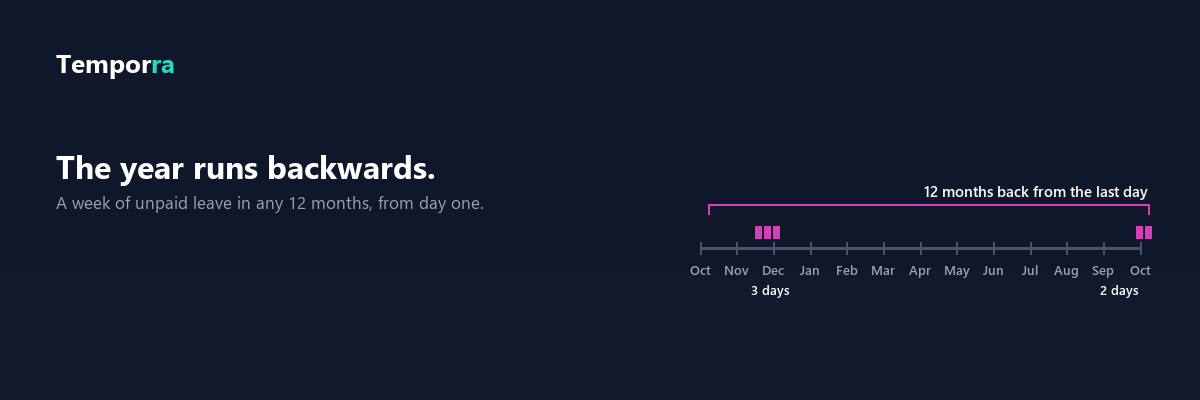
The 12 months count backwards from the last day
This is the rule that catches people. Regulation 3 defines the relevant period as a period of 12 months which ends on the last day of the carer's leave the employee has requested. It isn't the calendar year or the holiday year. For every request you stand on its last day and look back a year.
Back to the groundworker. He works a fixed five-day week, so his week of carer's leave is five days. He took Monday 17 to Wednesday 19 November 2025, booked the week before, to look after his father after a hip operation. He is now asking for Thursday 8 and Friday 9 October 2026.
| Step | Result |
|---|---|
| Last day of this request | Friday 9 October 2026 |
| 12 months back from it | Reaches into October 2025, so November 2025 is inside |
| Already taken in that window | 3 days |
| This request | 2 days, which uses the week exactly |
| A further request in December 2026 | The November days have dropped out, the October days haven't: 3 days available |
Had he asked for three days this October, only two would be carer's leave. The third would need to be holiday, unpaid leave by agreement, or time off for dependants if it genuinely was an emergency.
It's tempting to count it by leave year instead, because that's how holiday works. Doing so is safe in one direction: a fixed 12-month year can never be stricter than the rolling one, since any window that respects the rolling rule also respects a calendar year. Counting by leave year just gives away a few days now and then. Regulation 14 lets the employee take whichever of the statutory and contractual rights is more favourable, so if your contracts promise "a week per holiday year", that is what you owe. What you can't do is invent a stricter rule, such as no carer's leave during probation.
Notice: a part day counts as a day
Under regulation 7, the employee tells you the days they want, says which are part days, and says they're entitled, meaning they have a dependant with a long-term care need and want the time to provide or arrange care. The notice has to arrive before the earlier of two dates: twice as many days before the first day of leave as the number of days or part days requested, or three days before it. In plain terms, twice the length or three days, whichever gives more notice.
The words "days or part days" do real work. Acas's table turns a day and a half into four days' notice, not three, because the half day counts as a whole day. Two days needs four. Five needs ten.
The groundworker asked on Monday for Thursday. Two days of leave needs four days' notice, so the deadline was Sunday. He was a day late. Regulation 7(5) lets you waive that and treat the notice as valid, and most employers would. If you do, note that you waived it.
Two more things from regulation 7 and GOV.UK. The request doesn't have to be in writing, which is why so many of them arrive as a word at the van at half seven. And regulation 7(4) says you can't require evidence before granting the leave. No doctor's letter, no care plan, no diagnosis. Which also means there is nothing about the dependant's health you need to keep on file, so don't.
You can postpone it, not refuse it
If the timing is genuinely bad, regulation 8 lets you move the leave, but only if every one of these holds:
- you reasonably consider that the business would be unduly disrupted if the leave went ahead on those days;
- you allow the same amount of leave, starting on a date you set after consulting the employee, no later than one month after the first day they asked for;
- you give written notice stating the reason and the new dates;
- that notice reaches them as soon as reasonably practicable, and no later than seven days after their request or before the first day they asked for, whichever comes first.
GOV.UK and Acas paraphrase the test as "serious disruption". The regulation says "unduly disrupted", and that's the one a tribunal will read. A concrete pour that can't move is a reason. A short week because someone else is on holiday probably isn't.
The seven-day limit is the one that gets missed. A supervisor says "not this week, mate" on the Tuesday and nobody puts it in writing. That's not a postponement under regulation 8. It's a refusal, and there's no power to refuse.
During and after the leave
Under section 80K and regulation 9, the employee keeps the benefit of all their terms and conditions during carer's leave except remuneration, which regulation 9(3) limits to wages or salary. Holiday keeps accruing, which Acas confirms. After an isolated period of carer's leave, regulation 10 gives the right to go back to the same job.
Regulation 13 is the odd one. Where a week's pay has to be averaged over 12 weeks under Part 14 of the 1996 Act, a week in which the employee was on carer's leave and was paid less than they would have been for working is skipped, and an earlier week is used instead. So a firm working out redundancy pay needs to know which weeks had carer's leave in them. That is hard to find out a year later from a payslip.
Regulations 11 and 12 protect the employee from detriment and make a dismissal automatically unfair where the reason is that they took or sought to take carer's leave, including selection for redundancy on that basis. Acas lists what detriment can look like, and cutting someone's hours without good reason is on the list. For variable-hours staff, that's the one to watch.
Carer's leave or time off for dependants?
They are different rights, and it helps to know which one you're granting. Section 57A of the Employment Rights Act 1996 gives employees a reasonable amount of time off to deal with the unexpected: a dependant falling ill or being injured, care arrangements breaking down, a death, or an incident at a child's school. There is no notice period, only a duty to tell you the reason as soon as reasonably practicable and how long they expect to be off. It has no fixed length at all.
Carer's leave is planned. It's for a long-term care need, it has a notice rule and it's capped at a week. A 6am call because his father has had a fall is time off for dependants. The care home move, arranged days ahead, is carer's leave. Recording the first as the second eats into a week he's entitled to keep.
No duty to keep a record. Keep one anyway
Neither the Act nor the regulations prescribe a record of carer's leave, and none sets a retention period. That's different from holiday, where regulation 16B of the Working Time Regulations now requires six years of records (our guide to annual leave records covers it).
But look at what the rules above need from you. The rolling window needs every day and part day taken in the last 12 months. The variable-hours week needs 12 months of hours. A postponement needs a dated written notice. Regulation 13 needs to know which weeks had leave in them. And a detriment claim is argued from dates. So for each employee, keep:
- the date each notice arrived and the days and part days it asked for;
- that they said they were entitled, and nothing about the dependant's condition;
- the size of their week at the time of the request, and for variable hours the hours total and divisor you used;
- any late notice you waived, and any postponement notice with its reason, new dates and the date it was given;
- which days ended up as carer's leave and which were holiday, time off for dependants or unpaid leave by agreement.
How long? The regulations' own look-back is 12 months, so anything shorter breaks the entitlement check. I'd keep it with the holiday record for the same six years. It's the same absence data, it sits in the same system, and one retention rule is easier to follow than two.
Where it goes wrong
Resetting the week on 1 January and then refusing leave the rolling count would have allowed. Rarer than the reverse, but it happens when someone applies the holiday year one way and the statute the other.
Asking for a letter from the GP or the care home. Regulation 7(4) rules it out before granting the leave.
Counting a part day as half a day for notice. It counts as a day.
Measuring a variable-hours week from the contract's minimum rather than the hours actually worked, or dropping holiday weeks out of the total.
Saying "not this week" out loud and calling it a postponement.
And booking an emergency afternoon as carer's leave when it was time off for dependants, then refusing the planned day later because the week is used up.
Common questions
Is carer's leave paid?
Not by law. Carer's leave is unpaid, and GOV.UK calls it unpaid carer's leave. Acas says an employer can choose to pay for it but does not have to, so check the contract and any policy you have. The employee keeps every other term of their employment during the leave, including holiday accrual.
Does an employee need a minimum length of service to take carer's leave?
No. It is a day-one right for employees. It does not extend to workers who are not employees, so a genuinely self-employed subcontractor has no statutory right to it. The Carer's Leave Regulations 2024 apply in England, Scotland and Wales.
How much notice does an employee have to give for carer's leave?
Twice as many days as the leave requested, or three days, whichever is longer. Under regulation 7(3) a part day counts as a day, so a day and a half needs four days' notice, not three. The notice does not have to be in writing, and you can waive a late notice if you want to.
Can an employer ask for evidence before granting carer's leave?
No. Regulation 7(4) says an employer cannot require evidence before granting the leave. The employee's notice has to say that they are entitled to it, meaning they have a dependant with a long-term care need and want the time to provide or arrange care, and that statement is what you record.
Can an employer refuse carer's leave?
No, but it can postpone it. Regulation 8 allows a postponement only where you reasonably consider the business would be unduly disrupted, you allow the same amount of leave to start no later than one month after the first day requested, and you give written notice with the reason and the new dates within seven days of the request and before the leave was due to start.
How is the 12-month period for carer's leave worked out?
Backwards. Regulation 3 defines the relevant period as the 12 months ending on the last day of the carer's leave being requested. For each new request you look back 12 months from its last day and add up what has already been taken. It is not a calendar year or your holiday year.
How much carer's leave does someone on variable hours get?
One week, measured in their own hours. Regulation 6 divides the hours they are normally required to work over the period by 52, or by the number of weeks employed if that is less than a year. GOV.UK and Acas apply it as the hours worked in the 12 months before the leave, divided by 52, and Acas counts holiday and family leave in that total.
What records does an employer have to keep for carer's leave?
None are prescribed. Neither the Employment Rights Act 1996 nor the Carer's Leave Regulations 2024 sets a record duty or a retention period. In practice you need the date each notice arrived, the days and part days taken, the size of the employee's week at the time of each request, and any postponement notice, kept for at least the 12 months the entitlement looks back over.
Where hours fit in
Temporra records the hours people actually work: clock-in and clock-out against a job and a site, on a phone or a shared site tablet. There is a face check at clock-in so a colleague cannot clock in for someone who isn't there. That check is a descriptor match against a stored photo rather than a liveness test, so treat it as one control against buddy punching and not as proof of identity.
Leave requests go in digitally and a manager approves or declines them, so the request, the dates and the decision sit in the same place as the hours. That covers two of the things carer's leave needs: twelve months of hours for a variable-hours week, and a dated trail of what was asked for and when. It is not payroll software. It doesn't decide who counts as a dependant or work out anyone's carer's leave week for you, and it does not build your rota.
Related guides
- Annual Leave Records: The New Duty Nobody's Fully Explained Yet
- Neonatal care leave: counting the weeks, and the three-year pay record
- Unpaid parental leave: 18 weeks per child, from day one, and the count you'll need to keep
- Statutory Sick Pay in 2026: What You Actually Have to Record
No card needed for the trial. One flat monthly price by team size, from £39 for up to five workers, VAT included. See pricing.