 Tempor
Recording Apprenticeship Off-the-Job Training Hours Without Losing the Funding
An apprentice electrician spends Tuesdays at college and the rest of the week on the tools. That looks like solid off-the-job training on paper. Then the training provider's auditor asks for the actual record, hours, dates, what was covered, signed off by someone, and the college register turns out to prove attendance, not hours. It doesn't show whether the time fell inside paid working hours, or whether the same Tuesday has quietly been claimed against two different things. That gap between "we know roughly what happened" and "we can prove exactly what happened" is where apprenticeship funding gets clawed back. It's a UK guide to what the current rules actually require, what changed in August 2025, and how to keep the record without it becoming a second admin job.
What off-the-job training actually is
Off-the-job training is time spent learning the knowledge, skills and behaviours in the apprentice's standard, during their normal paid working hours, away from their everyday production duties. College days count. Structured online modules count. A mentoring session with a qualified assessor counts, as does the assessment itself. What doesn't count is anything that happens outside paid hours, and it doesn't count just because a skill happened to get picked up while doing the day job, because the training has to be planned and structured, not incidental.
Functional skills English and maths sit outside this altogether. They're funded and tracked separately, so a Friday afternoon spent on a maths module is additional to the training-hours total, not part of it. Mixing the two up is one of the more common ways employers overstate what's actually been delivered.
How many hours are actually required
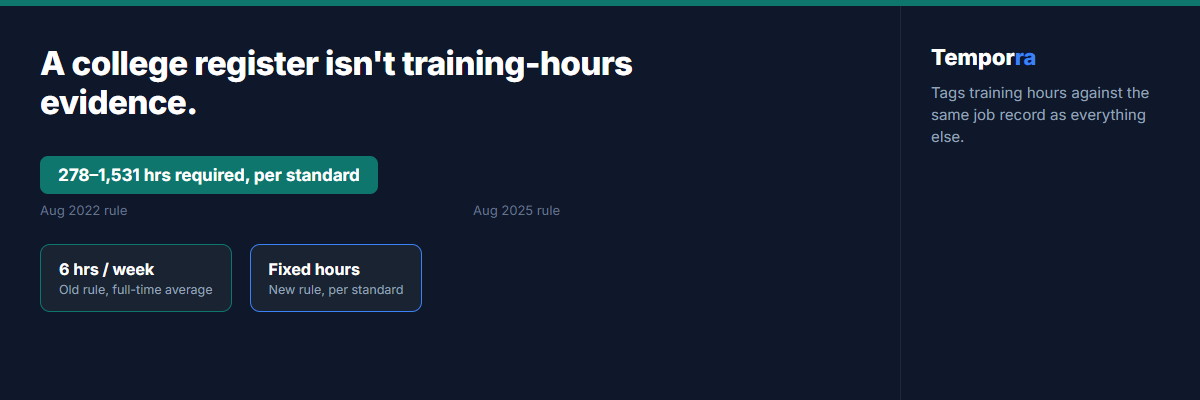
You'll still see "20% of working hours" quoted as the headline rule, and it's not wrong so much as out of date as a way to calculate anything. From 1 August 2022, the technical requirement for a full-time apprentice, defined as 30 or more hours a week, was a minimum average of 6 hours a week of off-the-job training, pro-rated down for part-time hours. That's the version most people learned and the one that's stuck in a lot of employers' heads.
It changed again for new apprenticeship starts from August 2025. Rather than a weekly average tied to programme length, each of the roughly 700 individual apprenticeship standards, the specific qualification your apprentice is working towards, now has its own fixed minimum total of off-the-job hours, shown on the standard's page on the Skills England website. Responsibility for the funding rules moved from the Department for Education to the Department for Work and Pensions on 1 April 2026, and apprentices starting from 1 August 2026 come under the 2026 to 2027 rules. Those totals range from around 278 hours on the shortest standards to well over 1,500 hours on the longest, and a provider can now deliver them across any timeframe, as long as the whole programme runs for at least eight months. The upshot for you as the employer: the weekly-hours mental model most people carry is only correct for apprentices who started before the change. Ask the training provider which rule applies to yours, and don't assume.
Part-time and shorter apprenticeships
Under the older rule, a part-time apprentice working 15 hours a week would need roughly 3 hours of off-the-job training a week, half the full-time figure, with the programme extended to give them time to fit it all in. Under the standard-specific rule, the total hours for a given standard don't move, and for starts from 1 August 2025 the provider no longer has to extend the programme automatically for a part-time apprentice. It should still plan around the hours they actually work so the weekly load is realistic, and the programme has to last at least eight months either way. Either way, the number that actually applies depends on the individual apprentice's contracted hours and their specific standard, so treat any figure you've seen quoted online, including the ones in this article, as a starting point for a conversation with the training provider rather than a number to plug straight into a spreadsheet.
What your training provider actually needs from you
The provider holds the formal evidence pack, and it's what gets checked in a funding audit, but they can only put in it what you've given them. The funding rules don't prescribe a format, which is more freedom than it sounds: timesheets, HR system exports, learning logs and college registers are all acceptable, as long as the record shows a real, quantifiable number of hours rather than a rounded estimate. "About a day a week" isn't evidence. A dated log showing start and finish times against a training activity is.
This is the same standard other guides on this site keep coming back to for ordinary hours: exact times, not an approximation, tied to what the time was actually for. The difference here is that the record has to distinguish training time from everyday work time clearly enough that someone outside your business, an auditor who has never met your apprentice, can tell the two apart at a glance.
Where this goes wrong
Treating a college timetable as proof is the most common mistake. It shows where the apprentice was supposed to be, not the hours actually delivered against the standard, and an auditor knows the difference even if nobody in the office does.
Letting training hours blur into ordinary site hours is the second. If a supervisor logs "8 hours" for a Tuesday without separating the two hours of toolbox-talk training from the six hours on the tools, the training portion effectively disappears from the record, even though it genuinely happened.
The third is assuming the old 20% figure still applies to a new starter without checking. Guidance changes; the number your apprentice's programme actually needs might be higher or lower than what you remember from the last one you took on.
Building it into your normal time-tracking
Most construction and trades employers already tag hours against a job or cost code so labour costs land against the right project. Off-the-job training can sit in the same system as its own code rather than a separate spreadsheet nobody else checks. Log the apprentice's college days, mentoring sessions and structured online learning under a dedicated training code the same way a normal shift gets logged against a site, and the hours end up in the same record as everything else: dated, timed, and pulled together in one place when the training provider asks for evidence. Temporra doesn't run the apprenticeship programme or decide what counts as off-the-job training, that's still between you and the provider, but the same clock-in-and-tag record that already separates one job from another works just as well for separating training time from site time. See our guide on tracking employee hours for how the underlying record works day to day.
Frequently asked questions
How many off-the-job training hours does an apprentice need?
It depends when they started. For apprentices who began before the August 2025 changes, the usual rule was a minimum average of 6 hours a week for a full-time apprentice working 30 or more hours a week, pro-rated down for part-time hours. For new starts from August 2025, the Department for Education set a fixed total hours figure for each individual apprenticeship standard instead, which your training provider will confirm for the specific standard your apprentice is on.
What actually counts as off-the-job training?
Learning that develops the knowledge, skills and behaviours set out in the apprenticeship standard, delivered within the apprentice's normal paid working hours and away from their everyday production duties. College days, structured online modules, mentoring sessions and assessments all count. Routine site work that happens to teach something in passing doesn't, and neither does anything done outside paid hours.
Does English and maths tuition count towards the hours?
No. Time spent on functional skills English and maths is funded and tracked separately from off-the-job training hours. It's additional to the minimum, not part of it, so don't count a Friday afternoon of maths towards the training-hours total.
What changed with the August 2025 apprenticeship funding rules?
The Department for Education moved away from calculating hours as a percentage or weekly average of programme length, and instead published a fixed minimum total of off-the-job training hours for each of the roughly 700 apprenticeship standards. Those totals range from around 278 hours for the shortest standards up to well over 1,500 hours for the longest, and providers can now deliver them over whatever timeframe suits the apprentice, as long as the programme runs for at least eight months.
What evidence do we actually need to give our training provider?
Quantifiable records showing the number of hours actually delivered, matched against what was planned. The funding rules don't prescribe a format, so timesheets, HR system exports, learning logs and registers are all acceptable, provided they show real hours rather than an estimate. Your training provider holds the formal evidence pack for audit, but they can only include what you give them.
What happens if the hours can't be evidenced?
The apprenticeship funding for that learner is at risk of being recovered, because the training provider can't prove the delivery it was paid for. That's a shared problem: the provider gets audited, but you're the one holding the day-to-day evidence they need to pass that audit.
Do part-time apprentices need fewer hours?
Under the pre-August-2025 rule, yes, the weekly average was pro-rated to the apprentice's actual working hours. Under the new standard-specific rule, the total hours required for the standard stay fixed, and for starts from 1 August 2025 the provider no longer has to extend the programme automatically for a part-time apprentice, though it should plan the training around the hours they work. Ask your training provider how long the programme will run and how much training that means each week.
Related guides
- Young workers: the hours limits, and what you have to record
- National Minimum Wage: The Records HMRC Actually Checks
- How to Track Employee Hours: A UK Small-Business Guide
- Working Time Regulations: The 48-Hour Week, Opt-Outs and Rest Breaks
Start a free 14-day trial · Book a demo
No card required. Flat monthly pricing by team size, every feature on every tier — see pricing.