 Tempor
Young workers: the hours limits, and what you have to record
A sixth-former takes a Saturday job in a shop and picks up a few evenings in a kitchen on the side. Neither employer knows about the other. Both are running a rota that would be perfectly legal if the person on it were nineteen, and between them they have probably broken a hard statutory ceiling that nobody can opt out of.
None of the rules below are hard to follow. They are just not the rules most managers have in their heads, because the ones in their heads are the adult ones.
Who this actually covers
The Working Time Regulations 1998 split workers into three groups, not two, and the middle one is easy to miss.
An adult worker, under regulation 2(1), is anyone who has reached 18. A young worker is somebody who has reached 15 but not 18 and who is over compulsory school age, which in England and Wales is read against section 8 of the Education Act 1996 and in Scotland against section 31 of the Education (Scotland) Act 1980. Anybody below that is a child, and children are not covered by these regulations at all.
So the dividing line is not a birthday, it is the school leaving date. In England that is the last Friday in June, for anyone who will be 16 by the end of the summer holidays. The Monday after that, a person who was a child on the Friday is a young worker, and a completely different set of rules starts applying to your rota.
One more thing worth knowing before you plan anyone's hours. In England, a young person has to stay in education or training until they are 18, which can mean college, an apprenticeship, or 20 hours or more a week of work or volunteering alongside part-time education or training. Their Tuesday evening is not necessarily free just because they have left school.
Eight a day and 40 a week, with nothing to average against
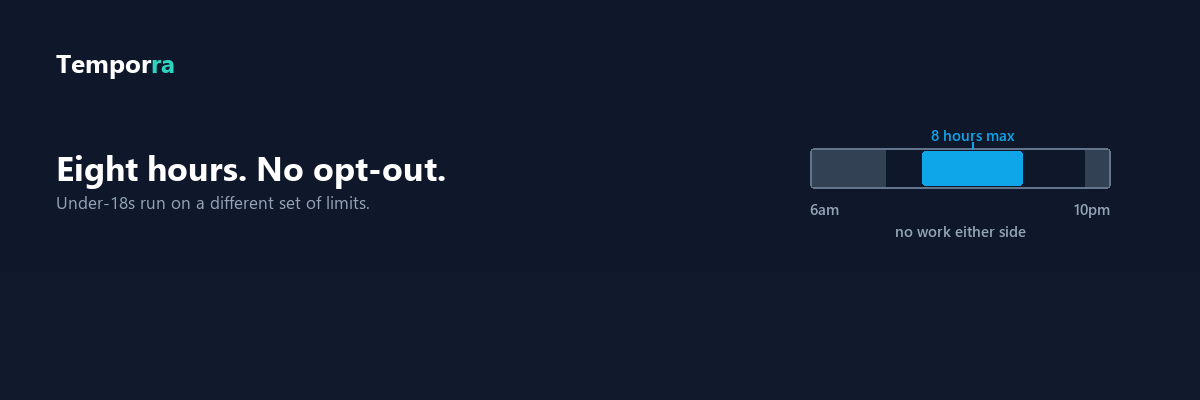
Regulation 5A is short and it is absolute. A young worker's working time shall not exceed eight hours a day, or 40 hours a week. The week starts at midnight between Sunday and Monday.
Compare that with the adult regime for a moment, because the difference is the whole point. The 48-hour limit in regulation 4(1) is an average across a 17-week reference period, which is why a busy fortnight is not automatically a problem, and an individual can agree in writing to disapply it entirely. We went through all of that in the piece on the 48-hour week and the opt-out.
None of it transfers. There is no averaging in regulation 5A, so a nine-hour Thursday is a breach on Thursday even if Friday is a half day. And there is no opt-out, because the only opt-out in the regulations is written into regulation 4(1), and it lifts the adult 48-hour average and nothing else.
What there is instead is regulation 27A, and it is narrower than most people expect. All three of its conditions have to be met at the same time: the work has to be necessary either to maintain continuity of service or production or to respond to a surge in demand, no adult worker can be available to do it, and doing it must not adversely affect the young worker's education or training. Cover for a no-show on a Friday night, when there is a full-time member of staff at home who could come in, is not that.
Regulation 5A(4) then puts the obligation on you rather than on them. The employer shall take all reasonable steps, in keeping with the need to protect health and safety, to ensure the limits are complied with. Not record. Ensure.
The second job counts, and you are expected to have asked
This is the provision that turns a tidy rota into a breach without anybody doing anything wrong.
Regulation 5A(2) says that if a young worker is employed by more than one employer on any day or in any week, their working time is worked out by aggregating the hours worked for each employer. The same aggregation appears again at regulation 12(5) for the rest break.
Read that as an employer and it is uncomfortable, because you cannot see the other rota. In practice the only workable answer is to ask at the point of hiring, write down the answer, and ask again when the pattern changes. It is not a perfect control. It is considerably better than finding out in an investigation that you never raised the subject.
Nights are a prohibition, not a limit
For adults, night work is restricted. For young workers it is banned outright, and the wording of regulation 6A leaves no room: an employer shall ensure that no young worker employed by him works during the restricted period.
The restricted period is defined at regulation 2(1) as 10pm to 6am. Where the contract provides for work after 10pm, it shifts to 11pm to 7am. Note what that second limb does. It does not create a general permission to work until 11; it moves the window, so the morning end moves with it.
Regulation 27A carves out two groups, and only in the same circumstances as before. Hospitals and similar establishments, and work connected with cultural, artistic, sporting or advertising activities, are released from 6A entirely. Agriculture, retail trading, postal or newspaper deliveries, a catering business, a hotel, public house, restaurant or bar or similar establishment, and a bakery are released from it except so far as it prohibits work between midnight and 4am. Those four hours stay shut.
And when the exclusion does apply, two obligations attach. The young worker has to be supervised by an adult worker where supervision is necessary for their protection, and they have to be allowed an equivalent period of compensatory rest.
The assessment almost nobody does
Regulation 7(2) is short, specific and widely ignored.
Before you assign a young worker to work during the restricted period, you have to have made sure they will have the opportunity of a free assessment of their health and capacities, and each young worker already assigned to it has to have the opportunity again at whatever intervals are appropriate. Regulation 7(3) defines free as at no cost to the worker, which rules out the arrangement where they pay and you reimburse later.
There is one exception, at regulation 7(4): it does not apply where the work assigned is of an exceptional nature. And there is a confidentiality rule at 7(5) that people breach casually. You may not disclose the assessment to anyone other than the worker it relates to, unless they have consented in writing, or unless what you are disclosing is confined to a statement that it found them fit to take up or continue the assignment.
Rest: twelve, forty-eight, thirty
Every rest entitlement is longer for a young worker, and they are easy to trip over on a split shift.
Daily rest under regulation 10(2) is twelve consecutive hours in each 24-hour period, against eleven for an adult. It may be interrupted where the work is split up over the day or is of short duration, which is regulation 10(3), and that is the only give in it. A shift finishing at 9pm and starting again at 8am the next morning is eleven hours, which is fine for a 19-year-old and not fine for a 17-year-old.
Weekly rest under regulation 11(3) is 48 hours in each seven-day period, against 24 for an adult. It can be reduced where there are technical or organisation reasons, but regulation 11(8) puts a floor under that at 36 consecutive hours, and it can be interrupted for split or short-duration work.
The break is the one that shows up most often on a shop or kitchen rota. Regulation 12(4): where a young worker's daily working time is more than four and a half hours, they are entitled to a rest break of at least 30 minutes, consecutive if possible, and to spend it away from their workstation. An adult gets 20 minutes after six hours. So a five-hour Saturday shift needs a proper half-hour break, and a five-hour shift for the person standing next to them does not. We covered the general version of this, and the way unpaid breaks go wrong, in recording breaks correctly.
Still at school is a different regime entirely
If the person is under compulsory school age, put the Working Time Regulations down. None of the above applies to them, and what does apply comes from local authority byelaws.
GOV.UK's guidance on child employment sets the shape. Children can work part-time from 14, and from 13 in some council areas. Many councils require an employment permit issued by the education department, and where local byelaws require one it is not optional. No work during school hours, none before 7am or after 7pm, and no more than four hours without a break of at least an hour.
The weekly totals are lower than most employers assume. In term time it is 12 hours a week, made up of two hours on school days and Sundays and five hours on a Saturday at 14, or eight hours at 15 to 16. In the school holidays it is 25 hours a week at 14 and 35 at 15 to 16. There is also a requirement for a two-week break from any work during the school holidays in each calendar year, which almost nobody rosters for.
Factories and industrial sites are out, except as part of work experience, and separately the Management of Health and Safety at Work Regulations 1999 put their own restrictions at regulation 19 on the kind of work any young person can be given.
What regulation 9 makes you keep
The record-keeping duty was rewritten on 1 January 2024 by the Employment Rights (Amendment, Revocation and Transitional Provision) Regulations 2023, and the new wording names young workers directly.
Regulation 9(1)(a) requires records adequate to show whether you have complied with the limits in regulations 4(1), 5A(1) and 6(1) and (7), and the requirements in regulations 6A and 7(1) and (2). In plain terms, that is the adult 48-hour average, the young worker's eight and 40, the night work limits, the night work prohibition, and the health and capacities assessments. Four of those five are young worker duties or apply to them.
Regulation 9(1)(b) sets the retention period at two years from the date the record was made. That is shorter than most of the numbers on this site, and it is the one that catches people out in the other direction: minimum wage records run to six years, and so does the holiday record-keeping duty introduced in April 2026. Keeping the working time record for two and binning it is technically compliant and practically a mistake, because the same shift is evidence for all three.
Two useful clauses came in with the same amendment. Regulation 9(2) says the records may be created, maintained and kept in whatever manner and format the employer reasonably thinks fit, so there is no prescribed form. And regulation 9(3) says you need not record each worker's daily working hours if you can demonstrate compliance without doing so.
Which sounds like relief until you try to use it. For a salaried adult on fixed shifts, demonstrating compliance without daily hours is straightforward. For a 17-year-old on a variable rota who also works somewhere else, with a ceiling that bites per day rather than on average, there is no way to show compliance except by knowing what time they started and what time they stopped.
Where it goes wrong
Almost never at the point of writing the rota. It goes wrong in the gap between the rota and what happened.
The common one is the extra hour. A shift is rostered as seven and a half, somebody is short, and the 17-year-old stays until the delivery is put away. That is a breach of a hard limit and it will be recorded, if it is recorded at all, as the rostered seven and a half.
The second is the summer. A student picks up full-time hours in August, everybody treats it as a normal week, and 40 arrives on Thursday afternoon rather than Friday evening.
The third is the one you cannot see from inside your own business, which is the other employer, and the only defence against it is having asked and written down the answer.
Common questions
How many hours can a 17-year-old work?
Eight in a day and 40 in a week, and those are ceilings rather than averages. Regulation 5A of the Working Time Regulations 1998 says a young worker's working time shall not exceed eight hours a day, or 40 hours a week, with the week starting at midnight between Sunday and Monday. The adult 48-hour limit is an average over 17 weeks, so a heavy week can be balanced by a light one. This is not. Nine hours on Thursday is a breach on Thursday, whatever the rest of the week looks like.
Can a young worker sign an opt-out like an adult can?
No. The opt-out agreement is written into regulation 4(1), which is the adult 48-hour average, and there is no equivalent written into regulation 5A. The only route past the eight and 40 is regulation 27A, and it needs three separate conditions to hold at once: the work is necessary to maintain continuity of service or production or to meet a surge in demand, no adult worker is available to do it, and doing it would not adversely affect the young worker's education or training. That is an emergency door, not a piece of paperwork you get signed on day one.
Do hours worked for another employer count?
Yes, and this is the one that catches people. Regulation 5A(2) says that where a young worker is employed by more than one employer, working time is determined by aggregating the hours worked for each of them. The same aggregation applies to the 30-minute break under regulation 12(5). A sixth-former doing Saturdays in your shop and three evenings in a restaurant is one worker with one weekly total, and you are expected to have asked.
Can an under-18 work nights?
Not as a rule. Regulation 6A says an employer shall ensure that no young worker works during the restricted period, which regulation 2(1) defines as 10pm to 6am, or 11pm to 7am where the contract provides for work after 10pm. It is a prohibition, not a limit. Regulation 27A lifts it for some sectors in the narrow circumstances described above, but for retail, catering, hotels and bars, agriculture, bakeries and postal or newspaper deliveries the ban between midnight and 4am still stands even then.
What is the health assessment for night work?
Regulation 7(2) says that before you assign a young worker to work during the restricted period, you have to make sure they have had the opportunity of a free assessment of their health and capacities, and then at appropriate intervals afterwards. Free means at no cost to the worker. It does not apply where the work is of an exceptional nature. And the assessment itself is confidential: regulation 7(5) stops you disclosing it to anybody but the worker, beyond a bare statement that it found them fit.
What rest does an under-18 get that an adult does not?
Three things, all longer. Daily rest is twelve consecutive hours in each 24-hour period instead of eleven, under regulation 10(2). Weekly rest is 48 hours in each seven-day period instead of 24, under regulation 11(3), and it can only be cut for technical or organisation reasons and never below 36 consecutive hours. And the break is 30 minutes once daily working time passes four and a half hours, instead of 20 minutes after six, with the right to take it away from the workstation.
Does any of this apply to a 15-year-old on a Saturday job?
Not these rules. A young worker under the Working Time Regulations is someone aged 15 to 17 who is over compulsory school age. Somebody still at school is a child, and children sit under local authority byelaws and a permit system instead. GOV.UK's summary is that children can work part-time from 14, from 13 in some council areas, never during school hours, never before 7am or after 7pm, no more than four hours without an hour's break, and a maximum of 12 hours a week in term time. Those rules are enforced by your council's education department, not by the Working Time Regulations.
What records do I actually have to keep, and for how long?
Regulation 9 was rewritten on 1 January 2024 and it now names the young worker duties directly. You must keep records adequate to show whether you have complied with the limits in regulations 4(1), 5A(1) and 6(1) and (7) and the requirements in regulations 6A and 7(1) and (2), and retain them for two years from the date they were made. The format is up to you. Regulation 9(3) says you need not record daily hours if you can demonstrate compliance without doing so, which for a salaried adult on fixed days is easy and for a 17-year-old on a variable rota is not.
Where hours fit in
Temporra records the hours people actually worked rather than the hours somebody planned: clock-in and clock-out, against a job and a site, with a face check at the point of clocking in so a colleague cannot do it for someone who is not there. That check is a descriptor match against a stored photo rather than a liveness test, so treat it as one control against buddy punching and not as proof of identity.
It does not run payroll, it does not build your rota, and it does not decide anybody's age category for you. What it does is put a timestamp on the moment the shift started and the moment it ended, which is the only thing regulation 9 can actually be satisfied with when the limit is eight hours in a day.
Related guides
- Working Time Regulations: The 48-Hour Week, Opt-Outs and Rest Breaks
- Night workers: the eight-hour limit nobody can opt out of, and what to record
- Recording Apprenticeship Off-the-Job Training Hours Without Losing the Funding
- Recording Breaks Correctly: Why an Unpaid Break Nobody Took Still Costs You
No card needed for the trial. One flat monthly price by team size, from £39 for up to five workers, VAT included. See pricing.