 Tempor
Unpaid parental leave: 18 weeks per child, from day one, and the count you'll need to keep
An electrician's mate who started with you on 3 August asks on Friday 2 October for the week of 26 October off. It's half-term, her son's school is shut and the childminder who'd normally have him is away. Until this spring the answer was simple. She hadn't done a year, so she had no right to parental leave, and you could call the week holiday or say no. Since 6 April 2026 she has the right from her first day.
The timing is awkward too. Half-term is when school refurbishment gets done, and your firm is booked into a primary school that week to finish the second fix before the pupils come back on Monday 2 November.
Unpaid parental leave has been law since 1999. Three changes since then matter here, and a staff handbook written before April 2026 gets at least one of them wrong. One written before 2013 gets all three. This guide is about the counting: 18 weeks per child, four a year, whole weeks only, and a postponement rule with a seven-day fuse. None of it has to be written down by law. Very little of it can be done without writing it down.
What changed on 6 April 2026
Section 15 of the Employment Rights Act 2025 deleted the qualifying-service condition from section 76 of the Employment Rights Act 1996, the section that tells the government to make parental leave rules. The matching cut to regulation 13 of the Maternity and Parental Leave etc. Regulations 1999 came from SI 2026/15. Both came fully into force on 6 April 2026 under the Employment Rights Act 2025 (Commencement No. 1) Regulations 2026 (SI 2026/3), and employees could give notice from 18 February so that leave starting in April could be booked ahead.
What's left is regulation 13 on its own. An employee qualifies if they have, or expect to have, responsibility for a child: parental responsibility (parental responsibilities in Scotland), or being registered as the child's father. GOV.UK's guide to unpaid parental leave fills in the edges. Workers, agency workers and contractors aren't covered, and nor is a foster parent unless they've secured parental responsibility through the courts. The rules apply in England, Scotland and Wales.
On a building site that boundary decides a lot. A self-employed subcontractor paid under CIS has no statutory right to parental leave whatever their family looks like. Your directly employed electrician's mate has it from the morning she starts.
Three dates that make an old handbook wrong
| Rule | What an old policy may say | The law now | Changed on |
|---|---|---|---|
| Weeks per child | 13 (18 for a disabled child) | 18 for every child | 8 March 2013 |
| Age limit | Before the fifth birthday (18th for a disabled child) | Before the 18th birthday | 5 April 2015 |
| Service needed | One year | None | 6 April 2026 |
The 18 weeks came from SI 2013/283, the age limit from SI 2014/3221 and the day-one right from the 2025 Act. A policy that still says "13 weeks" or "children under five" tells your staff they have less than the law gives them. Fix the wording before somebody relies on it.
18 weeks per child, and the weeks follow the child
Regulation 14 gives 18 weeks' leave "in respect of any individual child". Two children means 36 weeks, which is the figure Acas uses for a parent of twins. Each parent has their own 18 for the same child, because the right belongs to the employee.
The weeks also follow the child from one job to the next. GOV.UK says parental leave "applies to each child, not to an individual's job", and its example is someone who used 10 weeks with a previous employer and can take 8 with the new one.
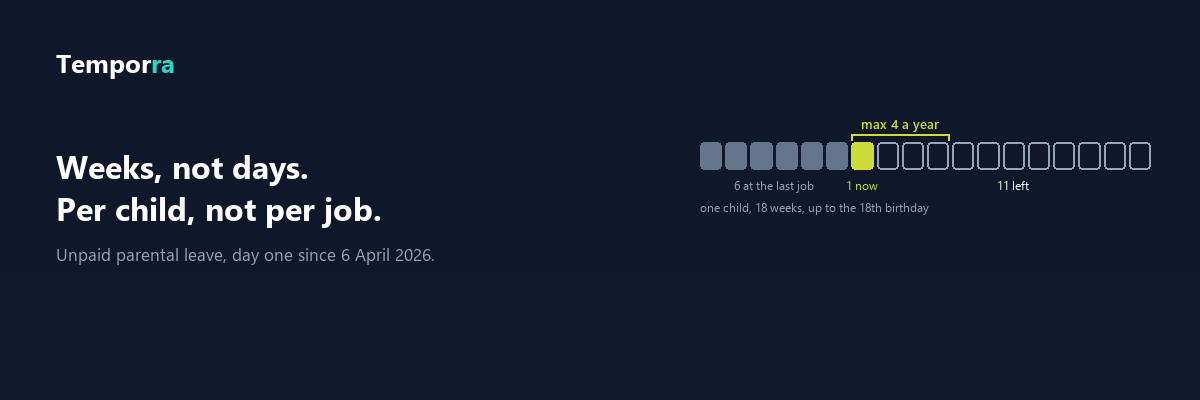
Our electrician's mate says she took six weeks for her son at her last job, all of them before March this year. That leaves her 12. She has a daughter too, born in November 2023, whose 18 weeks are untouched. So the first two things to write down are which child this week is for, and what she told you about the old job, with the date she told you.
Why the second? Because you can't check it. Schedule 2 lets you ask for evidence that she's responsible for the child and of the child's date of birth. It says nothing about proving what was taken somewhere else, and her old employer owes you no answer. Her word is the record. If it later turns out to be wrong, a dated note of what she said shows you counted in good faith.
Four weeks a year, and which year that is
Under the default rules in Schedule 2, paragraph 8 caps the leave at four weeks per child in any year. Paragraph 9 decides what "year" means, and it isn't the calendar year or your holiday year. It's the 12 months beginning on the date the employee first became entitled to parental leave for that child, then each 12 months from that anniversary.
Acas gives a child's birth or adoption as the usual start. Take that for her son, born on 14 March 2019, and the years run from 14 March to 13 March. The October week sits in the year that began on 14 March 2026. Nothing has been taken in it yet, so this is week one of four, and she could have three more between now and 13 March 2027.
She's a new starter with an older child, though, and that's where it gets murky. Until April, paragraph 9 had a second limb that restarted the year after a break in continuous employment. The 2026 regulations deleted it along with the one-year rule, and nothing replaced it. Read literally, the year runs from the date she first became entitled for that child, which may have been at a previous job. The regulations don't settle it more clearly than that, and GOV.UK doesn't try.
The safe direction is the generous one. GOV.UK says the four-week limit applies "unless the employer agrees otherwise", and regulation 21 lets an employee take whichever of a contractual and a statutory right is better in any particular respect. Starting the year on a date that allows more leave can't put you on the wrong side of these rules. Pick the date, write down which one you used and why, and apply the same rule to everyone.
A week means her week, and it comes whole
Paragraph (2) of regulation 14 makes a week's leave the length of the employee's normal working week. She works Monday to Thursday, so a week of parental leave for her is four days, 26 to 29 October. GOV.UK's own example is a three-day worker whose week of leave is three days.
Where hours vary, paragraph (3) takes the total the employee is normally required to work in a year and divides it by 52. GOV.UK does the same sum with days. A labourer who normally works 1,716 hours a year has a parental leave week of 33 hours. One who works 213 days a year has a week of about 4.1 days. Neither sum is possible without a year of that person's hours.
Paragraph 7 of Schedule 2 then says the leave comes in whole weeks, or multiples of a week. The one exception is a child entitled to disability living allowance, personal independence payment or armed forces independence payment. For that child the leave can be taken in shorter pieces (Acas says days or hours), and regulation 14(4) adds the pieces up until they make a week.
A single day for a sick child or a childminder who's let you down belongs somewhere else, usually time off for dependants under section 57A, which our carer's leave guide compares with planned leave. If you agree to let someone take parental leave a day at a time anyway, that's a contractual extra on top of the default rules. Count the days and fold them into weeks the way regulation 14(4) does, or the 18 drifts.
Notice, and what "inspection" means
Paragraph 3 asks for at least 21 days' notice of the dates the leave will start and end. GOV.UK says it doesn't have to be in writing unless you ask for that. Her request on 2 October for leave from 26 October is 24 days ahead, so it's in time.
Two cases run off a different date. A father who wants leave to start on the day his child is born gives notice 21 days before the expected week of childbirth, stating that week and how long he'll be off. Leave that starts on the day an adoption placement begins needs notice 21 days before the expected week of placement, or as soon as reasonably practicable if that can't be done.
Evidence works on request. Paragraph 1 says the employee has to produce it "for the employer's inspection": proof of responsibility for the child, and the child's date of birth or the date the placement began. Nothing in it asks you to keep a copy. Note that you saw a birth certificate, the date of birth on it and the day you saw it, then hand it back. GOV.UK adds that you can't ask for proof every time someone books leave.
Postponing it: six months, seven days, in writing
There's no power to refuse parental leave. You can postpone it, but only inside paragraph 6 of Schedule 2, and every part has to hold:
- you consider that the operation of the business would be unduly disrupted if the leave went ahead on those dates;
- you allow the same length of leave, starting on a date you set after consulting the employee, no later than six months after the date it was due to start, and ending before the child's 18th birthday;
- you give written notice stating the reason and the new start and end dates;
- that notice is given no more than seven days after the employee gave theirs.
Leave a father has booked to start on the birth, or an adopter on the placement, can't be postponed at all. GOV.UK describes the test as needing a "significant reason", such as serious disruption. The regulation's words are "unduly disrupted", and those are the words that get argued over.
Back to the school job. The second fix has to be finished by Friday 30 October and she's one of two people on it. On Monday 5 October her supervisor talks it through with her. On Wednesday 7 October the firm writes to her: the leave is postponed because the school contract has to finish over half-term, and her week now runs from Monday 21 to Thursday 24 December. Christmas is a school holiday as well, so she gets a week she can actually use. Given the word "unreasonably" in section 80, below, I'd much rather defend that than a week in the middle of term. The deadline for that letter was Friday 9 October. Sent a week later, it isn't a postponement under paragraph 6 and her original dates stand.
From 1 October 2026, six months to claim
Section 80 of the Employment Rights Act 1996 lets an employee complain to an employment tribunal that you unreasonably postponed their parental leave, or prevented or tried to prevent them taking it. A supervisor who tells her the week is off the table, and never writes anything down, has done the second. If the tribunal agrees, it makes a declaration and can award whatever compensation it thinks just and equitable, looking at how you behaved and at what the employee lost.
The time limit for that complaint was three months. It's six for anything that happens on or after 1 October 2026. Section 152 of the Employment Rights Act 2025 and Schedule 12 to that Act did it, brought into force by SI 2026/954, and paragraph 4(22) of the schedule changes section 80 by name. Early conciliation through Acas can stretch the limit further. Six months is a long time to remember why a week was moved. The written postponement notice, with its reason in it, does the remembering.
While she's off, and when she's back
Regulation 17 is shorter for parental leave than people expect. During the leave the employee keeps the benefit of the implied duty of trust and confidence, and of any terms about notice, redundancy compensation and disciplinary or grievance procedures. They stay bound by good faith and by terms on notice, confidential information, gifts and working for another business. That's the whole list. There's no pay unless your contract provides it, which Acas notes some employers do. Statutory holiday keeps building up, and Acas confirms that too.
Coming back depends on how long they were away. Regulation 18 gives the right to return to the same job after an isolated period of parental leave of four weeks or less. After more than four weeks it's the same job or, if that isn't reasonably practicable, another job that's suitable and appropriate. Either way regulation 18A brings them back with seniority, pension rights and similar rights as if they'd never gone, on terms no worse than before. Acas points out that someone with two children can take more than four weeks in one go. Where parental leave follows straight on from maternity, paternity, adoption or shared parental leave, the right changes again. So the length of each period, and what came before it, both belong in the record.
Regulations 19 and 20 protect anyone who takes or asks to take parental leave from detriment, and make a dismissal for that reason automatically unfair, including picking them for redundancy because of it. Acas's examples of detriment include turning down training requests and cutting hours without good reason. On variable hours, watch the second one in the weeks after someone comes back.
One narrow rule applies if you pay something during the leave. Where a week's pay has to be averaged over 12 weeks under Part 14 of the 1996 Act, regulation 22 skips any week of parental leave that was paid at less than the normal rate and reaches back to an earlier week instead. You can only do that if you know which weeks they were.
The count nobody makes you keep
Nothing in the 1996 Act or the 1999 Regulations requires a record of parental leave, and nothing sets a retention period. Holiday is different: regulation 16B of the Working Time Regulations now asks for six years, which our guide to annual leave records covers.
Yet every rule above needs a number you'd otherwise be guessing. For each employee, and for each child, keep:
- which child, the date of birth or placement you saw, and the date you saw the evidence;
- each period of leave taken with you, with start and end dates, and whether it ran past four weeks;
- what the employee told you about leave taken for that child elsewhere, and when they told you;
- the date you used to start the four-week year, and why;
- the size of their week at the time, and for variable hours the total and the divisor;
- the date each notice arrived, and any postponement letter with its date, reason and new dates.
How long for? The count stays live until the child turns 18, which for her son is 14 March 2037. Keep it for as long as she works for you. When she leaves, keep it at least until the six-month tribunal limit has run, under the same retention rule you already use for leavers, rather than inventing a new one.
Common questions
Is unpaid parental leave a day-one right?
Yes, since 6 April 2026. Section 15 of the Employment Rights Act 2025 removed the one-year qualifying period, and regulation 13 of the Maternity and Parental Leave etc. Regulations 1999 now only asks that the employee has, or expects to have, responsibility for the child. It covers employees. Workers, agency staff and self-employed contractors don't get it.
How much unpaid parental leave can an employee take?
18 weeks for each child, up to the child's 18th birthday. Under the default rules in Schedule 2 that is no more than four weeks per child in any year, taken in whole weeks. A week is the employee's own working week, so for someone who works three days it is three days. The leave is unpaid unless the contract says otherwise.
Does parental leave taken with a previous employer count towards the 18 weeks?
Yes. The entitlement is per child, not per job. GOV.UK's example is an employee who used 10 weeks with a previous employer and can take up to 8 with the new one. Nothing lets you demand proof of leave taken elsewhere, so record what the employee tells you and the date they told you.
Can parental leave be taken as single days?
Not under the default rules, unless the child is entitled to disability living allowance, personal independence payment or armed forces independence payment. Otherwise it is taken in whole weeks. An employer can agree something more flexible, and a single day for an emergency is usually time off for dependants instead.
How much notice does an employee have to give for parental leave?
At least 21 days before the leave starts, giving the start and end dates. A father taking leave from the birth gives notice 21 days before the expected week of childbirth. Leave from the start of an adoption placement needs notice 21 days before the expected week, or as soon as reasonably practicable. GOV.UK says the notice need not be in writing unless the employer asks for that.
Can an employer refuse or postpone parental leave?
It cannot refuse it. It can postpone it where the business would be unduly disrupted, but only for the same length of leave, starting no more than six months after the requested start and ending before the child's 18th birthday, with written notice of the reason and the new dates no more than seven days after the employee's notice. Leave booked to start on a birth or an adoption placement cannot be postponed.
What is the time limit for a tribunal claim about parental leave?
Six months where the postponement or refusal happened on or after 1 October 2026, when Schedule 12 to the Employment Rights Act 2025 came into force. Before that it was three months. The claim is made under section 80 of the Employment Rights Act 1996, that the employer unreasonably postponed the leave or prevented or tried to prevent it.
What records does an employer have to keep for parental leave?
None are prescribed. Neither the Employment Rights Act 1996 nor the 1999 Regulations sets a record duty or a retention period. In practice you need, for each child, the weeks taken with you and when, what the employee said about leave taken elsewhere, the date the four-week year starts, the size of their week, and any written postponement notice.
Where hours fit in
Temporra records the hours people actually work: clock-in and clock-out against a job and a site, on a phone or a shared site tablet. That gives you a year of hours to work a variable-hours week out from. There's a face check at clock-in so a colleague can't clock in for someone who isn't there. It's a descriptor match against a stored photo rather than a liveness test, so treat it as one control against buddy punching and not as proof of identity.
Leave requests go in digitally and a manager approves or declines them, so what was asked for and what was decided sit next to the hours. It doesn't keep the per-child count for you. It won't know which child a week was for, what someone took at a previous job or when their four-week year starts, so keep those alongside. It isn't payroll software (it exports hours to yours), and it doesn't build your rota.
Related guides
- Carer's leave: one week in any 12 months, and the record you'll need to prove it
- Neonatal care leave: counting the weeks, and the three-year pay record
- Maternity pay records: what you must keep, and for how long
- Annual Leave Records: The New Duty Nobody's Fully Explained Yet
No card needed for the trial. One flat monthly price by team size, from £39 for up to five workers, VAT included. See pricing.