 Tempor
Protecting your CIS gross payment status (0% deduction): how verified labour vs materials records stop a 20% cash-flow shock
Invoice a main contractor for £25,000 of labour under standard 20% CIS and £5,000 is held back at source before you pay a single Friday wage. With Gross Payment Status (0%), the full £25,000 lands in your bank account. Here is how clean, verified site labour records help you pass HMRC's £30,000/£100,000 net labour turnover test and protect your 0% status.
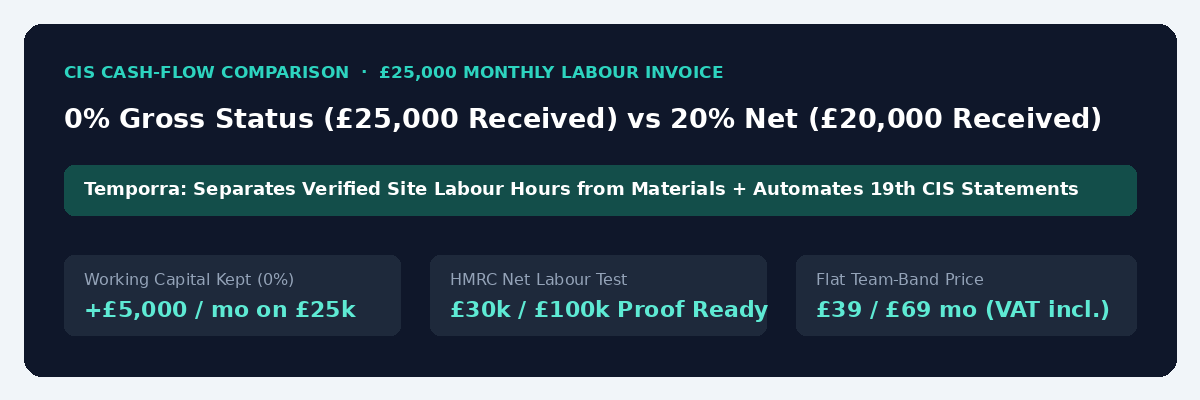
If your electrical, plumbing, or building company operates as a subcontractor to main contractors, holding HMRC Gross Payment Status (0 per cent deduction) is the single biggest cash-flow advantage in the trade. Invoice a main contractor for £25,000 of labour under standard 20 per cent CIS and only £20,000 lands in your bank account; the other £5,000 disappears to HMRC before you have even paid your own lads’ Friday wages. Across a year, that is £60,000 of your own working capital locked away until your year-end tax offset. With Gross Payment Status, the full £25,000 hits your account every month.
The catch is that getting Gross Payment Status, and keeping it when HMRC runs its automated annual compliance review, depends on two things that paper timesheets and sloppy Word invoices regularly ruin: proving your qualifying labour turnover (excluding VAT and materials) sits cleanly above HMRC’s £30,000 to £100,000 thresholds, and never missing your own 19th of the month CIS returns and PAYE deadlines. We built Temporra alongside STF Electrics so every hour your crew clocks on site turns into a clean, verifiable labour record and an on-time monthly CIS statement.
How unseparated labour and materials mess up both your CIS deduction and your £30k/£100k turnover test
To qualify for Gross Payment Status under HMRC’s Construction Industry Scheme rules, you have to pass the turnover test over the previous twelve months. A sole trader needs at least £30,000 of net construction turnover. A partnership or limited company needs either £30,000 per partner or relevant director/shareholder, or £100,000 of total net construction turnover.
Here is what trips contractors up: HMRC calculates that qualifying turnover strictly on the labour element after stripping out VAT and the direct cost of materials. If you invoiced £48,000 over a period and £14,000 of that was cable, consumer units, and containment, your qualifying CIS labour turnover is £34,000, not £48,000.
It cuts the other way while you are still on standard 20 per cent CIS deductions too. If you send a main contractor a rushed lump-sum invoice on Friday evening that does not clearly split your verified site labour from your materials, the main contractor’s accounts team is legally required to apply the 20 per cent CIS deduction to the entire invoice, deducting 20 per cent tax off the copper cable and switchgear you already paid your wholesaler full price for.
Lump-sum spreadsheet invoices vs Temporra verified labour & CIS records
Look at the cash-flow difference for an eight-worker UK electrical or building firm billing £25,000 a month of site labour plus £10,000 a month of materials:
| Where cash flow leaks | WhatsApp hours & lump-sum Word/Excel invoices | Temporra (£69/mo flat 6–10 worker band, VAT incl.) |
|---|---|---|
| 20% CIS deducted on £25k/mo labour vs 0% Gross Status | £5,000/month (£60,000/yr) held back at source by main contractors | Keep 100% of your cash flow by qualifying for and protecting Gross Payment Status |
| Unseparated labour on a £10k materials invoice | Main contractor deducts 20% CIS off your materials too = £2,000 cash flow lost | Itemised labour invoices generated straight from clocked hours keep labour 100% separate from materials |
| Proving £30k / £100k qualifying labour turnover to HMRC | Weeks spent digging through bank statements and guessed Friday texts | Every labour hour is tied to a worker, a date, a job site, and a GPS + Face ID / Kiosk timestamp |
| Missing the 19th CIS return or 22nd payment deadline | Risk losing Gross Payment Status for 12 months (or a 5-year ban under the April 2026 fraud rules) | 10-minute Friday & 19th exports for CIS statements, Sage, Xero, QuickBooks, and BrightPay |
| Annual software cost | £0 on paper, tens of thousands trapped in deductions | £828 / year (£69/month flat, UK VAT included) |
Why the April 2026 HMRC rules made clean records even more important
Holding onto Gross Payment Status is tougher in 2026 than it was two years ago. Under the CIS reforms that came into force on 6 April 2026, HMRC widened its powers to revoke Gross Payment Status immediately where a business knew or should have known a transaction was tied to tax fraud, increasing the reapplication ban from twelve months to five years, alongside bringing back mandatory monthly nil returns for contractors who paid no subbies in a tax month.
Even on an ordinary annual compliance review, HMRC’s automated computer check looks at whether you filed your own monthly CIS300 returns on time by the 19th and paid your PAYE and CIS deductions on time by the 22nd. If your office is still spending four hours every month chasing paper sheets and typing UTR numbers into spreadsheets on the night of the 18th, one late return can trigger a revocation notice that drops your company back onto 20 per cent deductions for a full year.
How Temporra builds your labour audit trail automatically
In Temporra, your audit trail starts the second an operative arrives at the site gate. They clock in on their phone inside the job’s 200-metre postcode geofence (or via their four-digit PIN on a shared Kiosk tablet in the site cabin).
When you bill your client or main contractor at the end of the week, Temporra generates the labour invoice directly from those approved hours, listing each job, each worker, and each shift clearly on the line. Your labour total is undeniable, your materials stay completely separate so you never suffer an accidental 20 per cent CIS deduction on stock, and your live job-costing dashboard shows your real labour margin while the job is still running.
For the subcontractors you pay underneath you, Temporra stores their UTR and deduction rate (0 per cent gross, 20 per cent standard, or 30 per cent higher rate) on their profile, generates their monthly CIS payment and deduction statements in seconds, and exports a one-click payroll CSV for Sage, Xero, QuickBooks, and BrightPay so your own 19th and 22nd filings never slip.
Flat team-band pricing with UK VAT included
Protecting £5,000 a month of working capital should not require enterprise software that charges you per seat. As we showed in our breakdown of per-worker pricing versus flat team bands, Temporra includes every feature on every plan for one flat monthly price with UK VAT included: £39 a month for 1 to 5 active workers (£32.50 net if VAT-registered), £69 a month for 6 to 10 workers (£57.50 net), £129 a month for 11 to 20 workers (£107.50 net), and £239 a month for 21 to 50 workers (£199.17 net). See the full band breakdown on our pricing page.
Common questions
What is the turnover threshold for CIS Gross Payment Status in the UK?
Your net construction labour turnover (excluding VAT and the cost of materials) over the past 12 months must be at least £30,000 for a sole trader, or £30,000 per partner or relevant director/shareholder (or £100,000 total) for a partnership or limited company.
CanTemporra handle subcontractors on 0% Gross Payment Status alongside 20% and 30% subbies?
Yes. You set the appropriate CIS rate against each subcontractor profile in Temporra along with their UTR details, and Temporra applies the right calculation across your subcontractor invoices and monthly CIS statements automatically.
How long does a business have to wait to reapply if it loses CIS Gross Payment Status?
If HMRC removes Gross Payment Status following a standard compliance test failure, you must wait 12 months before reapplying. Under the stricter anti-fraud rules introduced on 6 April 2026, cancellations linked to tax fraud take effect immediately and carry a 5-year bar on reapplying.
Can we test Temporra on our live jobs for 14 days without a card?
Yes. Every new account starts with a 14-day free trial with all features unlocked and no payment card required. Set up your jobs and crew today and run your next two Friday invoice and payroll runs through it for free.
Related guides
- Beating the 19th of the Month CIS Rush: Site Clock-Ins to Sage & Xero
- CIS Payroll for Construction: A Subcontractor Deductions Guide
- Winning Main-Contractor Daywork and Variation Disputes
- Why ‘Free’ Generic Time-Tracking Apps Cost a UK Construction Firm £8,000 a Year
We post each new guide on the Temporra Facebook page. Follow it there if you’d like the next one, and a like helps other UK employers find it.
Start a 14-day free trial →No card needed for the trial. One flat monthly price by team size, from £39 for up to five workers, VAT included. See pricing.