 Tempor
Laying staff off without pay: guarantee pay, short-time working and the weeks that decide a redundancy claim
The main contractor rings on a Friday afternoon. The slab pour is off, the next phase is three weeks away, and you have four groundworkers with nothing to do on Monday. Sending them home is the obvious answer. Whether you can send them home unpaid depends on a clause most people signed without reading, and what you owe after that depends on a count of days and weeks that nobody keeps until a claim arrives.
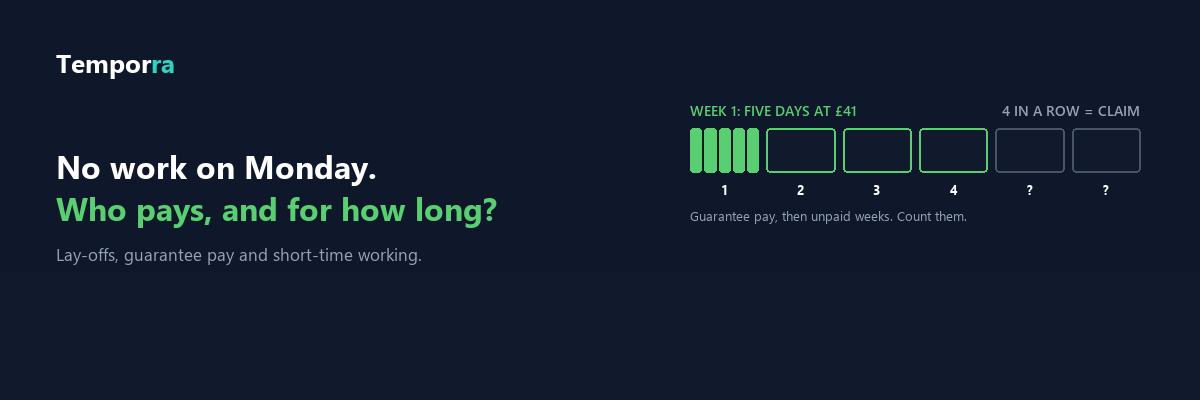
November is when this question turns up on sites. Short days, wet ground, programmes slipping into the new year. This guide covers England, Wales and Scotland, and it's about employees. Workers on zero-hours arrangements are a different case, which comes up near the end.
First question: does the contract let you?
There's no general right to lay someone off without pay. Acas lists the routes that make it lawful: a lay-off or short-time clause in the employment contract, a custom and practice in your firm with clear evidence behind it, a national agreement for the industry, an agreement with a trade union, or the employee agreeing to change their terms. If none of those applies, an employee you send home for lack of work is still owed their normal pay. Stop paying them and you're making a deduction from wages, and the employee may be able to treat it as a dismissal.
Custom and practice is the one that fails most often. "We've always stood the lads down in January" needs to have been done consistently, for years, and known about. A text sent to the crew in 2023 isn't much of a custom.
If you agree a change with someone, Acas says a permanent change to the contract has to be confirmed in writing within a month. For a temporary change it's still worth an email. That email is the record that you had the right in the first place, and it's the first thing anyone will ask for.
Guarantee pay: what you owe for a workless day
Even with a valid lay-off clause, the first days aren't free. Section 28 of the Employment Rights Act 1996 gives an employee a guarantee payment for any day, during which they'd normally be required to work, when you don't provide work because the business needs less of their kind of work or something else has disrupted it. The Act calls these "workless days". A day means midnight to midnight, and a night shift that crosses midnight counts on whichever side has more of the hours.
The amount comes from section 30: normal working hours on that day, multiplied by a guaranteed hourly rate, which is a week's pay divided by normal weekly hours. Then section 31 caps it. Since 6 April 2026 the cap is £41 a day, and it applies for no more than the number of days the employee normally works in a week, up to five, in any three-month period.
| Employee | Normal day | Day's guarantee pay | Days in any 3 months | Most you'd pay |
|---|---|---|---|---|
| Groundworker, 5 × 8 hours at £14 | £112 | £41 (capped) | 5 | £205 |
| Labourer, 3 × 8 hours at £12.71 | £101.68 | £41 (capped) | 3 | £123 |
| Cleaner, 5 × 3 hours at £12.71 | £38.13 | £38.13 | 5 | £190.65 |
So for a full-time employee, the statutory cost of the first week of a lay-off is £205. That's the whole statutory bill for three months, which surprises people in both directions. It's much less than a week's wages. It's also not nothing, and it's due through payroll like any other pay.
The conditions sit in section 29. One month's continuous service, ending the day before the workless day. No guarantee pay if the lack of work is caused by a strike, lock-out or other industrial action involving your employees or an associated employer's. None for a day when you offered suitable alternative work, even work outside their contract, and they unreasonably refused it. And none if they don't comply with reasonable requirements to keep themselves available, such as answering the phone in the morning. GOV.UK's guarantee pay page adds the practical one: no guarantee pay for any day on which the employee does some work. Acas adds that it isn't due for days of holiday or sickness either.
Where the 12-week figures come from
For someone on fixed hours the sum is easy. For hourly staff whose weeks went up and down, the Act tells you to average. Under section 30(3), if normal working hours vary, the week's pay is divided by the average normal working hours over the 12 weeks ending with the last complete week before the workless day. Section 31(4) does the same for the number of days: average normal working days over the same 12 weeks, rounded up, capped at five.
Somebody who did four days some weeks and five in others might be a five-day employee or a four-day one, and the difference is a day's guarantee pay. The answer is in the last 12 weeks of timesheets. If those live on a whiteboard in the cabin, you're estimating. Write the averages down with the dates you used, because the employee can complain to a tribunal under section 34, and for days from 1 October 2026 they have six months from the workless day to do it, up from three.
A contractual scheme can be more generous. If you pay under your own scheme, the employee doesn't get statutory guarantee pay on top, but your scheme can't be worse than the statutory one.
The rolling three months
The five days aren't per calendar quarter. They're "in any period of three months", so each time you're about to pay a guarantee day, look back three months from that day and count the guarantee days already paid. That's a running log per employee, not a figure you can rebuild from payslips, because a payslip shows the money and not which days it covered.
Take the groundworker. Laid off Monday 9 November, five guarantee days paid that week. Back for most of December, then stood down again from 4 January. Nothing statutory is due for the January days, because the five November days are still inside the three months. From about 10 February the window starts to clear, a day at a time. Whether a contractor owes £0 or £205 for a February lay-off turns on those dates.
Short-time working: the half-a-week line
Cutting hours is the other tool. Short-time also needs the contract, a custom, an agreement or consent, exactly as a lay-off does. For the redundancy rules, section 147 gives the two terms a precise meaning:
- Laid off for a week: pay under the contract depends on being given work, and the employee is entitled to no pay at all for that week because you gave none.
- On short-time for a week: because you provided less work, their pay for the week is less than half a week's pay.
The half is measured against a week's pay as the Act defines it. For fixed hours that's section 221: what they'd earn working their normal hours. For varying hours it's averaged over 12 weeks, again. A five-day employee cut to four days isn't on short-time in this sense. Cut to two days, they are. Two and a half days is usually right on the line, which is where the arithmetic needs to be on paper and not in your head.
Guarantee pay doesn't stop a week counting. A week where the only money was guarantee pay is still a week of less than half a week's pay.
The week count that turns into a redundancy claim
There's no legal limit on how long a lay-off can last, GOV.UK says. There is a point after which the employee can choose to leave with a redundancy payment. Under section 148, an employee who has been laid off or kept on short-time for four or more consecutive weeks, or for six or more weeks in a 13-week period with no more than three of them consecutive, can give you written notice of intention to claim. The notice has to arrive within four weeks of the end of the last of those weeks. Lay-off weeks and short-time weeks can be mixed in the series, and weeks caused by a strike or lock-out don't count.
They need two years' continuous service for a redundancy payment, under section 155. For the groundworker who joined in 2019, that's easily met. The payment uses a week's pay capped at £751 since 6 April 2026.
Then the clock is yours. Section 149 gives you seven days to serve a written counter-notice contesting the claim. Section 152 says when it holds: if on the date of the employee's notice it was reasonable to expect that, within four weeks, they'd start at least 13 weeks of work with no lay-off or short-time weeks. That's the only defence, and it fails anyway if the employee is then laid off or on short-time for each of the next four weeks. Miss the seven days and the claim is treated as accepted, according to Acas.
The employee also has to resign to get the money. Section 150 gives them a window: notice of at least one week (or their contractual notice if longer), served within three weeks after your seven days run out, or after you withdraw a counter-notice. Get the dates wrong on either side and a claim that should have worked doesn't, or one that shouldn't, does.
So the thing to keep is a plain week-by-week line for each employee you lay off or put on short-time: the week, laid off or short-time or normal, the hours worked, the pay. Six weeks in thirteen is easy to miss when the weeks are scattered across Christmas.
Zero-hours and agency workers
Acas makes the point that lay-offs and short-time working only apply to employees. Agency, casual and zero-hours workers usually aren't employees, and someone with no guaranteed hours can simply not be offered work. The zero-hours reforms in the Employment Rights Act 2025 will add payments for shifts cancelled at short notice, but that's a separate scheme with its own dates. Check status person by person. A labourer who's been on the same site five days a week for three years, whatever the paperwork says, may well be an employee.
What to keep for each person
- the lay-off or short-time clause, or the signed agreement, or the email confirming a temporary change;
- each workless day, and the guarantee pay paid for it;
- the 12 weeks of hours and days you averaged, with the dates;
- any alternative work you offered, and the answer;
- a week-by-week line: laid off, short-time or normal, hours and pay;
- any notice of intention to claim, the date it arrived, and your counter-notice or acceptance.
None of that is a prescribed form the way the minimum wage records are. It's simply what a tribunal will ask you to show, and most of it is hours.
Common questions
Can I lay off an employee without pay?
Only if the contract allows it, or there's a clear custom and practice, an industry or union agreement, or the employee agrees to the change. Without one of those, an employee sent home for lack of work is still owed full pay. Even with a clause, statutory guarantee pay is due for the first workless days.
How much is statutory guarantee pay in 2026?
Up to £41 a day from 6 April 2026, for no more than five days in any three-month period, so £205 at most. Someone who normally earns less than £41 for a day gets their normal day's pay. A worker on a three-day week gets three days, not five.
Who qualifies for guarantee pay?
Employees with at least one month's continuous service. They lose it for a day if they unreasonably turn down suitable alternative work you offer, don't comply with reasonable requirements to stay available, or the lack of work is caused by industrial action.
How long can I lay someone off for?
There's no legal limit. But an employee with two years' service who has been laid off or on short-time for four weeks in a row, or six weeks within 13 (no more than three in a row), can give written notice that they intend to claim a redundancy payment.
What counts as short-time working?
For a redundancy claim, a week counts as short-time if, because you provided less work, the employee's pay for that week was less than half a week's pay. Cutting someone from five days to four doesn't trigger it on its own.
Can I refuse a lay-off redundancy claim?
You can give a written counter-notice within seven days, if it's reasonable to expect the employee to start at least 13 weeks of work, with no lay-off or short-time weeks, within four weeks. If you don't respond in seven days, the claim is treated as accepted.
Do zero-hours and agency staff get guarantee pay?
Usually not. Acas says lay-offs and short-time apply to people with employee status, and agency, casual and zero-hours workers often don't have it. Workers without guaranteed hours can simply not be offered work, though short-notice cancellation rules are coming under the Employment Rights Act 2025.
How long does an employee have to claim unpaid guarantee pay?
Six months from the workless day, for days from 1 October 2026, when the Employment Rights Act 2025 extended the tribunal time limit from three months. A claim can also be brought as an unlawful deduction from wages.
Where hours fit in
Temporra records clock-in and clock-out against a job and a site, on a phone or a shared site tablet, with a face check at clock-in so a colleague can't clock in for someone else. That check is a match against a stored photo, not a liveness test, so it's one control against buddy punching rather than proof of identity.
For a lay-off, the useful part is that the hours already exist. The 12 weeks behind a guarantee-pay average are timestamped, a day with no clock-in shows as a day with no clock-in, and a short-time week shows its real hours rather than what someone remembers. What it doesn't do: there's no lay-off leave type, it doesn't work out guarantee pay or a week's pay, it isn't payroll software (it exports hours to yours), and it doesn't build your rota. The clause, the notices and the money stay with whoever runs your payroll.
Related guides
- Zero-Hours Contracts: The Guaranteed-Hours Reform, and the Records It Will Take
- Payslips and hours worked: what the law actually requires
- National Minimum Wage: The Records HMRC Actually Checks
- How to Run Payroll for a Small Business (UK): A Practical 2026 Guide
We post each new guide on the Temporra Facebook page. Follow it there if you'd like the next one, and a like helps other UK employers find it.
Track hours in Temporra →No card needed for the trial. One flat monthly price by team size, from £39 for up to five workers, VAT included. See pricing.