 Tempor
Parental bereavement leave and pay: what an employer records, and what it can't ask for
The call comes at ten past six, before the van leaves the yard. One of your fixers won't be in. You don't need to know much more than that to deal with the leave, and the law is set up so that you mostly can't ask. The pay is different. It has paperwork, a 28-day deadline and a record HMRC can ask to see three years later.
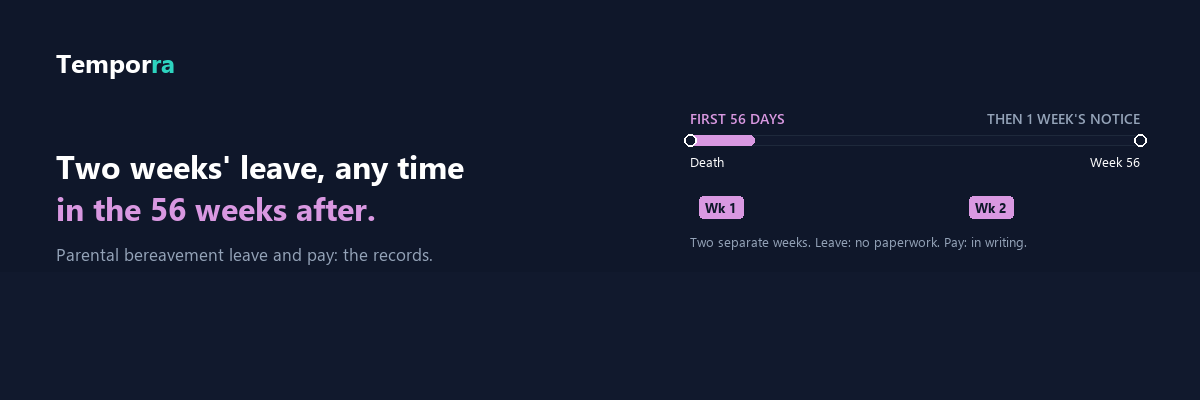
Parental bereavement leave, sometimes called Jack's Law, came in through the Parental Bereavement (Leave and Pay) Act 2018 and has applied since April 2020. Most small firms will use it once, if ever. That's exactly why the details aren't in anybody's head when it happens, and why the record is worth getting right while you're also trying to be decent to someone.
Who gets what
Section 80EA of the Employment Rights Act 1996 gives an employee the right to leave if their child dies under the age of 18, or is stillborn after 24 weeks of pregnancy. "Parent" is wider than the birth parents. It includes adopters, intended parents in a surrogacy arrangement, and someone who had day-to-day care of the child in their home for the four weeks before the death. There's no service requirement for the leave. It's a day-one right, but only for employees. Acas notes that agency, casual and zero-hours workers are unlikely to have that status.
The pay sits in a different Act. Section 171ZZ6 of the Social Security Contributions and Benefits Act 1992 sets the tests: 26 weeks' continuous employment by the end of the relevant week (the week ending with the Saturday before the death), still employed on the day of the death, and normal weekly earnings of at least £129.
| Parental bereavement leave | Statutory Parental Bereavement Pay | |
|---|---|---|
| Service | None | 26 weeks by the relevant week |
| Earnings | No test | At least £129 a week on average |
| How much | 1 week, 2 weeks, or 2 separate weeks | £194.32 or 90% of average weekly earnings, whichever is lower |
| When | Within 56 weeks of the death | The same 56 weeks |
| Notice | Can be by phone or text | In writing, within 28 days |
| Evidence you can ask for | None | A one-off written declaration |
| Record the law prescribes | None | Regulation 9: three years after the tax year |
Notice: the first 56 days are different
Regulation 6 of the Parental Bereavement Leave Regulations 2020 splits the year after the death into two parts. Period A is the 56 days starting with the date of death. Inside it, notice only has to reach you before the employee would normally start work on the first day of absence, or as soon as reasonably practicable if that isn't possible. So the ten-past-six phone call is valid notice. So is a text to the foreman.
Period B is everything after that, up to the end of week 56. Here the employee gives at least one week's notice before the week of leave starts. Either way, the notice should tell you the date of the death, when the leave starts and whether it's one week or two.
Cancelling follows the same split. In Period A they can cancel a week up to the time they'd have started work on its first day; in Period B, a week before. A week that's already begun can't be cancelled.
The leave comes in whole weeks. Regulation 5 of the Parental Bereavement Leave Regulations 2020 sets one week as the minimum and lets the two weeks be separate. A "week" isn't Monday to Friday, though. It's any seven days, so leave that starts on a Wednesday runs to the following Tuesday. People often take one week straight away and save the second for the funeral, an inquest or the first anniversary, which is why the 56-week window exists.
What you can't ask for
This is where the leave is unlike every other kind of time off on this site. GOV.UK's employer guide is blunt about it: you can't require the notice in writing, you can't ask for evidence of entitlement to the leave, and you can't ask for details of the employee's relationship to the child. No death certificate, no hospital letter.
So the record for the leave is simply what you were told and when. Write down the date and time of the call or the text, who took it, the date of death the employee gave, and the start date and length of the leave. That's the whole file. If the employee later says they were treated badly for taking it, regulation 12 protects them from detriment, and the dated note is what shows you treated it as protected leave from the first conversation.
The pay has paperwork
Statutory Parental Bereavement Pay works the other way round. Under regulation 8 of the Statutory Parental Bereavement Pay (General) Regulations 2020 the employee has to ask for it in writing, before the end of 28 days starting with the first day of the week they're claiming, or as soon as reasonably practicable. The request gives their name and the date of the death. The first time they ask, it also includes a written declaration that they meet one of the parent conditions. That declaration is needed once, not for each week.
In practice, a short form the employee signs when they're back, or an email from them, does both jobs. Don't chase it on the day of the phone call. The 28 days run from the start of the week being claimed, and "as soon as reasonably practicable" covers someone who wasn't in a state to send an email.
If they don't qualify, GOV.UK says to send form SPBP1, or your own written notice, within 28 days of the request, and to keep a record of the week and the reason. An employee who disagrees can go to HMRC's Statutory Payments Disputes Team within six months. The most common reason for refusal in a firm that takes on people through the year is simple: they haven't been there 26 weeks. They still get the two weeks off.
Regulation 9: the record, in two halves
For anyone you pay, the record is prescribed in regulation 9 of the Statutory Parental Bereavement Pay (Administration) Regulations 2020. It reads as one list, but the retention rule has two anchors, and they can land a year apart.
- The date the pay period began, the evidence of entitlement the employee gave you, and any week in the period you didn't pay, with the reason. Keep these for three years after the end of the tax year in which the pay period began.
- The weeks you paid and the amount paid in each week. Keep these for three years after the end of the tax year in which you made the payments.
Take a death in February 2027. The first week is paid in March, in tax year 2026/27, so the start date and the declaration are kept to 5 April 2030. The second week is taken in May for the funeral and paid in tax year 2027/28, so that payment record runs to 5 April 2031. One employee, one claim, and two different destroy dates. GOV.UK's optional form SPBP2 covers the lot, or you can use your own.
The money mostly comes back. You can usually reclaim 92% of what you pay, or 109% if you qualify for Small Employers' Relief, according to GOV.UK's page on reclaiming statutory pay. Keep what you reclaimed alongside the rest.
The half day that costs the week
That third item, the week you didn't pay and why, sounds like an edge case. It isn't, on a site.
Section 171ZZ9(6) of the 1992 Act says an employer isn't liable to pay bereavement pay for any statutory pay week during any part of which the employee works under a contract with that employer. Not a day docked. The whole week. Grief doesn't follow the rules of a pay system, and plenty of people want to be busy. A plasterer who comes in on the Thursday of a paid week because sitting at home is worse has, legally, worked during that week. Regulation 10 of the general regulations even requires a person who works for a different employer during a claimed week to tell you within seven days.
What to do with that is a judgement call, not just a payroll one. Before the leave starts, tell the employee plainly that working any part of a paid week means that week's statutory pay isn't due, and that they can move the week instead if they'd rather be at work. If it happens anyway, record the week as unpaid with the reason, as regulation 9 asks. Some firms top it up from their own pocket, which is allowed and kind. It still isn't statutory pay, and it isn't reclaimable.
The evidence of that Thursday is the clock-in, which is one reason the timesheet belongs in the same file.
Average earnings for people paid by the hour
Whether someone reaches the £129 threshold, and whether they get the flat £194.32 or 90% of their average, depends on their normal weekly earnings over a relevant period before the death, as defined in regulation 19 of the general regulations. For a salaried manager that's a payslip. For an hourly worker whose weeks went up and down with the weather and the job list, it's whatever your timesheets say about a few weeks nobody was watching.
Anyone averaging under about £216 a week gets 90% of their average rather than the flat rate. Someone on £180 a week gets £162. If their hours lived on a whiteboard, the figure is a guess, and it's being made at the worst possible moment to get it wrong.
Alongside maternity, paternity and shared parental leave
After a stillbirth from 24 weeks, an eligible parent keeps their maternity or paternity leave and gets the two weeks of bereavement leave as well. GOV.UK says that if an employee is already on another statutory leave when the child dies, the bereavement leave starts after that leave ends, still inside the 56 weeks. It can also be taken between blocks of shared parental leave that were booked before the death. Expect the dates to stack, and keep each type in its own line of the record.
Other bereavements, and what's coming
Outside the parental scheme there's no general right to paid bereavement leave. Acas points to time off for dependants under section 57A of the Employment Rights Act 1996, which gives a reasonable amount of unpaid time to deal with a dependant's death, and to whatever your own policy says. If you don't have one in writing, the first death in the team is a bad time to write it.
That will change. Section 18 of the Employment Rights Act 2025 rewrites section 80EA so that the leave covers a wider group of bereavements, including pregnancy loss before 24 weeks. As of today it's in force only for the purpose of making regulations. Lewis Silkin, reporting the government's consultation response in September, says the wider right will be two weeks, unpaid, from April 2027. Treat the date as a plan until the regulations are made. Northern Ireland already moved: for bereavements from 6 April 2026, GOV.UK says employees there can qualify after a miscarriage too, with no minimum service for the pay.
What to keep in one file
- the date and time you were told, who took it, and the date of death given;
- each week of leave: start date, one or two weeks, and any cancellation;
- for pay: the written request, the one-off declaration, and the date the pay period began;
- the weeks and amounts paid, and any week not paid with the reason;
- the SPBP1 if you refused pay;
- the amounts reclaimed from HMRC;
- the hours behind the average, for anyone paid by the hour.
Common questions
How much parental bereavement leave does an employee get?
Two weeks for each child who dies under 18, or is stillborn after 24 weeks of pregnancy. It can be one week, two weeks together or two separate weeks, taken any time in the 56 weeks after the death. It's a day-one right for employees.
Is parental bereavement leave paid?
It can be. Statutory Parental Bereavement Pay is £194.32 a week or 90% of average weekly earnings, whichever is lower, for up to two weeks. It needs 26 weeks' continuous employment by the end of the relevant week and average earnings of at least £129 a week. Someone who doesn't qualify still gets the leave, unpaid.
Can I ask for a death certificate before granting the leave?
No. GOV.UK says an employer can't ask for evidence of entitlement to the leave, can't insist on written notice, and can't ask for details of the relationship to the child. For the pay, the employee gives a written declaration once, with their name and the date of death.
How much notice is needed for parental bereavement leave?
In the first 56 days after the death, notice only has to arrive before the employee would normally start work on the first day off, or as soon as reasonably practicable. After that, it's at least one week before the week of leave starts. A phone call or a text is enough.
What records do I have to keep for Statutory Parental Bereavement Pay?
Regulation 9 of the Statutory Parental Bereavement Pay (Administration) Regulations 2020 lists them: the date the pay period began, the evidence of entitlement the employee gave you, any week in the period you didn't pay and why, and the weeks you paid with the amount each week. Keep them for three years after the end of the relevant tax year.
What happens if the employee works during a week of bereavement pay?
Section 171ZZ9(6) of the Social Security Contributions and Benefits Act 1992 says you aren't liable for Statutory Parental Bereavement Pay for any week during any part of which they work for you. Record that week as unpaid and the reason.
Do I have to give paid time off when any other relative dies?
Not at the moment. Acas says there's no general legal right to paid bereavement leave outside the parental scheme. Employees can take reasonable unpaid time off for dependants, which covers dealing with a dependant's death. A wider unpaid bereavement leave right is in the Employment Rights Act 2025 and isn't in force yet.
Can parental bereavement leave be added to maternity or paternity leave?
Yes. If the employee is already on maternity, paternity, adoption or shared parental leave, the bereavement leave starts after that leave ends, still inside the 56 weeks. After a stillbirth from 24 weeks, eligible parents get maternity or paternity leave as well as the two weeks.
Where hours fit in
Temporra records clock-in and clock-out against a job and a site, on a phone or a shared site tablet, with a face check at clock-in so a colleague can't clock in for someone else. That check is a match against a stored photo rather than a liveness test, so treat it as one control against buddy punching and not as proof of identity.
For bereavement leave, it holds two things. Its leave screen has a compassionate leave type, so the dates of the absence sit next to the timesheet with the approval on them. And the hours are already timestamped, so the weeks behind an hourly worker's average earnings are there when payroll needs them, and a shift clocked during a paid week shows on the timesheet rather than surfacing in a dispute months later. What it doesn't do: there's no separate parental bereavement leave type, it doesn't work out bereavement pay, it isn't payroll software (it exports hours to yours), and it doesn't build your rota. The declaration, the SPBP1 and the regulation 9 record stay with whoever runs your payroll.
Related guides
- Neonatal care leave: counting the weeks, and the three-year pay record
- Maternity pay records: what you must keep, and for how long
- Paternity leave from day one, paternity pay after 26 weeks: the records in between
- Carer's leave: one week in any 12 months, and the record you'll need to prove it
We post each new guide on the Temporra Facebook page. Follow it there if you'd like the next one, and a like helps other UK employers find it.
Track hours in Temporra →No card needed for the trial. One flat monthly price by team size, from £39 for up to five workers, VAT included. See pricing.