 Tempor
Paternity leave from day one, paternity pay after 26 weeks: the records in between
A groundworker who joined you on 2 November mentions in the canteen in December that his partner is due in April. A year ago the answer was simple: under 26 weeks, no paternity leave, no paternity pay. Since 6 April 2026 he gets the leave. He still doesn't get the pay. And the paperwork for both has deadlines that fall before most firms know there's anything to decide.
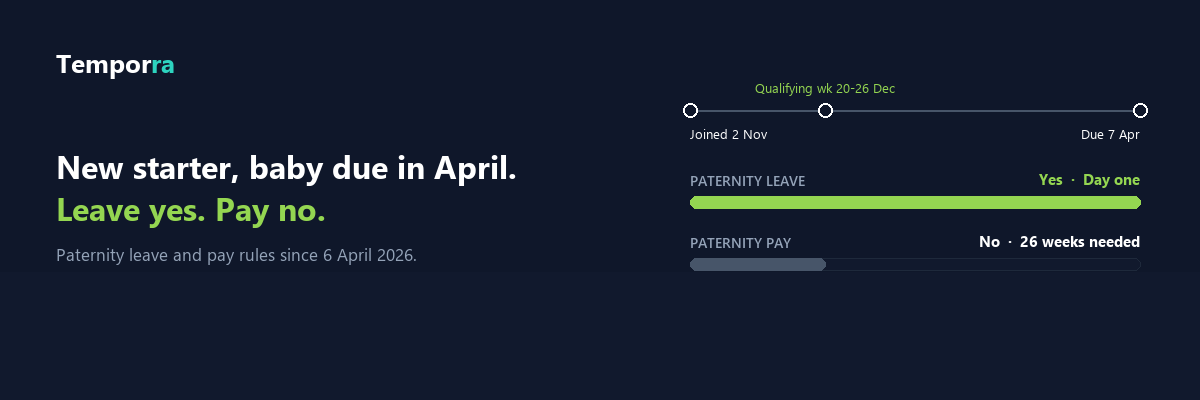
Paternity leave and Statutory Paternity Pay always had separate tests. They used to give the same answer for most people, so nobody kept them apart. Now they don't, and the gap between them is where the records go missing.
What changed in April 2026
Section 80A of the Employment Rights Act 1996 lets the government set the conditions for paternity leave. Until this year one of those conditions was length of service. Section 16 of the Employment Rights Act 2025 deleted it, with effect from 6 April 2026. The leave regulations followed, so an employee who is the father, or the mother's husband, civil partner or partner, and who will be responsible for bringing up the child, can take paternity leave on his first day.
The pay sits in a different Act and nobody touched it. Section 171ZA of the Social Security Contributions and Benefits Act 1992 still asks for 26 weeks' continuous employment ending with the relevant week, normal weekly earnings over eight weeks at or above the lower earnings limit, and still being employed by you when the baby is born.
Two smaller changes are worth knowing. Since 6 April 2024, regulation 5 of the Paternity and Adoption Leave Regulations 2002 lets the leave be one week, two weeks together, or two separate weeks, any time in the 52 weeks after the birth. Before that it was one block inside eight weeks. And section 17 of the 2025 Act lets paternity leave come after shared parental leave, which it couldn't before.
| Paternity leave | Statutory Paternity Pay | |
|---|---|---|
| Who | Employees only | Employees and workers on your payroll |
| Service | None, since 6 April 2026 | 26 weeks by the qualifying week |
| Earnings | No test | At least £129 a week, averaged over 8 weeks |
| How much | 1 week, 2 weeks, or 2 separate weeks | £194.32 or 90% of average weekly earnings, whichever is lower |
| Window | 52 weeks from the birth | The same 52 weeks |
| Record the law prescribes | None | Regulation 9: three years after the tax year |
The qualifying week lands on Boxing Day
Back to the groundworker. The baby is due on Wednesday 7 April 2027. The expected week of childbirth is the Sunday-to-Saturday week containing that date, so it starts on Sunday 4 April. Count back fifteen weeks and the qualifying week runs from Sunday 20 December to Saturday 26 December 2026.
By then he'll have been with you about eight weeks. Nowhere near 26, so no Statutory Paternity Pay, however much he earns. But he can take the leave, and the first notice is due by the end of that qualifying week. Boxing Day. Your office is shut, his supervisor is off, and the conversation in the canteen is the only notice anybody has.
That's fine, legally. Regulation 6 of those Regulations says the notice of the expected week of birth must be given in or before the fifteenth week before it, or as soon as reasonably practicable. What it also asks for is a written declaration that he is the father or the mother's partner and will be responsible for the child. A chat with the foreman isn't that. Get the declaration in writing, in December, and date it.
(For babies due between 5 April and 25 July 2026, GOV.UK relaxed the fifteen-week notice for new starters while the change bedded in. That window has closed. For anything due from 26 July 2026 the normal rules apply.)
Two notices, and the second one repeats
The first notice says the baby is coming and when. The second says when he wants to be off. It has to reach you at least 28 days before the leave starts, with a written declaration that the leave is to care for the child or support the mother, and if he takes two separate weeks, each one gets its own notice. Acas says this second notice doesn't have to be in writing. The declaration does.
So the groundworker who wants the week of the birth and then a week in June gives you three dated pieces of paper: the December declaration, a notice by 7 March 2027 for the first week (28 days before the expected week starts, if he's choosing the date of birth), and another at least 28 days before the June week. Change his mind about June, and the variation needs 28 days too.
None of this has a retention period written against it. The leave regulations prescribe the notices but not how long you keep them. My view: keep them with the pay record, or for three years if there is no pay record, because a notice is the thing that turns a week off into protected leave. If he later says he was treated badly for taking it, the dates are the first thing anyone asks for.
Refusing the pay: the SPP1 and your copy
When someone asks for Statutory Paternity Pay and doesn't qualify, GOV.UK's employer guide says to give them form SPP1 within 28 days of the request, and to keep a copy. If they ask for a written statement of your reasons, give it within a reasonable time; GOV.UK suggests seven working days.
This is the step new-starter cases now trip over. Before April, a man with eight weeks' service didn't ask for paternity anything. Now he's entitled to the leave and will reasonably ask about the money as well. Answer the leave question with a letter confirming his dates. Answer the pay question with an SPP1. They're two separate replies and they go in the same file.
The pay record: regulation 9
For anyone you do pay, the record is set out in regulation 9 of the Statutory Paternity Pay and Statutory Adoption Pay (Administration) Regulations 2002. It's short and prescriptive, much like the maternity one. For each tax year in which you pay Statutory Paternity Pay, keep:
- if the pay period began in that year, the date it began and the evidence of entitlement the employee gave you (in practice, the name, the expected week and the signed declarations that regulation 6B of the Statutory Paternity Pay (General) Regulations 2002 asks for);
- the weeks in that tax year you paid it, and the amount paid in each week;
- any week inside the pay period you didn't pay, and why.
Three years after the end of the tax year the payments were made in. A week paid in the March 2027 payroll falls in 2026/27, so its record runs to 5 April 2030. A second week paid in June falls in 2027/28 and runs to 5 April 2031. Same employee, same baby, two tax years, and the destroy dates are a year apart. Regulation 10 lets an HMRC officer ask to see these records, along with the wage sheets behind them, at a place you agree or wherever they're normally kept.
GOV.UK adds the amounts you reclaimed to its list. You can usually get back 92%, or 109% if your Class 1 National Insurance bill for the last complete tax year was £45,000 or less, according to its page on reclaiming statutory pay.
The week he came in for a morning
The third item on that list, the week you didn't pay and why, sounds like an edge case. On a building site it isn't.
Section 171ZE(5) of the 1992 Act says paternity pay isn't payable for any week during any part of which he works for you. Not a day's pay docked. The whole week. So the electrician on paternity leave who comes in on Thursday morning to finish a consumer unit because the client won't wait another week has, by that one morning, cost himself £194.32. Plenty of firms never notice and pay it anyway, because nobody connects the timesheet to the payslip.
The fix isn't complicated. Tell him before the leave starts that any work at all during a paid paternity week costs that week's pay. If it happens anyway, record the week as unpaid and give the reason, which is precisely what regulation 9 asks for. The clock-in on site that Thursday is your evidence.
Eight weeks of hours you weren't watching
For people who do qualify, the amount depends on average weekly earnings across an eight-week relevant period that ends with the qualifying week. For a salaried office manager that's arithmetic. For someone paid by the hour, with a short week when it rained and a long one before a handover, it's whatever your timesheets say about a stretch of autumn nobody was paying attention to.
Two thresholds matter. The average has to be at least £129 a week, the lower earnings limit for 2026/27, or there's no pay at all. Ten hours a week at the National Living Wage of £12.71 is £127.10, which misses by less than two pounds. Twelve hours clears it. And anyone averaging less than about £216 a week gets 90% of their average rather than the flat £194.32, so a part-timer on £180 a week gets £162.
If those eight weeks of hours live on a whiteboard and in a supervisor's memory, the average is a guess. The person most likely to check it is the employee whose pay depends on it.
Workers, agency staff and CIS
Leave and pay don't even cover the same people. Acas says only employees get statutory paternity leave, while someone with worker status may still be entitled to Statutory Paternity Pay. So a casual labourer on your payroll as a worker can qualify for the money without having any right to the time off, and you agree the time off as unpaid leave or holiday.
For agency workers the agency is normally the one that pays, and GOV.UK flags them as having their own rules, though you'll still want to know when they're off. A genuinely self-employed subcontractor paid under CIS gets neither from you. As with every guide on this site, the label doesn't decide it. How the work is actually done does.
If the mother dies
One more day-one right arrived in April. Where the mother or birth parent dies within the first year, the father or partner can now take up to 52 weeks of unpaid bereaved partner's paternity leave, in one block, from the first day of employment. It applies to deaths on or after 6 April 2026. It's rare, and when it happens nobody will be thinking about records, so the note for now is only that it exists. Acas sets out how it works.
What to keep in one file
- the written declaration of the expected week and his relationship to the child, dated;
- each leave notice and its declaration, with the date you received it, and any variation;
- your written confirmation of the leave dates;
- the SPP1 if you refused pay, and any statement of reasons;
- for pay: start date, evidence of entitlement, weeks and amounts, unpaid weeks with reasons, amounts reclaimed;
- the hours behind the eight-week average, for anyone paid by the hour.
Common questions
Is paternity leave a day-one right in the UK?
Yes, for employees, since 6 April 2026. Section 16 of the Employment Rights Act 2025 removed the 26-week qualifying period from section 80A of the Employment Rights Act 1996. Statutory Paternity Pay didn't change: it still needs 26 weeks' continuous employment by the qualifying week and average earnings of at least £129 a week.
How much is Statutory Paternity Pay in 2026/27?
£194.32 a week or 90% of average weekly earnings, whichever is lower, for one or two weeks. Tax and National Insurance come off it as normal.
Can paternity leave be split into two separate weeks?
Yes. Since 6 April 2024 an employee can take one week, two weeks together, or two separate weeks, any time in the 52 weeks after the birth. It has to be whole weeks, and each period needs at least 28 days' notice.
What records do I have to keep for Statutory Paternity Pay?
Under regulation 9 of the Statutory Paternity Pay and Statutory Adoption Pay (Administration) Regulations 2002: the date the pay period began and the evidence of entitlement the employee gave you, the weeks you paid and the amount each week, and any week in the pay period you didn't pay, with the reason. Keep it for three years after the end of the tax year you paid in.
What do I do if an employee asks for paternity pay and doesn't qualify?
Send form SPP1 within 28 days of their request and keep a copy. If they ask for a written statement of your reasons, GOV.UK says to give it within a reasonable time, for example seven working days. They may still be entitled to the leave.
Can someone work during paternity leave?
Not without losing pay for that week. Section 171ZE(5) of the Social Security Contributions and Benefits Act 1992 says Statutory Paternity Pay isn't payable for a week during any part of which they work for you, so one morning on site costs the whole week's pay.
Do workers and agency staff get paternity leave?
Only employees get statutory paternity leave. Acas says someone with worker status isn't entitled to the leave but might still be entitled to Statutory Paternity Pay. Genuinely self-employed CIS subcontractors get neither from you.
Where hours fit in
Temporra records clock-in and clock-out against a job and a site, on a phone or a shared site tablet, with a face check at clock-in so a colleague can't clock in for someone else. That check is a match against a stored photo rather than a liveness test, so treat it as one control against buddy punching and not as proof of identity.
For paternity, what it holds is the hours. The eight weeks that set an hourly worker's average earnings are already timestamped when someone asks, and a clock-in during a paid paternity week shows up on the timesheet instead of in an argument at payroll. It doesn't do the rest. Its leave screen has annual, sick and compassionate leave and nothing for paternity, it doesn't calculate Statutory Paternity Pay, it isn't payroll software (it exports hours to yours), and it doesn't build your rota. The notices, the SPP1 and the regulation 9 record stay with whoever runs your payroll.
Related guides
- Maternity pay records: what you must keep, and for how long
- Neonatal care leave: counting the weeks, and the three-year pay record
- Unpaid parental leave: 18 weeks per child, from day one, and the count you'll need to keep
- Parental bereavement leave and pay: what an employer records, and what it can't ask for
We post each new guide on the Temporra Facebook page. Follow it there if you'd like the next one, and a like helps other UK employers find it.
Track hours in Temporra →No card needed for the trial. One flat monthly price by team size, from £39 for up to five workers, VAT included. See pricing.