 Tempor
Recording Breaks Correctly: Why an Unpaid Break Nobody Took Still Costs You
Ask most employers whether they record breaks correctly and they'll say yes, obviously. It's on the rota, and it's on the payslip as an unpaid half hour. That isn't what "correctly" means under the Working Time Regulations 1998, and it isn't what HMRC checks either. A break only counts as a break if someone actually took it. Deduct thirty minutes from every timesheet whether or not the person ate lunch at their desk with tools still in their hands, and you haven't recorded a break. You've quietly underpaid someone and called it admin. This piece covers the 20-minute rest break specifically (the 48-hour average and the individual opt-out are covered in our separate guide, linked below): what the law requires, the three ways employers get this wrong without realising it, and what proof actually looks like if HMRC or a tribunal ever asks.
What the law actually requires
Workers who put in more than six hours a day get one uninterrupted rest break of at least 20 minutes, under the Working Time Regulations 1998. It doesn't have to be paid. Gov.uk is explicit that whether the break is paid depends on the employment contract, not the regulations themselves. What the regulations do insist on is that the break actually happens: uninterrupted, during the shift, not tacked onto the start or the end of it.
Eleven hours between shifts and 24 hours off a week, or 48 a fortnight, apply too, and we've covered those alongside the 48-hour average in a separate guide. This one stays on the 20-minute break, because it's the rule small teams get wrong most often, and the one that turns into a pay problem rather than just a paperwork one.
Three ways this goes wrong
None of these look like a violation at the time. That's exactly why they're common.
Auto-deducting a break that wasn't taken
Most payroll and timesheet systems default to knocking 30 or 60 minutes off every shift over six hours, unpaid, automatically. It's convenient. It's also the single biggest source of the problem. HMRC's National Minimum Wage manual is specific on this: a break only comes off working time if it was genuinely taken. Working through lunch to hit a deadline still counts as working time whether or not it was deducted, and if that deduction takes someone below minimum wage for the hours they actually worked, that's an underpayment. Not a rounding error.
On a site where the crew eat a sandwich walking between vans, or a shop where one person is covering the till alone at 1pm, that auto-deduction is happening every single day without anyone taking the break it claims was taken.
Rounding
Fifteen minutes here, ten there, and none of it looks dishonest in the moment. A break logged as "roughly half an hour" because that's what it usually is isn't the same as a break that started at 12:04 and ended at 12:19. Fifteen minutes is a quarter of the legal minimum. If a dispute ever needs the real figure, "roughly" isn't a figure.
No record at all
The most common gap isn't a bad record. It's no record. A lot of small businesses run on a verbal understanding. Everyone knows to take their break, so nobody writes anything down. That works fine right up until someone leaves unhappy, or a working time complaint lands, and there's nothing to show except a rota that says a break was scheduled. We made this point about rotas in our 48-hour week guide, and it holds here too: a schedule is a plan, not a record of what happened.
What "correctly recording" a break actually means
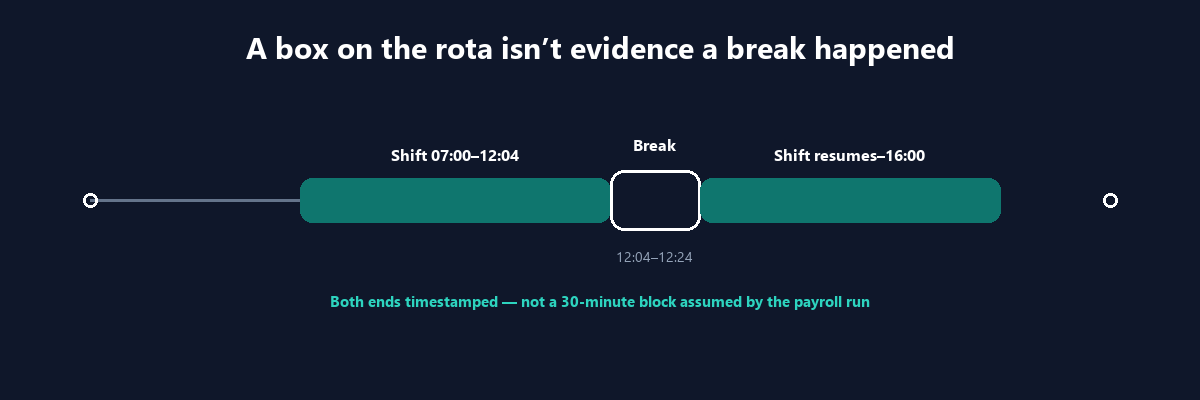
Three things, and none of them are complicated on their own. The break needs a real start time and a real end time, not a flat duration assumed at payroll. It needs to be logged by the person taking it, or a device they used, not backfilled by a manager at the end of the week from memory. And it needs to sit alongside the clock-in and clock-out for the same shift, so the whole day adds up instead of the break existing as a separate note nobody cross-checks.
That's the bar HMRC and an employment tribunal both work to, for different reasons. HMRC wants proof the deducted time was genuinely unworked, because if it wasn't, it's wages owed. A tribunal wants proof the worker had the chance to take the break the regulations promised. Neither question gets answered by a rota showing a break in the plan. Both get answered by two timestamps.
Where the record protects you
Picture the two situations most employers actually end up in. First: a former worker raises a grievance, or takes it to a tribunal, claiming they never got proper breaks over the eighteen months they worked for you. Second: an HMRC minimum wage check flags that your payroll deducts an unpaid break from every shift over six hours, and asks you to show the deduction reflects time genuinely not worked.
In both cases, "we always make sure people get breaks" isn't an answer, however true it is. What answers it is a record: this person clocked out at 12:04, clocked back in at 12:24, on this date, for this shift. Multiply that by however many shifts are in question and you have exactly what's being asked for, not a reconstruction from memory six months after the fact.
This is where Temporra fits, and it's worth being precise about what it does and doesn't do. Temporra doesn't build your rota or decide who's working when. That's still down to you, same as it always was. What it tracks is the shift that actually happened: clock-in, clock-out, and the break start and stop in between, logged as they occur rather than assumed afterwards. That record exports straight to payroll, so what proves the break happened is the same data that pays people for the hours either side of it, not a separate spreadsheet someone has to remember to keep. See our guide on tracking employee hours for the wider picture, or the real cost of paper timesheets for what the manual version of this usually looks like in practice.
Frequently asked questions
Does the 20-minute break have to be paid?
No, not by law. Gov.uk is explicit that whether the 20-minute break is paid depends on the employment contract, not the Working Time Regulations. Plenty of employers pay it anyway, but the regulations only guarantee the break happens, not that it's paid.
Can I auto-deduct a lunch break from every timesheet?
You can, but only if the break was actually taken. HMRC's guidance on the minimum wage treats a break that wasn't genuinely taken as working time, whatever the deduction says. An automatic 30-minute deduction on a day nobody actually stopped is a wage underpayment, not admin.
What if someone chooses to skip their break to leave early?
The right belongs to the worker, and they can choose not to use it. What matters for your records is that the opportunity genuinely existed. A shift with no cover, no time and constant interruptions doesn't really offer that choice, whatever the rota says.
Who actually enforces the rest break rules?
Two different routes, and they don't always overlap. Underpayment linked to a break that was deducted but not actually taken is an HMRC minimum wage matter. A straightforward failure to allow the break at all is more likely to surface as an employment tribunal claim or a grievance.
Does a written break policy protect me if I can't prove it happened?
A policy shows intent. It doesn't show what happened on any specific shift, and that's the gap that matters if a claim comes in. Keep the policy. Back it with the actual timestamps too.
How is this different from the 48-hour week rules?
Different mechanism, same underlying problem. The 48-hour rule is about total hours averaged over 17 weeks, covered in our separate guide. This one is about the 20-minute break itself and whether the record shows it genuinely happened, which is usually the more immediate risk on an ordinary working week.
Do casual and zero-hours workers get the same break rights?
Yes. The 20-minute break applies to workers, not only employees on a fixed contract, so casual, zero-hours and agency staff working more than six hours in a day are covered the same way.
What should I do if our current setup doesn't record breaks properly?
Fix it going forward before worrying about the past. Start logging genuine break start and stop times from today, check whether your payroll deduction matches what's actually being taken, and deal with the gap directly if it doesn't.
Related guides
- Working Time Regulations: The 48-Hour Week, Opt-Outs and Rest Breaks
- Lorry drivers and working time: the 60-hour week, no opt-out, and the two-year record
- How to Track Employee Hours: A UK Small-Business Guide
- National Minimum Wage: The Records HMRC Actually Checks
Start a free 14-day trial · Book a demo
No card required. Flat monthly pricing by team size, every feature on every tier — see pricing.