 Tempor
Travel time to site: which drives count as working time, and which ones you have to pay
An electrician on your books leaves home in Romford at 6.40, drives to a rewire in Chelmsford, moves to a fault in Basildon after lunch and gets home at five to eight. Three drives. The middle one is working time whatever else is true. The other two depend on one fact about how you employ this electrician, and whether any of the three has to be paid at the minimum wage is a separate question, under a different law, with its own answer.
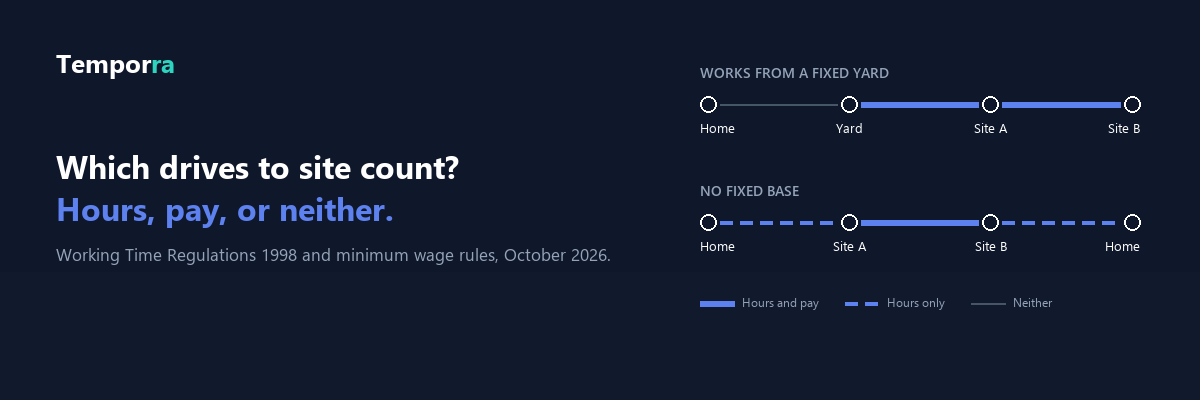
Most small firms settle this with a rule of thumb: travel is the worker's own business and the clock starts on site. For somebody who reports to the same yard every morning, that's close to right. For a tradesperson sent from job to job it's wrong in two places, and one of them can drag an hourly rate that looks perfectly fine below the legal minimum.
Everything here is about employees and workers. A genuinely self-employed subcontractor paid under CIS sits outside both the Working Time Regulations and the minimum wage, so their travel is paid however the contract says. If you aren't sure which side of that line someone is on, sort that out first.
Two laws asking two different questions
Regulation 2 of the Working Time Regulations 1998 defines working time as any period when someone is working, at your disposal and carrying out their duties. That definition drives the 48-hour average week, the 11 hours of daily rest and the night work limits. It says nothing about pay.
Pay has its own test. Regulation 34 of the National Minimum Wage Regulations 2015 treats travelling as minimum wage time when the worker would otherwise be working, then carves out the journey between home and a place of work or an assignment. Above the minimum wage floor, it's down to the contract. Acas says the same: when travel counts as working time, what the worker gets depends on the employment contract, provided the minimum wage rules are met.
So one drive can count towards somebody's 48 hours without having to be paid at £12.71 an hour. Almost every rule of thumb misses that.
The four journeys
| Journey | Working time? | Minimum wage time? |
|---|---|---|
| Home to a fixed yard, office or long-running site | No | No |
| Yard to site, after reporting in | Yes | Yes |
| Site to site during the day | Yes | Yes |
| Home to first site, last site to home, no fixed base | Likely yes | Generally no |
The first row is the ordinary commute. Acas says regular travel to and from a fixed workplace doesn't usually count, and adds that an employer can choose to count it anyway. GOV.UK's guidance on minimum wage hours says commuting isn't minimum wage time whether or not the worker has a fixed place of work.
Rows two and three are the easy ones that still go wrong. Once someone has reported to the yard, loaded the van and set off, they're working, and that's as true for the labourer in the passenger seat as for the driver. Same for the drive from a morning job to an afternoon one. GOV.UK counts waiting time on the way as well, such as waiting to collect materials or to meet someone at a site gate.
Row four is the one with a court case in it.
No fixed base: the Tyco ruling
In 2015 the Court of Justice of the European Union decided the Tyco case (C-266/14). A Spanish security firm had closed its regional offices, so its technicians drove from home to the first customer of the day and home again from the last. The court held that for workers with no fixed or habitual place of work, those first and last journeys are working time. The firm set each day's list of customers and could change it while the technicians were on the road. They were at its disposal from the moment they set off.
UK guidance still follows it. The Acas page, last updated in March 2025, says travel between home and work is likely to count as working time for what it calls peripatetic workers, and plumbers and other tradespeople are on its list of examples. GOV.UK refers to the same ruling on its minimum wage page and then draws the line: pay is a separate question, and minimum wage law doesn't require the minimum wage for that time.
That leaves the first and last drive of the day counting for hours and rest but not for the minimum wage. Your contract can still pay it, and plenty of firms pay travel beyond a set distance or a flat daily allowance. If you follow an industry agreement, such as the JIB rules for electricians or the CIJC Working Rule Agreement, read its travel terms. They sit on top of everything in this guide.
Who counts as having a fixed place of work?
The Regulations don't define it. There's no rule that a site becomes someone's workplace after a set number of weeks. It's a judgement about the pattern of the job.
A bricklayer who has been on the same housing development since March, driving there every morning and home every night, looks like someone with a fixed place of work, even though the development isn't yours. A maintenance electrician doing three call-outs a day across Essex and never seeing an office is the Tyco technician almost exactly. Most firms have both, plus people in between who spend a fortnight on one job and then three days on another.
Decide which group each role falls into, write down the decision and the reason, and apply it the same way to everyone in that role. That won't bind a tribunal. What it does is show you thought about it before anybody complained, and it stops the answer changing with whichever manager signs the timesheet that week.
What it does to the 48-hour week and daily rest
Take a plumber with no base who spends 46 hours a week on jobs and about 50 minutes each way between home and the first and last job. If that travel is working time it adds just over eight hours a week, so the week is closer to 54 hours. Averaged over the 17-week reference period in regulation 4, that's over the 48-hour limit unless they've signed an opt-out under regulation 5.
Daily rest bites sooner. Regulation 10 asks for 11 consecutive hours of rest in each 24. Go back to the electrician: home at 19:55 after Basildon, out of the door at 06:40 the next morning for Chelmsford again. That's 10 hours 45 minutes. If the drive home is working time, the rest is a quarter of an hour short. Regulation 21 does lift the daily rest rule where a worker's different places of work are distant from one another, but only in exchange for an equivalent period of compensatory rest under regulation 24. The hours don't disappear.
Where unpaid travel breaks the minimum wage
This is the expensive one. A labourer on £14.00 an hour is paid for 40 hours on site, £560 for the week. In a typical week they also spend five hours moving between your three small jobs, unpaid. Those five hours are minimum wage time under regulation 34, so the test divides £560 by 45 hours, not 40. That's £12.44 an hour, 27p under the National Living Wage of £12.71 for anyone 21 or over.
The shortfall comes to £11.95 a week, about £620 a year for one labourer, and there's a penalty on top of the arrears (our guide to minimum wage records covers how that's worked out). You don't have to pay travel at the site rate. The test only looks at the total: pay for the period divided by every counted hour in it. It runs pay reference period by pay reference period, usually the week or month you pay for, so a quiet week doesn't make up for a busy one.
And the burden of proof is on you. Under section 28 of the National Minimum Wage Act 1998, if a worker brings a claim, the law presumes they were underpaid unless you show otherwise. If the timesheet only has site hours on it, there's nothing to show.
What to record
Regulation 59 of the 2015 Regulations needs records that show you paid at least the minimum wage, kept for six years. Regulation 9 of the Working Time Regulations needs records that show whether you've stayed within the 48-hour and night work limits, kept for two years, although since 1 January 2024 you don't have to log daily hours if you can show compliance some other way. For anyone who moves between jobs, a timesheet with only site hours does neither. For each day, keep:
- the clock-in and clock-out at each site, with the site named;
- each drive between sites as its own entry, with start and finish times;
- for roles you've classed as having no fixed base, the time they left home and got back, if you're counting those drives towards their hours;
- waiting time on the way, such as queuing at a builders' merchant for materials;
- which roles you decided have a fixed place of work, and when you decided;
- signed 48-hour opt-outs, if you use them.
The weak point is the drive folded quietly into the gap between two site entries. Nobody can prove afterwards whether it took 20 minutes or an hour and a half, and section 28 means the doubt goes the worker's way.
Common questions
Is travel time to work paid in the UK?
Not the ordinary commute. Travel between home and a fixed workplace isn't working time and isn't minimum wage time. Travel during the working day, such as from the yard to a site or from one site to another, is both, so it goes into the hours you check pay against. Anything above the minimum wage depends on the contract.
Does travel between sites count as working time?
Yes. Acas says travel while at work, such as from one client to the next, usually counts as working time, and regulation 34 of the National Minimum Wage Regulations 2015 counts it as minimum wage time when the worker would otherwise be working. Record each drive as its own entry.
Is the drive from home to the first site working time if there's no fixed workplace?
Likely yes, for the Working Time Regulations. The 2015 Tyco ruling held that for workers with no fixed or habitual place of work, the first and last journeys of the day are working time, and Acas says travel between home and work is likely to count for peripatetic workers such as tradespeople. GOV.UK says minimum wage law doesn't require that time to be paid at the minimum wage.
Do I have to pay travel time at the same rate as site work?
No. For travel that counts as minimum wage time, the rule is that total pay for the pay reference period, divided by every counted hour in it including that travel, comes to at least the minimum wage. From 1 April 2026 that's £12.71 an hour for anyone aged 21 or over. Above that, the rate for travel is whatever the contract says.
Does the commute count towards the 48-hour week?
Not for someone with a fixed place of work. For a worker with no fixed base, the first and last journeys are likely to count, which can take a long site week over the 48-hour average across the 17-week reference period unless the worker has signed an opt-out.
What records should I keep for travel time?
Records that show you paid at least the minimum wage, kept for six years under regulation 59 of the National Minimum Wage Regulations 2015, and records that show whether you kept within the 48-hour limit, kept for two years under regulation 9 of the Working Time Regulations 1998. In practice: clock-in and clock-out at each site, and each drive between sites as its own timed entry.
Do these rules apply to CIS subcontractors?
Not to a genuinely self-employed subcontractor. The Working Time Regulations and the minimum wage cover employees and workers. The label doesn't decide it: a tribunal looks at how the work is actually done, and someone paid as a CIS subcontractor can still turn out to be a worker.
Where hours fit in
Temporra records clock-in and clock-out against a job, on a phone or a shared site tablet, with the location checked against the site's geofence at those two moments. Each clock-in and clock-out pair becomes its own timesheet entry. So a worker who clocks out in Chelmsford at 12:10 and in at Basildon at 12:55 leaves a 45-minute gap between two named jobs, and a manager sees it when reviewing timesheets before approving them, rather than one long day with the travel lost somewhere inside it.
It doesn't track the drive itself. There's no route tracking, no mileage log and no separate travel entry, so if you pay travel or count it towards someone's 48 hours you'll work it out from those gaps, and it won't decide which of your roles has a fixed place of work. There's a face check at clock-in so a colleague can't clock in for someone else. It's a match against a stored photo rather than a liveness test, so treat it as one control against buddy punching. Temporra isn't payroll software (it exports hours to yours), and it doesn't build your rota.
Related guides
- National Minimum Wage: The Records HMRC Actually Checks
- Working Time Regulations: The 48-Hour Week, Opt-Outs and Rest Breaks
- On-call and standby hours: what counts, and what to record
- Lorry drivers and working time: the 60-hour week, no opt-out, and the two-year record
We post each new guide on the Temporra Facebook page. Follow it there if you'd like the next one, and a like helps other UK employers find it.
Track hours in Temporra →No card needed for the trial. One flat monthly price by team size, from £39 for up to five workers, VAT included. See pricing.