 Tempor
Night workers: the eight-hour limit nobody can opt out of, and what to record
A contractor takes on a four-week run of night work, puts a crew on five twelve-hour shifts a week, and checks the file: every one of them signed the 48-hour opt-out when they started. That signature covers the wrong regulation. For anyone working nights there is a second limit, and nobody can sign their way out of it.
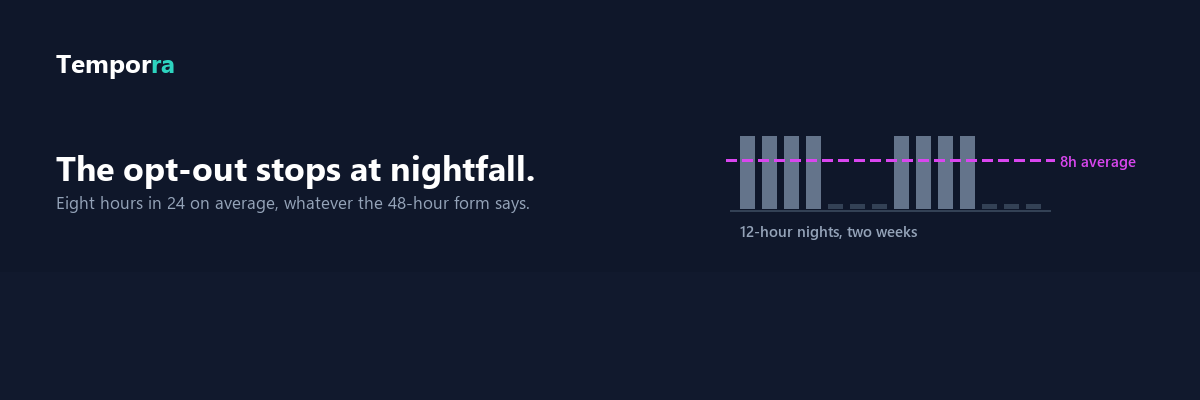
Night work has its own limit, its own health duty and its own line in the record-keeping regulation. Most of it is ignored because people assume the day rules cover it.
Who counts as a night worker
Night work under the Working Time Regulations 1998 is a defined term, and it is narrower and more mechanical than most people expect.
Start with night time. Regulation 2(1) says it is a period of at least seven hours that includes midnight to 5am, fixed by a relevant agreement. If nothing has been agreed, it is 11pm to 6am. GOV.UK adds that an agreed alternative has to be in writing.
A night worker is then someone who, as a normal course, works at least three hours of their daily working time during night time. The regulation explains "as a normal course" by saying a person works hours that way if they work them on the majority of days they work, and it is careful to say that explanation does not limit the general meaning. There is a second route as well. A collective or workforce agreement can specify a proportion of annual working time, and anyone likely to work that share at night qualifies.
So a warehouse operative on permanent 10pm to 6am shifts is obviously a night worker. The person who needs thinking about is the one on a rotating pattern, or the one who started on days and has quietly drifted onto nights through shift swaps. Nobody assigned them to night work. They became a night worker anyway, and the duties below attached to them the day they did.
The eight-hour average, and why the opt-out does not reach it
Regulation 6(1) says a night worker's normal hours of work in the reference period shall not exceed an average of eight hours for each 24 hours.
The reference period is 17 weeks under regulation 6(3), either any rolling 17 weeks or, if a relevant agreement says so, successive fixed blocks. For someone who has been with you less than 17 weeks, regulation 6(4) makes it the time since they started. GOV.UK notes it can run to 52 weeks where workers and employer agree, for example through a collective agreement.
Now the opt-out. The individual agreement everybody knows about is written into regulation 4(1) itself: the general limit of 48 hours a week on average applies unless the employer has first obtained the worker's agreement in writing. Regulation 5 only sets how long that agreement runs and how the worker ends it. Neither says anything about regulation 6. GOV.UK: "Workers cannot opt out of the limit." Acas goes further and adds "including for overtime". We covered the 48-hour side, and how the opt-out works there, in the 48-hour week guide. Almost none of it carries across.
The arithmetic, done once
Regulation 6(5) gives a formula, and it is worth running because the answer is a number people can plan around.
Take the normal working hours in the reference period. Divide by the number of days in the period, minus the weekly rest the worker is entitled to under regulation 11 (counted in hours and divided by 24). Seventeen weeks is 119 days. Someone on the minimum of 24 hours' uninterrupted rest a week is entitled to 17 of those days as rest, which leaves 102.
Eight hours times 102 is 816. That is the ceiling on normal hours across 17 weeks for a night worker on minimum rest, and it comes out at exactly 48 a week.
Four twelve-hour nights a week is 48 hours. It sits right on the line. For a crew whose usual pattern is already four nights, a four-week push to five adds 48 hours, and every rolling 17-week window containing that push goes over 816 unless lighter weeks are built in around it. Five twelve-hour nights for the full 17 weeks averages ten.
Two caveats, both from the wording. The limit is on normal hours, and GOV.UK's reading is that regular overtime is included in the average while occasional overtime is not. That is an argument you might need to make to an inspector one day, and the only thing that makes it is a record showing the extra shift really was occasional. The second caveat is that regulation 6(2) puts the burden on you: the employer shall take all reasonable steps to ensure the limit is complied with for each night worker.
Hazardous work: a flat eight, and your own risk assessment can trigger it
Regulation 6(7) is shorter and harder. A night worker whose work involves special hazards or heavy physical or mental strain must not work more than eight hours in any 24-hour period during which they do night work. No reference period and no averaging.
Which work counts is set by regulation 6(8), and it is the part that surprises people. The work qualifies if a collective or workforce agreement identifies it, taking account of the specific effects and hazards of night work. Or if it is recognised in a risk assessment you made under regulation 3 of the Management of Health and Safety at Work Regulations 1999 as involving a significant risk to the health or safety of your workers.
Read that from the employer's side. If your own risk assessment for night-time work on a live road, or on an energised installation, records a significant risk, you have just put that crew under a hard eight-hour cap on those nights. Unless one of the exceptions below applies, a ten-hour night shift is then a breach every time it runs. The risk assessment and the rota have to agree with each other, and in plenty of businesses they are written by different people who never compare notes.
When the limits switch off
There are exceptions, and they are real, but they are narrower than the list people repeat.
Regulation 21 disapplies regulations 6(1), 6(2) and 6(7) in a set of special cases. One is a worker whose home and place of work are distant from one another, or whose places of work are distant from each other. Another is security and surveillance work that needs a permanent presence to protect property and persons. The longest is work needing continuity of service or production, and its examples include hospitals and residential institutions, docks and airports, gas, water and electricity production and distribution, refuse collection, industries that cannot be interrupted on technical grounds, and agriculture. Then there is a foreseeable surge of activity in agriculture, tourism or postal services, and the emergency cases: unusual and unforeseeable circumstances, exceptional events, accidents.
Separately, regulation 23(a) lets a collective agreement or a workforce agreement modify or exclude regulations 6(1) to (3) and 6(7) for particular workers or groups.
Two things follow. Whenever an exception or an agreement takes a worker outside the night limit, regulation 24 requires you wherever possible to allow an equivalent period of compensatory rest, and where that is genuinely impossible for objective reasons, to give whatever protection is appropriate for their health and safety. And regulation 21 does not mention regulation 7 at all. The health assessment still applies to a security guard on nights even where the eight-hour limit does not.
The health assessment
This is the duty most small employers have never heard of, and it applies before the first night shift.
Regulation 7(1)(a) says you shall not assign an adult worker to work that will make them a night worker unless you have ensured they will have the opportunity of a free health assessment before they take up the assignment. The exception is where they had one before an earlier night assignment and you have no reason to think it is no longer valid. Regulation 7(1)(b) then requires you to make sure every night worker has the opportunity of a free assessment at regular intervals of whatever length is appropriate for them. Free, under regulation 7(3), means at no cost to the worker.
The form is not prescribed. GOV.UK says it can happen in different ways, and might include a questionnaire written with input from a health professional. How often it is repeated depends on what each worker's assessment finds. And the worker does not have to accept it, which moves the weight onto proving the offer. GOV.UK tells employers to keep a record of the dates assessments were offered to anyone who declined.
Regulation 7(5) sets the confidentiality rule. Nobody may disclose the assessment to anyone other than the worker, unless the worker has consented in writing or the disclosure is limited to a statement that it shows them fit to take up, or carry on with, the assignment. A line manager needs to know "fit for nights: yes". Nothing more.
Then regulation 7(6), the one with teeth. Where a registered medical practitioner has advised you that a worker's health problems are connected with night work, and it is possible to transfer them to work they are suited to that would stop them being a night worker, you shall transfer them. Not consider it. Transfer them.
The under-18 version of all this is different again, because young workers are mostly barred from nights altogether rather than limited, and their assessment covers "health and capacities". That sits in the young workers guide.
What regulation 9 makes you keep
The record duty was rewritten from 1 January 2024 by the Employment Rights (Amendment, Revocation and Transitional Provision) Regulations 2023, and it now lists the night work provisions by number.
Regulation 9(1)(a): records adequate to show whether you have complied with the limits in regulation 6(1) and (7) and the requirement in regulation 7(1). Regulation 9(1)(b): keep them for two years from the date they were made. Regulation 9(2): any manner and format you reasonably think fit.
In practice that is two separate records. The first is hours: enough to work out each night worker's normal hours across any 17-week window, plus the length of every shift for anyone under the hazardous-work cap. The second is the assessment trail. That means offered on what date, taken or declined, and when the next one is due, kept apart from the hours record and away from line managers because of regulation 7(5).
Regulation 9(3) says you need not record daily hours if you can demonstrate compliance without doing so. For a night worker on a fixed four-on, four-off pattern that never varies, maybe. For anyone whose nights move with the work, the formula in regulation 6(5) needs actual hours to go in, and a rota is the plan rather than what happened. The on-call guide covers a related trap: whether hours spent available overnight count as working time at all.
Two years is short next to the other numbers on this site. Minimum wage records run to six years, and so does the holiday record duty from April 2026. The same night shift is evidence under all three. Keep the hours for six.
Who enforces it
This is a health and safety matter, not a pay dispute. Regulation 28 gives enforcement of the "relevant requirements" to the Health and Safety Executive or, for premises where the local authority enforces health and safety law, to the local authority. HSE's own page on the regulations lists night work limits and health assessments for night work as things it enforces, and rest breaks and leave as things it does not.
The relevant requirements include regulation 6(2), 6(7), 7(1), 7(6) and 9. Under regulation 29, an employer who fails to comply with any of them is guilty of a criminal offence, punishable on summary conviction by a fine not exceeding the statutory maximum and on indictment by a fine. Obstructing an inspector, or knowingly giving one a false statement, are separate offences under the same regulation.
Where it goes wrong
Rarely on the first rota. Usually somewhere between the rota and the payslip.
The drift is the common one. Somebody on days swaps onto nights to cover a colleague, then again, then permanently in all but name, and by the time they are working nights on most of their working days they are a night worker who was never offered an assessment. Nobody made a decision. That is exactly the problem.
The push is the second. A job overruns, the crew goes to five or six nights for a few weeks, and nobody runs the 17-week average because everybody signed an opt-out.
The third is the paperwork disagreeing with itself. A risk assessment that calls night work on site a significant risk sits in one folder. A rota of ten-hour nights sits in another.
Common questions
Who counts as a night worker?
Under regulation 2(1) of the Working Time Regulations 1998, a night worker is someone who, as a normal course, works at least three hours of their daily working time during night time. Night time is 11pm to 6am unless a relevant agreement sets a different period, which has to be at least seven hours long and include midnight to 5am. The regulations say a person works hours as a normal course if they work them on the majority of days they work, though that is not the only way to meet the test. A collective or workforce agreement can also define night workers by a share of their annual hours.
Can a night worker opt out of the night work limit?
No. The opt-out is written into regulation 4(1), the general 48-hour average, and it lifts that limit and nothing else. The night work limit is in regulation 6. GOV.UK and Acas both say it plainly: workers cannot opt out of the limit. A signed opt-out on file lets a day worker average more than 48 hours a week, and it does nothing at all for someone working nights.
How is the eight-hour average worked out?
Regulation 6(5) gives the formula: normal working hours in the reference period, divided by the number of days in it minus the weekly rest the worker is entitled to under regulation 11 (in hours, divided by 24). Over a standard 17-week reference period, someone on the minimum 24 hours' weekly rest has 119 days minus 17 rest days, which is 102. Eight times 102 is 816 normal hours in 17 weeks, or 48 a week. Four twelve-hour nights a week lands exactly on it. Five, week in and week out, averages ten.
Does overtime count towards the night work average?
The limit in regulation 6(1) is on a night worker's normal hours of work. GOV.UK's reading is that regular overtime is included in the average and occasional overtime is not. Acas puts it more bluntly and says workers cannot opt out of the limits, including for overtime. If you are relying on an extra shift being occasional, you want a record that shows how often it actually happened.
What is the stricter limit for hazardous night work?
Regulation 6(7) says a night worker whose work involves special hazards or heavy physical or mental strain must not work more than eight hours in any 24-hour period in which they do night work. There is no averaging. The work falls into that category if a collective or workforce agreement identifies it, or if your own risk assessment under regulation 3 of the Management of Health and Safety at Work Regulations 1999 recognises it as a significant risk to health or safety.
Does a night worker have to accept the health assessment?
No. Regulation 7(1) obliges the employer to make sure the worker has the opportunity of a free health assessment before they start night work, and at regular intervals afterwards. GOV.UK says workers do not have to accept. What you must be able to show is that the offer was made, which is why GOV.UK tells employers to keep a record of the dates assessments were offered to anyone who turned one down.
What does a night worker health assessment involve?
The regulations do not prescribe a form. GOV.UK says it can happen in different ways and might include a questionnaire written with input from a health professional, and that how often it is repeated depends on the results for each worker. It has to be free, meaning at no cost to the worker. Under regulation 7(5) you cannot disclose it to anyone but the worker without their written consent, beyond a bare statement that it found them fit.
What records do I have to keep for night workers, and for how long?
Regulation 9 requires records adequate to show whether you have complied with the night work limits in regulation 6(1) and (7) and the health assessment requirement in regulation 7(1), kept for two years from the date they were made. The format is yours to choose. GOV.UK adds that the health assessment records should be kept confidential, which in practice means separately from the hours record, because regulation 7(5) restricts who can see them.
Where hours fit in
Temporra records the hours people actually worked rather than the hours somebody planned: clock-in and clock-out against a job and a site, with a face check at the point of clocking in so a colleague cannot do it for someone who is not there. That check is a descriptor match against a stored photo rather than a liveness test, so treat it as one control against buddy punching and not as proof of identity.
It does not run payroll, it does not build your rota, and it does not decide who counts as a night worker or hold anyone's health assessment. What it gives you is the start and finish of every shift, which is the input the regulation 6(5) formula needs and the thing a rota cannot prove.
Related guides
- Working Time Regulations: The 48-Hour Week, Opt-Outs and Rest Breaks
- Young workers: the hours limits, and what you have to record
- Recording Breaks Correctly: Why an Unpaid Break Nobody Took Still Costs You
- How to Create a Staff Rota: A UK Small-Business Guide
No card needed for the trial. One flat monthly price by team size, from £39 for up to five workers, VAT included. See pricing.