 Tempor
Flexible working requests: the two-month clock, the eight reasons, and the file you'll need
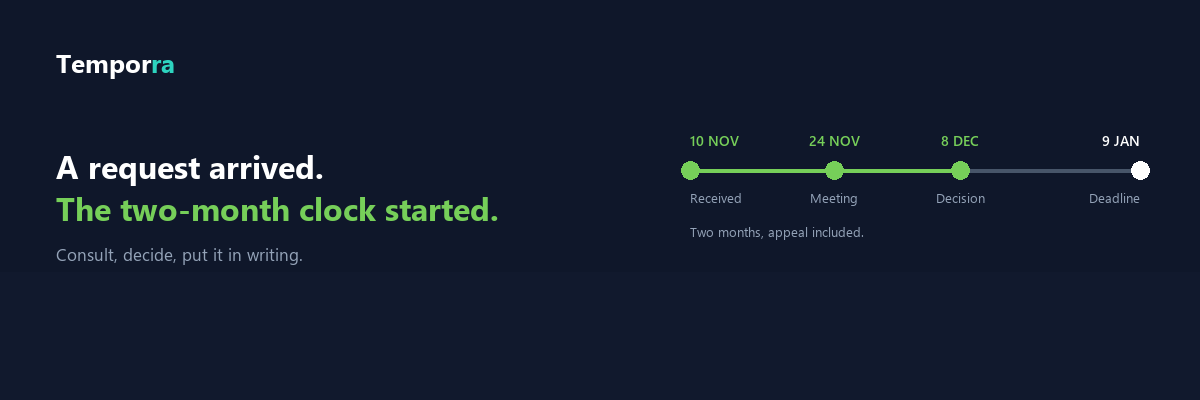
A flexible working request looks like a letter. Legally it's a clock. From the day you receive one, you have two months to consult, decide, hear any appeal and put the answer in writing, and the employee doesn't need to have worked for you a single day before sending it. Most small firms get this wrong in the same place: they treat the request as a conversation, say "let's see how it goes" in the yard, and find out four months later that the conversation was a statutory process with a deadline they missed.
This guide covers the statutory request under section 80F of the Employment Rights Act 1996, the version that applies in England, Scotland and Wales. Northern Ireland has its own rules. It's written for the person who has to answer the letter.
What counts as a statutory request
An employee can ask to change the hours they work, the times they work, or where they work as between home and your premises. That's the whole list in the Act. A site electrician asking to start at 8:30 instead of 7:30 for the school run is asking about times. A four-day week on the same total hours is hours and times. An office estimator who wants two days at home is asking about place.
To be a statutory request it has to be in writing and dated, and regulation 4 of the Flexible Working Regulations 2014 adds that it must say whether the employee has made one before and when. Section 80F(2) requires it to say it's a statutory application, specify the change and give the date they'd like it to start. GOV.UK lists the same four things. A text saying "any chance I could do Fridays off?" isn't a statutory request. It's still worth answering properly, because the next message might be.
The right has applied from day one since 6 April 2024, when the Flexible Working (Amendment) Regulations 2023 removed the old 26-week qualifying period. Employees can make two requests in any 12 months, with only one live at a time. Agency workers are excluded from the right against the business they're placed with, unless they're coming back from parental leave.
The date it arrives matters
The two months start on the day the request is received, and regulation 5 sets out how that's fixed. Handed over in person: that day. Posted: the day it would normally have been delivered. Email gets the clean rule (received the day it was sent) only where you've agreed requests can come electronically and said which address and form to use. So if you want requests by email, say so in your handbook and name the address. Then nobody argues about the start date.
The two-month clock, worked through
Under section 80G, subsection (1B), the decision period is two months beginning with the date the application is made. Take a request handed to a supervisor on Tuesday 10 November 2026. The period ends on Saturday 9 January 2027.
That window has Christmas in it. If your site shuts from 18 December to 4 January, you've really got about five working weeks to hold a meeting, think, write a decision, and hear an appeal if you offer one. The appeal is inside the two months too. It isn't a fresh period.
You can extend, but only by agreement with the employee. The Act lets you agree it before the period ends, or even afterwards with retrospective effect if you do it within three months of the original end. The Acas Code says to confirm any extension in writing. Do that. An extension agreed on the phone is one you'll have trouble proving.
One more rule in subsection (1D): if the employee misses both the first meeting and the rearranged one without a good reason, you can treat the request as withdrawn. You must tell them you're doing so. Sickness counts as a good reason, which GOV.UK uses as its own example.
You must consult before you refuse
Since 6 April 2024 you can't refuse a request without consulting the employee first. If you're going to agree it in full, you can just say yes. Anything less than a full yes, including a counter-offer, needs the conversation.
The Acas Code of Practice on requests for flexible working sets out how. Hold the meeting without unreasonable delay, in private, in person or by video (phone only if neither works). The person holding it should be able to make the decision. Talk about alternatives and whether a trial would answer the doubts. And paragraph 19: keep a written record of the meeting that accurately reflects what was said.
That record is the document people skip. It's also the one a tribunal asks for first, because the complaint it hears is mostly about whether you dealt with the request "in a reasonable manner". Five lines typed up the same afternoon, sent to the employee, is enough.
The eight reasons you can refuse on
If the answer is no, it has to rest on one or more of the grounds in section 80G:
- the burden of additional costs
- a detrimental effect on ability to meet customer demand
- inability to reorganise work among existing staff
- inability to recruit additional staff
- a detrimental impact on quality
- a detrimental impact on performance
- insufficiency of work during the periods the employee proposes to work
- planned structural changes
Right now a tribunal can't overrule your business judgement just because it would have said yes. What it can do, under section 80H, is find that the refusal was based on incorrect facts. This is where firms come unstuck. "There isn't enough work on Friday afternoons" is a reason on the list. If your own timesheets show the crew clocked out at 16:30 every Friday for the last three months, it's an incorrect fact, and the employee's solicitor will ask for the timesheets.
So before you rely on demand or workload, look at the hours you actually recorded. If they support you, quote them in the decision. If they don't, you've learned something useful before a tribunal pointed it out.
What changes in 2027
The Employment Rights Act 2025 rewrites this part of section 80G. A refusal will have to be on a listed ground and it'll have to be reasonable to refuse on that ground, the written decision will have to explain why, and regulations will set out specific steps for the consultation. The new wording is on the statute book now, but it was commenced on 6 January 2026 only so that those regulations can be made. It doesn't yet bind employers.
Acas opened a consultation on a draft updated Code on 1 October 2026, which closes on 17 December 2026. It says the changes are expected to take effect in autumn 2027, and that until then employers should follow the current Code. The draft's four principles start with "reaching decisions based on evidence". Firms that start writing their reasons down with numbers now won't have to change much.
What getting it wrong costs
If a tribunal upholds a complaint, section 80I lets it order you to reconsider the request and award compensation. The cap is eight weeks' pay under regulation 6 of the 2014 Regulations, and a week's pay for this award is itself capped at £751 by section 227, the figure in force since 6 April 2026. So the most a straightforward procedural claim costs is £6,008, plus the time.
Since 1 October 2026 the employee has six months to bring the claim, up from three, starting from your decision or the end of the decision period. Acas early conciliation can stretch that.
The eight-week cap only covers the handling of the request. Treating someone worse because they asked is a separate claim under section 47E, and dismissing them for it is automatically unfair under section 104C. And if the request was really about a disability, childcare or a religious observance, the Equality Act sits alongside all of this. The Acas Code makes the point that a reasonable adjustment for disability is a separate legal duty from the flexible working one.
The file to keep
The law doesn't list the records, but every step it does list leaves a document behind. For each request, keep:
- the request itself, with the date and how it arrived
- the invitation to the consultation meeting and your written note of it
- any extension of the two months, agreed in writing
- the written decision, with the reason or reasons if it's a refusal
- the appeal, if there was one, and the note of the appeal meeting
- the terms of any trial: start, end, review date
- the written statement of the change, if you agreed it
That last one isn't optional. An agreed request changes the contract, and section 4 of the 1996 Act requires a written statement of the change at the earliest opportunity and no later than one month after it. GOV.UK puts it at 28 days, which keeps you safely inside.
How long to keep it
No regulation sets a retention period for flexible working files. Three things decide it in practice. You need the dates of earlier requests to apply the two-in-12-months rule, so a file under a year old is never disposable. A claim can come up to six months after the decision, plus conciliation time. And an agreed change is now part of the contract, so it belongs on the personnel file for as long as the person works for you.
Our view: keep the decision and the statement of change for the length of the employment, and set a date in your retention policy for the rest. Requests often mention health or caring details, which the UK GDPR expects you not to keep longer than you need.
Trial periods
Acas suggests a trial when you're not sure. It's often the right answer on a site, where the honest reply to "can I do four tens?" is "maybe, depending on whether the client's foreman will let us in at 7". Two things to watch. A trial that runs beyond the two-month decision period needs an agreed extension, or you'll be outside the deadline with no decision. And the review should look at what actually happened: hours worked, days on site, whether the job slipped. A trial reviewed on gut feel isn't much of a trial.
Compressed hours bring their own rules. Ten-hour days still need the rest breaks the Working Time Regulations set out, and if the change takes someone over 48 hours on average, you're into opt-out territory.
Common questions
Can an employee make a flexible working request on their first day?
Yes. Since 6 April 2024 there's no qualifying period. A new starter can put a statutory request in on day one, and you handle it exactly as you would for someone who's been with you ten years.
How many flexible working requests can an employee make in a year?
Two in any 12-month period, and only one can be live at a time. A request stays live until you decide it, it's withdrawn, you agree an outcome, or the two-month decision period runs out. An appeal or an agreed extension keeps it live.
How long does an employer have to respond to a flexible working request?
Two months, beginning with the day the request is received, and that includes any appeal. You can extend it if the employee agrees. Put the extension in writing, with the new end date.
Do I have to offer an appeal?
There's no statutory right of appeal, but the Acas Code calls it good practice and a tribunal will read the Code. If you offer one, the appeal has to be heard and decided inside the same two months unless the employee agrees to extend.
Can I refuse a flexible working request?
Yes, if you've consulted the employee first and the refusal rests on one or more of the eight business reasons in section 80G. Your written decision should say which reason and why. A further test, that refusing is reasonable, is in the Employment Rights Act 2025 and is expected to apply from autumn 2027.
What happens if I miss the two-month deadline?
Once the period ends without a decision, the employee can complain to an employment tribunal. The tribunal can order you to reconsider and award up to eight weeks' pay, with a week's pay capped at £751. The claim has to be brought within six months.
Can agency workers make a flexible working request?
Not a statutory one to the business they're placed with. Section 80F excludes agency workers from the right, except an agency worker returning from parental leave. Nothing stops you agreeing a change informally.
Does a trial period change the contract?
A trial is a way of testing the change before you decide. Write down when it starts, when it ends and when you'll review it. If the trial runs past the two-month decision period, agree an extension. If you then confirm the change, send a written statement of it within one month.
Where hours fit in
Temporra doesn't hold the request letter or write your decision for you, and it doesn't build rotas. It logs the hours people actually work, with the job and the time on each clock-in, against whatever pattern you've already agreed. That's the part of a flexible working decision most firms can't produce on demand. When the reason for refusing is customer demand or a lack of work, the timesheet is the evidence for or against it. When a trial ends, it's the record of how the trial went. And when a four-day week is agreed, it shows the four days were the ones worked.
Related guides
- Carer's leave: one week in any 12 months, and the record you'll need to prove it
- Unpaid parental leave: 18 weeks per child, from day one, and the count you'll need to keep
- Zero-hours contracts: the guaranteed hours reform
- Working Time Regulations: the 48-hour week and breaks
We post each new guide on the Temporra Facebook page. Follow it there if you'd like the next one, and a like helps other UK employers find it.
Start a 14-day free trial →No card needed for the trial. One flat monthly price by team size, from £39 for up to five workers, VAT included. See pricing.